






Cost of Living in California vs. Washington State
- Local Editor:Local Editor: The HOMEiA Team


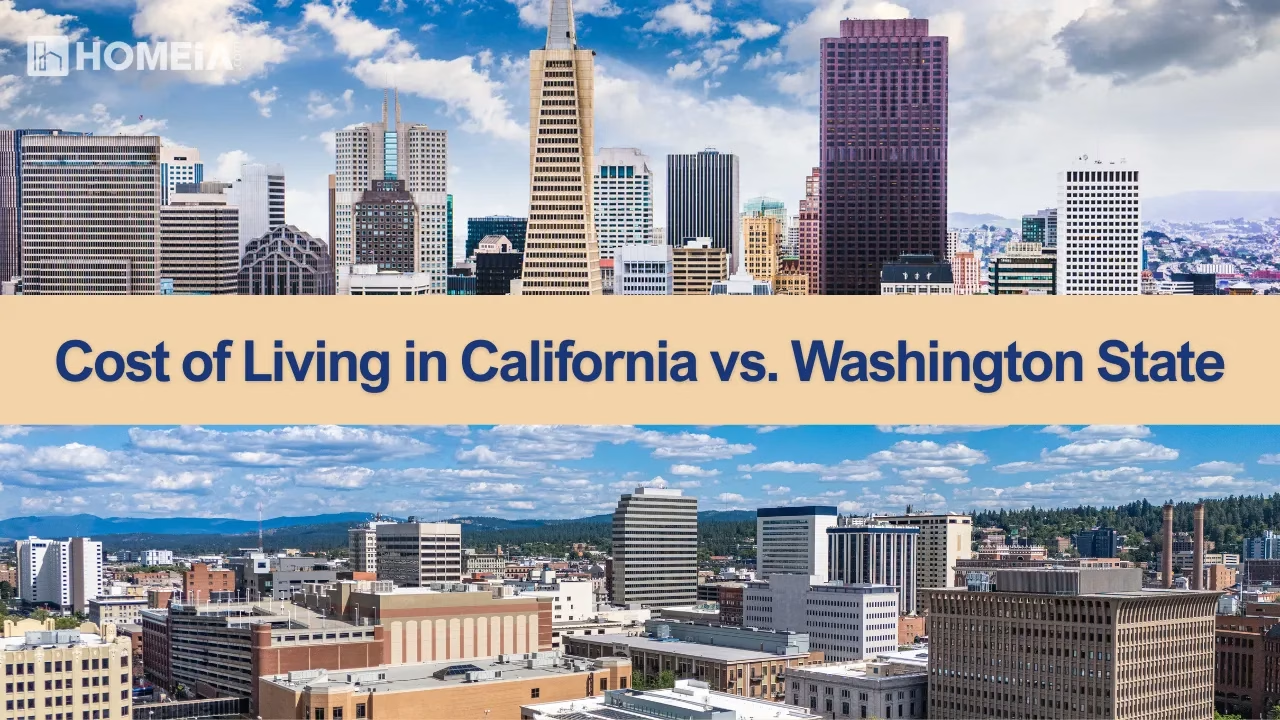
Cost of Living in California vs. Washington State: California and Washington State both lead the West Coast with thriving tech economies, spectacular natural landscapes, and a higher cost of living than much of the country. Yet, each takes markedly different approaches to taxes, housing policy, and everyday expenses. California’s progressive income tax funds an expansive public sector, while Washington relies heavily on sales and business taxes, charging no income tax at all. For households weighing a move between these two coastal powerhouses, the decision often turns on whether housing savings and tax policy can offset differences in salary and lifestyle.
Note: Using 2025–2026 data from the MIT Living Wage Calculator, Zillow, the Bureau of Economic Analysis, Insurify, and state agencies, we break down what each state truly costs for families, retirees, and remote workers.
Key Takeaways
- California’s overall cost of living index is about 25 points higher than Washington’s, pushed by a median home price roughly $190,000 more expensive and rents that run $500 higher per month statewide.
- Washington charges no state income tax, while California imposes a rate reaching 9.3% on middle-class earnings and climbs to 13.3% for top earners, creating a six-figure tax differential for high-income households.
- California’s effective property tax rate, capped by Proposition 13, sits near 0.75%, lower than Washington’s 0.95%. The higher home prices in California still produce larger annual bills in most metro areas.
- A single adult needs roughly $51,000 a year before taxes to cover basics in California, compared with $47,000 in Washington. Both minimum wages are among the highest in the nation but still fall short of true self-sufficiency.
- Homeowners insurance in California averages around $1,200 a year, but wildfire risk has made coverage scarce and expensive in many regions, while Washington’s lower-risk profile keeps average premiums near $950.
- Each state has expanded Medicaid and maintains uninsured rates below 7%, offering relatively strong healthcare safety nets compared to much of the country.
- Remote workers, high earners, and those without significant wildfire exposure often keep more take-home pay in Washington, while families anchored to California’s entertainment, agriculture, or specialized tech sectors may find the premium worthwhile.


Related article
22 Top-Rated Things to Do in Palo Alto, California
While San Francisco is the first city people think of whenever California‘s Bay Area is mentioned, several other cities make sizable contributions to the region. One of these is Palo Alto, a mid-sized city of 66,649. Palo Alto was founded in 1894 by Leland Stanford, an American naturalist who founded the esteemed Stanford University…
At-a-Glance Comparison Table
Metric | California | Washington |
|---|---|---|
| Population | ~39.0 million | ~7.9 million |
| Median Household Income | ~$92,000 | ~$91,000 |
| Median Home Price | ~$790,000 | ~$600,000 |
| Average Rent (1-BR statewide) | ~$2,400 | ~$1,900 |
| Cost of Living Index | ~138 | ~113 |
| State Income Tax | Progressive (1%–13.3%) | None |
| Effective Property Tax Rate | ~0.75% | ~0.95% |
| Average Homeowners Insurance | ~$1,200/year | ~$950/year |
| Living Wage (Single Adult, annual) | ~$51,000 | ~$47,000 |
| State Minimum Wage | $16.50/hour | $16.28/hour |
1. Living Wage Comparison
The MIT Living Wage Calculator, updated in early 2026, shows that a single childless adult needs about $24.50 an hour in California, adding up to roughly $51,000 per year before taxes. In Washington, the same adult requires approximately $22.60 an hour, or $47,000 annually. That $4,000 difference can cover a year of car payments or most of a community college tuition bill. For a single parent with one child, California’s living wage climbs to around $44.00 an hour ($91,500), while Washington sits near $39.50 an hour ($82,200). A household with two working adults and two children sees each earner needing about $32.00 an hour in California and $28.50 in Washington.
California’s minimum wage of $16.50 an hour yields $34,320 a year, covering about two-thirds of a single adult’s living costs. Washington’s $16.28 floor produces $33,862, paying for roughly 72% of a single adult’s needs. Both figures are superior to the federal $7.25 minimum, but they still leave single earners thousands of dollars short of basic self-sufficiency in their respective states. In practice, lower-wage workers in both places often patch together multiple jobs, rely on shared housing, or tap family support. Middle-class households frequently need two solid incomes to build meaningful savings after covering the elevated cost of housing.

Related article
12 Best Places in Washington State to Raise a Family
We’ll explore areas of the state that represent all different value systems and explain why people love living there. We’ll present each place’s unique characteristics, complete with opinions from locals…
2. Housing Costs
Housing represents the largest single expense in both states, with California’s prices being in a league of their own.
A. Home Prices: The median home value in California stands near $790,000, while Washington’s median is roughly $600,000. In the Bay Area, their median can exceed $1.4 million, while Los Angeles County hovers around $880,000. Seattle’s King County pushes toward $850,000, but the rest of Washington pulls the statewide figure down, with Spokane at $390,000 and Tacoma near $520,000. California’s inland markets offer some relief: Fresno sits around $405,000, and Bakersfield near $360,000. Still, a buyer who sells a $790,000 California home can often purchase a larger, newer home in Washington’s desirable suburbs and put $150,000 to $200,000 into savings. Price per square foot averages about $420 in California and $320 in Washington, a difference directly influencing mortgage payments and property tax bills.
B. Renting: Statewide, a one-bedroom apartment leases for about $2,400 a month in California and $1,900 in Washington. San Francisco and San Jose one-bedrooms easily top $3,200, while Seattle’s core commands $2,300 to $2,600. Inland California cities like Sacramento or Riverside offer one-bedrooms in the $1,700 to $2,000 range, closer to Washington’s Spokane or Vancouver suburbs. The $500 monthly gap in statewide averages translates to $6,000 a year, enough to shift a family’s childcare or transportation budget. Renters with flexibility often find that Washington delivers comparable amenities and a lower monthly housing bill, though the savings narrow when comparing Seattle directly with California’s less expensive inland metros.
C. Homeowners Insurance: California’s average homeowners insurance premium is close to $1,200 per year, but that number masks a deepening crisis. In wildfire-prone areas from the Sierra foothills to Sonoma County, many insurers have stopped writing new policies, pushing homeowners into the FAIR Plan, California’s insurer of last resort. FAIR Plan policies can cost $3,000 to $5,000 a year or more, with limited coverage often requiring supplemental wraparound policies. Washington’s insurance market is more favorable, with average premiums around $950 per year. While earthquake risk exists, most policies exclude it, and separate earthquake coverage is optional. For Californians in a high-fire-risk zone, the real cost of insurance can be $2,000 to $4,000 higher than Washington’s, eroding some of the tax savings Proposition 13 provides.
D. Property Taxes: California’s effective property tax rate is about 0.75%, among the lowest in the country, thanks to Proposition 13’s limit of 1% of assessed value plus local assessments and its cap on annual increases. On the $790,000 median home, their annual tax bill runs roughly $5,925. Washington’s rate averages about 0.95%, producing a bill of $5,700 on a $600,000 home. The difference is minimal in dollar terms. However, California’s system creates stark disparities between longtime owners paying taxes on a fraction of their home’s market value, and new buyers, who pay the full 1% on the purchase price. In Washington, all owners pay based on current assessed value. Essentially, tax burdens rise more uniformly. For a recent buyer of a similarly priced home, California’s lower rate offers a slight edge, but the higher home price cancels out much of that advantage.

Related article
12 Key Factors to Know About Living in Los Angeles, California
If living in Los Angeles (or LA) is your reason for considering relocating to California, you will find a lot to love in this sunny, warm, sprawling, diverse city. In this article, we will give you a feel for L.A.’s standard of living, climate, housing, education and more. Below are top 12 key things to know about living in Los Angeles…
3. Economy and Taxes
A. Economic Landscape: California’s economy is the largest of any U.S. state and the fifth largest in the world, driven by technology (Silicon Valley), entertainment (Los Angeles), agriculture (Central Valley), and international trade. Median household income sits near $92,000. Washington’s economy, while smaller, is extraordinarily high-wage, led by Amazon, Microsoft, Boeing, Starbucks, and a growing biotech sector. Median household income is about $91,000, nearly identical to California’s. Unemployment in both states hovers between 4.0% and 4.5%. The critical difference for workers is that Washington’s income tax is zero, while California’s progressive system takes a significant chunk from six-figure earners. For a software engineer earning $200,000, the California income tax can exceed $16,000 while the same worker in Washington pays nothing to the state.
B. Tax Comparison
Tax Type | California | Washington |
|---|---|---|
| State Income Tax | Progressive, 1%–13.3% | None |
| Sales Tax (state + avg. local) | ~8.8% | ~9.4% |
| Effective Property Tax Rate | ~0.75% | ~0.95% |
| Capital Gains Treatment | Taxed as ordinary income | No state tax (7% on gains above $250k for certain taxpayers) |
| Estate / Inheritance Tax | None | 10%–20% on estates above $2.193 million |
To put these differences into perspective, consider a married couple filing jointly who own a median-priced home. At $100,000 of taxable income, California’s income tax runs about $5,200, property tax $5,925, and insurance $1,200, totaling $12,325. In Washington, income tax is zero, property tax $5,700, and insurance $950, totaling $6,650. The Washington couple keeps an extra $5,675 each year. At $150,000, California’s income tax climbs to roughly $9,500, making the total $16,625, while Washington remains at $6,650, a $9,975 gap. At $250,000, California takes about $21,000, total $28,125, versus Washington’s $6,650, a chasm of $21,475. High earners and dual-income professional couples see an enormous financial incentive to choose Washington, provided they can manage the housing market. However, their sales tax is higher (9.4% vs. 8.8%), and its estate tax can affect wealthy retirees, partially offsetting some of the income tax savings for a subset of households.
Recommended for you




4. Safety
FBI and state-aggregated crime data for 2024 show California’s violent crime rate at roughly 500 incidents per 100,000 residents, compared with Washington’s rate of about 340 per 100,000. Property crime presents a different picture: California reports about 2,400 incidents per 100,000, while Washington records approximately 2,800. Both sit near the national average for property crime but diverge on violent crime, with Washington significantly lower. These statewide figures hide variation. The Bay Area’s suburban Peninsula and Orange County report violent crime rates among the lowest in the country, while parts of the Central Valley and certain Los Angeles neighborhoods push the state average higher. In Washington, Seattle and Tacoma account for most reported violent crime, while rural counties and Eastside suburbs remain safe. Households should evaluate safety at the city and ZIP code level, as broad state statistics offer limited guidance for choosing a neighborhood.
5. Climate and Geography
California spans nearly every climate zone, from Mediterranean along the coast to alpine in the Sierra Nevada and scorching desert in the southeast. Wildfires are the dominant natural peril, with arid summers and Santa Ana winds creating annual fire seasons that increasingly encroach on suburban areas. Earthquake risk runs along the San Andreas and Hayward faults, though infrequent. Washington’s climate is famously wet west of the Cascades, with gray, drizzly winters and mild summers, while the eastern half is semi-arid with cold winters and hot summers. Wildfire smoke affects air quality statewide during bad fire years, but direct property loss from fire is less widespread than in California. The main natural risk in Washington are earthquakes, particularly the Cascadia Subduction Zone, which produce catastrophes. Climate shapes energy bills. California’s coastal strip rarely needs heavy heating or cooling, but inland areas see 100-degree summers. Washington’s western residents pay moderate heating bills in winter but often lack air conditioning, while eastern residents run both furnaces and AC. Overall, utility costs are comparable, but California’s high electricity rates (around 28 cents per kilowatt-hour) expand bills higher than Washington’s (about 11 cents), especially for air-conditioned homes.
Related article
What is It Like Living in Seattle, Washington?
Seattle is a beautiful port city on the Puget Sound in the northwestern U.S. state of Washington, 100 miles south of the Canadian border. As the largest city in the state (and the Pacific Northwest for that matter), Seattle is heavily endowed with natural resources. This hilly city earned…
6. Education
California’s K-12 public schools serve a vast and diverse student population, ranking in the middle of national assessments with a graduation rate near 85% and per-pupil spending around $15,000. Washington’s system ranks somewhat higher, with a graduation rate of about 83% and per-pupil spending of roughly $16,500. CA and WA fund schools through a mix of state and local dollars, with significant variation across districts. School choice is limited compared to Arizona or Florida, though charter schools are present. Families moving for schools should compare specific districts rather than state averages.
Academia in California is spearheaded by the University of California system, where in-state tuition runs about $14,000 a year, with total costs around $38,000 at campuses like UCLA and UC Berkeley. For private options, CalTech, Stanford, and Pepperdine are coveted and well-respected by many in their areas of study. The California State University system is cheaper, with tuition near $6,000. Washington’s flagship, the University of Washington in Seattle, charges about $12,000 in tuition, with total costs around $30,000. Both states offer developed community college pathways and generous need-based aid, but California’s Cal Grant program and Middle Class Scholarship can significantly reduce net costs for families earning under $200,000. WA’s state aid programs are less expansive, making California affordable for some in-state students who qualify for assistance.

Related article
10 Best Places to Live in Southern California in 2026
HOMEiA is here to help you explore ten of the best places to live in Southern California. Each place has its own charm and unique qualities. Let’s take a quick dive into what Southern California has to offer! Here’re 10 best places to live in Southern California…
7. Childcare
Childcare costs are among the highest in both states, reflecting the high cost of labor and real estate. The table uses recent market-rate survey data for center-based care.
Care Type | California (Monthly) | California (Annual) | Washington (Monthly) | Washington (Annual) |
|---|---|---|---|---|
| Infant (0–12 months) | ~$1,700 | ~$20,400 | ~$1,500 | ~$18,000 |
| Toddler (1–3 years) | ~$1,500 | ~$18,000 | ~$1,400 | ~$16,800 |
| Preschool (3–5 years) | ~$1,300 | ~$15,600 | ~$1,200 | ~$14,400 |
Families with an infant and a toddler pay roughly $3,200 a month, or $38,400 a year, in California, compared with $2,900 a month, or $34,800 a year, in Washington. The $3,600 annual difference can accumulate to $18,000 over five years of overlapping care. Each offers subsidized care for low-income families, but income eligibility thresholds remain tight; two-earner middle-class households typically pay full freight and will find Washington’s slightly lower rates a breath of fresh air.
8. Healthcare
California and Washington expanded Medicaid under the Affordable Care Act and operate their own state-based marketplaces, resulting in uninsured rates below 7%. California’s uninsured rate is about 6.5%, while Washington’s sits near 5.5%. These states provide trusted provider networks in urban areas, though rural healthcare access remains a challenge in California’s Central Valley and Washington’s Olympic Peninsula. For retirees on Medicare, these options offer robust Medigap protections and a wide range of Medicare Advantage plans. Employer-sponsored insurance is widespread in the tech and corporate sectors of both states. Lower-income households benefit significantly from the safety net, though undocumented immigrants in both states have varying degrees of access to publicly funded care. Overall, healthcare is a bright spot, with fewer coverage gaps than much of the country.

Related article
3 Most Affordable Neighborhoods to Live in Seattle, Washington
These communities demonstrate that Seattle still offers quality living environments that balance affordability with safety, making the Emerald City accessible to a wider range of residents seeking the Northwest lifestyle…
9. Additional Cost Considerations
- Utilities: California’s electricity rates, at roughly 28 cents per kilowatt-hour, are more than double Washington’s 11 cents, reflecting a heavier reliance on imported energy and wildfire mitigation costs. However, their milder coastal climate reduces overall usage, so typical monthly bills run $150 to $220, compared with $130 to $180 in western Washington, where heating is needed in winter. Inland areas of both states see higher seasonal peaks.
- Gas Prices: Regular unleaded gas averages about $4.80 a gallon in California and $4.10 in Washington as of mid-2026, driven by California’s unique fuel blend requirements and higher taxes. A driver covering 12,000 miles a year at 25 mpg saves about $336 a year in Washington, a noticeable but not transformative amount for most household budgets.
- Groceries: California’s grocery costs run about 10% above the national average, while Washington sits roughly 5% above. Families of four spending $1,200 a month on food might save $60 a month, or $720 a year, in Washington.
- Transportation: Car dependency is heavy in both states, but California’s larger metro areas offer more extensive transit options, including BART in the Bay Area and Metro in Los Angeles. Washington’s Seattle-Tacoma corridor offers light rail and ferry networks. Auto insurance premiums average about $1,900 a year in California and $1,400 in Washington, reflecting higher vehicle repair costs and liability exposure in California. Registration fees are also higher in California, adding several hundred dollars annually for a typical car.
Conclusion
California and Washington both demand a premium over the national cost of living, but Washington consistently delivers expanded purchasing power for the money. Cheaper housing, the absence of a state income tax, and lower insurance and fuel costs offset Washington’s slightly higher property tax rate and sales tax. High earners, remote workers, and families who can trade California’s coastline for Puget Sound or the Spokane Valley often find their take-home pay stretches significantly further. California remains a compelling choice for those whose careers or personal lives are deeply tied to this unmatched cultural, agricultural, and technological ecosystems, and for homeowners who have owned property long enough to benefit from Proposition 13’s tax protections. The best state depends on whether your household values the immediate financial savings of Washington or the longer-term professional and lifestyle advantages that can come with a California address.
Recommended for you




FAQs About the Cost of Living in California vs. Washington State
1. Is Washington really that much cheaper than California without an income tax?
Yes, especially for households earning above $100,000. Washington’s no income tax policy, combined with a median home price roughly $190,000 lower and rents $500 less per month, creates substantial savings. However, its higher sales tax and estate tax can offset some of the gain for big spenders and wealthy retirees, so the net benefit depends on spending patterns.
2. How much salary do I need in Washington to match a California lifestyle?
A $150,000 salary in California feels roughly equivalent to $115,000 to $125,000 in Washington, depending on housing choices and tax circumstances. The income tax savings alone can be $9,000 or more annually, and lower housing costs provide further breathing room. Remote workers and professionals relocating often feel comfortable accepting modest pay cuts while still improving their standard of living.
3. Which state is better for retirees in 2026?
Washington appeals to retirees with high retirement incomes because it fails to tax Social Security, pensions, or IRA withdrawals. California taxes retirement income as ordinary income but provides lower property taxes for longtime homeowners under Proposition 13. Retirees with substantial assets may also weigh Washington’s estate tax, which applies to estates above $2.193 million, while California has no estate tax.
4. Are people leaving California for Washington in 2026?
Yes, net domestic migration from California to Washington continues, driven by housing costs and income tax considerations. Census data found thousands of California households move to Washington each year, though the trend has moderated as Washington’s own home prices rise. Seattle and Spokane are common destinations.
5. Which state is better for remote workers in 2026?
Washington benefits remote workers more because of the zero state income tax, which instantly raises take-home pay regardless of where an employer is based. California taxes remote workers living in the state on their worldwide income. Remote workers who value mild winters and outdoor recreation will find both states attractive, but Washington’s financial edge is hard to beat.
Share