







Cost of Living in Georgia vs. Florida
- Local Editor:Local Editor: The HOMEiA Team


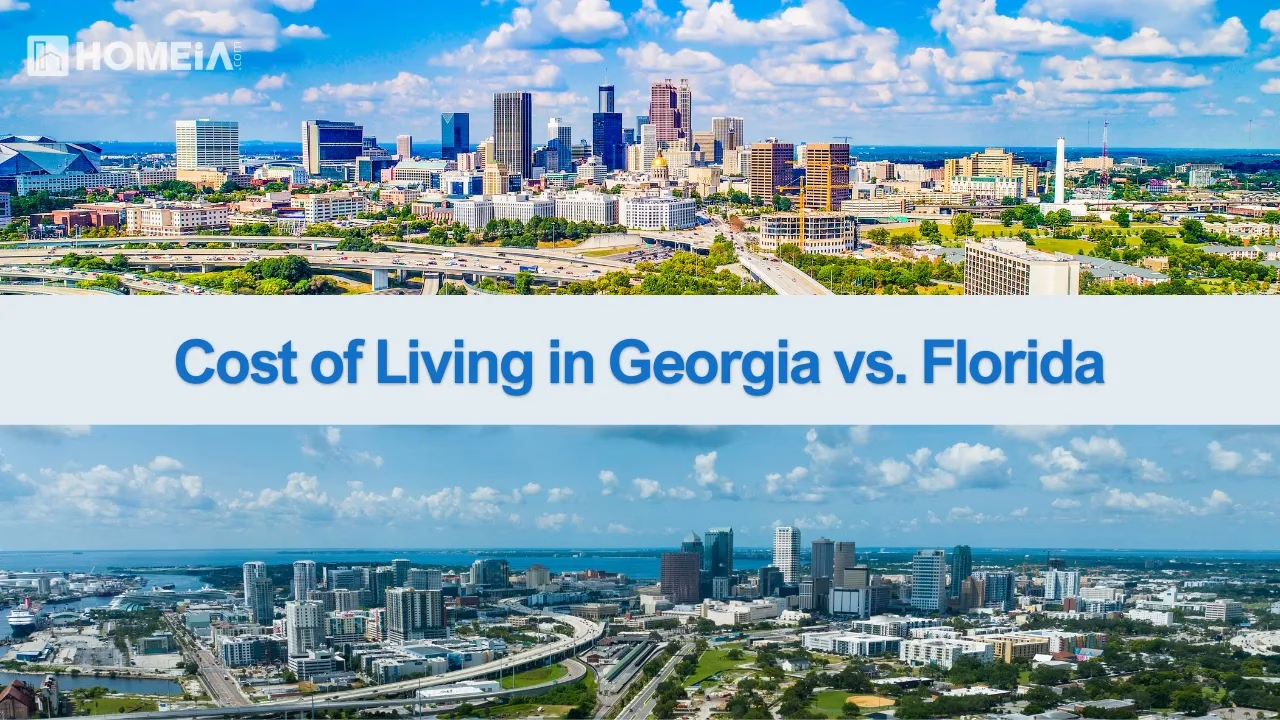
Cost of Living in Georgia vs. Florida: Georgia and Florida remain two of the fastest-growing states in the nation, each promising warmer weather and a relatively lower cost of living compared to the Northeast and Midwest. Florida’s zero state income tax continues to attract high earners, retirees, and remote workers, while Georgia’s booming Atlanta metro and affordable housing entices families and young professionals. But headline comparisons of tax rates and home prices blur the lines, especially when Florida’s property insurance market remains in crisis and Georgia’s income tax rate has lowered to 4.99% for 2026.
Using current 2025–2026 data from Zillow, Apartments.com, Insurify, the MIT Living Wage Calculator, the U.S. Federal Reserve, and state agencies, this article examines the cost of living in Georgia vs. Florida and which households come out ahead.
Key Takeaways
- Georgia’s overall cost of living index (~92–95) sits roughly 8–10 points below Florida’s (~101–105), driven primarily by housing that is about 12% less expensive statewide on Zillow data.
- Florida levies no state income tax, but homeowners insurance now averages $4,200–$6,060 a year, nearly double to triple Georgia’s ~$2,300, erasing much of the tax advantage for typical homeowners.
- Single adults need an annual pre-tax income of about $42,500 to meet basic needs in Florida, compared with $38,500 in Georgia; both states fall well short of these thresholds at their respective minimum wages.
- Florida’s minimum wage of $14.00/hour rises to $15.00 in late September 2026; Georgia remains at the federal floor of $7.25/hour, leaving a wage gap of more than $23,000 for a single adult.
- Neither state has fully expanded Medicaid, keeping uninsured rates above 11%–12%; access to affordable healthcare remains a significant challenge for lower-income households.
- Florida’s hurricane exposure drives extreme volatility in property and auto insurance, adding thousands of dollars annually that many relocating families underestimate.
- Remote workers, retirees with high investment income, and inland renters often benefit most from Florida’s tax structure; families and professionals seeking more housing value and lower insurance costs typically find Georgia’s total cost equation more favorable.


Related article
10 Best Places to Live in Georgia in 2026
If you’re looking for some good old-fashioned Southern hospitality, look no further than Georgia. The Peach State has plenty of small-town charm to welcome you in, as well as big-city development, artistic expression and innovation…
At-a-Glance Comparison Table
| Metric | Georgia | Florida |
| Population | ~11.3 million | ~23.7 million |
| Median Household Income | ~$80,000 | ~$77,700 |
| Median Home Value (Zillow, 2026) | ~$334,000 | ~$378,000 |
| Average Rent (1-BR statewide) | ~$1,440 | ~$1,692 |
| Cost of Living Index | ~92–95 | ~101–105 |
| State Income Tax | Flat 4.99% | None |
| Effective Property Tax Rate | ~0.91% | ~0.83% |
| Average Homeowners Insurance | ~$2,300/year | ~$4,200–$6,060/year |
| Living Wage (Single Adult, annual) | ~$38,500 | ~$42,500 |
| State Minimum Wage | $7.25/hour | $14.00/hour (→$15 Sept. 2026) |
1. Living Wage Comparison
The MIT Living Wage Calculator estimates the hourly wage a full-time worker needs to cover housing, food, healthcare, transportation, and other essentials without public assistance. In Georgia, a single adult requires around $18.50 an hour, nearly $38,500 annually.
In Florida, the same adult needs about $20.40 an hour, or $42,500 a year. The gap widens for families as a single parent with one child faces a living wage near $33.00/hour in Georgia ($68,600/year) versus about $37.00/hour in Florida ($77,000/year). For a household with two working adults and two children, each must contribute close to $23.50/hour in Georgia and $26.00/hour in Florida.
The contrast with mandated minimums is stark. Georgia’s $7.25 federal floor yields just $15,080 a year for full-time workers, less than 40% of the single-adult living wage. Florida’s $14.00/hour minimum (rising to $15.00 on September 30, 2026) produces roughly $29,000 annually, still about $13,500 short. In both states, lower-income households rely on multiple earners, side gigs, and shared housing to bridge the gap.

Related article
Moving to Florida: THE Complete Relocation Guide and Checklist
Moving to Florida? This all-in-one guide covers everything you need — cost of living, job market, best places to live, and settling-in tips. Whether you’re eyeing Miami, Orlando, St. Augustine, or anywhere between 30A and A1A, we’ll help you make a smart, informed move to the Sunshine State with confidence…
2. Housing Costs
Housing is the single largest household expense, and Georgia maintains a clear affordability advantage in 2026.
A. Home Prices: According to Zillow (mid-2026), the average home value in the Empire State of the South is approximately $334,000, off a modest 1.0% year-over-year. On the other hand, Florida’s average is roughly $378,000, down 3.3% from its recent peak. Metro Atlanta provides a range from ~$250,000 in outer suburbs to over $600,000 in Buckhead or Midtown, but the statewide median remains manageable.
In the Sunshine State, even inland cities like Orlando and Tampa carry medians above $390,000, while Miami, Naples, and the Keys routinely exceed $600,000. Days on market have lengthened in both states as elevated mortgage rates weigh on affordability, and Florida’s insurance crisis is increasingly causing coastal buyers to pause.
B. Renting: As of July 2026, a one-bedroom apartment averages about $1,440 per month in Georgia and $1,692 in Florida, per Apartments.com. In Atlanta’s urban core, one-bedrooms commonly lease for $1,700–$2,000. For Orlando and Tampa they run $1,600–$2,200. In Miami, one-bedrooms average $2,600 or more. The ~$250 monthly premium in FL adds up to roughly $3,000 per year, enough to cover a car payment or several months of groceries.
C. Homeowners Insurance: The sharpest cost divide between the two states is homeowners insurance. Georgia’s average annual premium has risen to approximately $2,300, consistently below the national average of ~$2,490–$2,868, driven by rising construction costs and litigation expenses. Their statewide average now ranges from $4,200 to $6,060 per year, depending on coverage level and location, according to Insurify’s 2026 data, making it the most expensive state in the nation for homeowners insurance.
Citizens Property Insurance announced an average 8.7% rate reduction effective Spring 2026, offering modest relief. However, coastal premiums in counties like Broward, Pinellas, and Lee routinely exceed $6,000–$8,000 annually. Windstorm deductibles of 2%–5% of dwelling coverage mean a $378,000 Florida home could carry an out-of-pocket hurricane deductible of $7,560–$18,900 before insurance pays.
D. Property Taxes: Both areas maintain relatively low property tax rates. The Peach State’s effective rate averages ~0.91%, yielding roughly $3,040 annually on the median home. Florida’s rate of ~0.83% translates to about $3,140 on its higher median. Florida’s Save Our Homes cap limits annual assessment increases to 3% for homesteaded properties. Georgia’s 2026 Homeownership Opportunity and Market Equalization Act (SB 33) now caps annual homestead assessment increases at 3% or the inflation rate statewide. For new buyers, the annual property tax bills differ by less than $100, not a meaningful driver of the overall cost gap.

Related article
3 Most Affordable and Safe Places to Live in Georgia
Each town maintains a cost-of-living index below the national average, ranging from 80% to 90%, further enhancing their appeal for family budgets. These communities exemplify Georgia’s reputation for offering an exceptional quality of life without compromising financial security…
3. Economy and Taxes
A. Economic Landscape: Georgia’s economy is put on a pedestal by the Atlanta metro, home to Delta Air Lines, Coca-Cola, UPS, and a growing fintech and film-production sector. This is supplemented by the reliable Ports of Savannah and Brunswick. Median household income reached $80,000 in 2024.
Florida’s economy favors tourism, hospitality, and healthcare, with an expanding finance sector in Miami. Median household income stood at $77,700 in 2024. These regions carried unemployment near 3.2%–3.5%. The key purchasing-power advantage belongs to Georgia: an $80,000 salary in Atlanta buys more housing and leaves more after insurance than the equivalent in Tampa or Orlando.
B. Tax Comparison
| Tax Type | Georgia | Florida |
| State Income Tax | Flat 4.99% (cut from 5.19% in 2026; path to 3.99% by 2034) | None |
| Sales Tax (state + avg. local) | ~7.4% | ~7.0% |
| Effective Property Tax Rate | ~0.91% | ~0.83% |
| Capital Gains Treatment | Taxed at 4.99% | No state tax |
| Estate / Inheritance Tax | None | None |
To understand how taxes and housing costs interact, consider a married couple filing jointly who own median-priced homes. At $100,000 of taxable income, Georgia income tax runs about $4,990 (at the new 4.99% rate). Georgia’s property tax (~$3,040) plus insurance (~$2,300) totals $5,340; combined burden: $10,330.
In Florida, zero income tax plus property tax (~$3,140) plus insurance (~$5,000 mid-range) equals $8,140, a Florida advantage of roughly $2,190. At $150,000 income, Georgia’s combined burden rises to ~$12,825 versus Florida’s $8,140, a $4,685 gap. At $200,000, Georgia’s burden reaches ~$15,320 versus Florida’s $8,140, a $7,180 Florida advantage. For high earners owning homes, Florida’s no-income-tax policy wins by a growing margin while lower earners and renters are more aligned to Georgia’s offerings.
Recommended for you




4. Safety
Nationally, violent crime declined 4% and property crime fell 8% in 2024, a trend reflected in both states. Atlanta specifically reported a 7% overall crime drop and a 43% decline in homicides from 2022 through 2025. Florida’s statewide violent crime rate has historically been somewhat lower than Georgia’s in aggregate, but urban centers in Miami, Jacksonville, and Orlando show elevated rates. Prospective movers should always review crime data at the city or ZIP-code level as opposed to relying on statewide averages, which conceal enormous local variation.
5. Climate and Geography
Georgia and Florida share scorching summers, but Florida’s subtropical and tropical climate means more intense heat and a longer cooling season. Its mild, dry winters are a major draw for snowbirds, while northern Georgia can experience occasional freezing temperatures.
The critical difference is natural-disaster risk. Florida is the most hurricane-prone state in the nation, with hundreds of miles of Atlantic and Gulf coastline exposed to storm surge, wind, and flooding. Georgia’s roughly 100-mile coastline is far less exposed to direct hurricane strikes. Energy costs reflect this. A typical Florida household spends $2,000–$2,600 annually on air conditioning versus $1,600–$2,000 in Georgia, even where per-kilowatt-hour rates are similar (~13–13.5 cents).

Related article
8 Best Places to Live in Florida for Young Professionals
Florida offers young professionals a compelling mix of career opportunities, warm weather, and no state income tax. Growing industries such as healthcare, technology, finance, and professional services support strong employment prospects across the state. This 2026 guide highlights eight of the best places for young professionals to build careers and enjoy a high quality of life…
6. Education
Florida’s K–12 public schools continue to rank above Georgia’s nationally. U.S. News & World Report placed Florida 10th in the country in its most recent rankings, citing strong graduation rates and standardized test scores, while Georgia ranked 26th. Florida’s broad school-choice programs offer families significant flexibility beyond their zoned school. Georgia provides charter schools and a voucher program, though at a smaller scale.
Academia is plentiful in both states. UGA and Georgia Tech are highly regarded. UGA’s in-state tuition is ~$11,000 (total cost ~$27,000), with the HOPE Scholarship covering much of tuition for students who maintain a 3.0 GPA. The University of Florida charges ~$6,380 in-state tuition (~$22,000 total), with Bright Futures covering full tuition for high achievers. Both states offer optimal low-net-cost pathways for qualified in-state students.
7. Childcare
Full-time center-based childcare is a significant expense in both states, with Georgia maintaining a modest cost edge.
| Care Type | Georgia (Monthly) | Georgia (Annual) | Florida (Monthly) | Florida (Annual) |
| Infant (0–12 months) | ~$1,100 | ~$13,200 | ~$1,200 | ~$14,400 |
| Toddler (1–3 years) | ~$1,000 | ~$12,000 | ~$1,100 | ~$13,200 |
| Preschool (3–5 years) | ~$900 | ~$10,800 | ~$1,000 | ~$12,000 |
A family with an infant and a toddler pays roughly $2,100 per month ($25,200 annually) in Georgia versus $2,300 per month ($27,600 annually) in Florida. The $2,400 annual savings accumulate to ~$12,000 over five years of overlapping care, enough to offset a year of in-state college tuition. Both offer childcare subsidies for low-income households, but eligibility thresholds are low. Most middle-class families pay full market rates.

Related article
Moving to Georgia: THE Complete Relocation Guide and Checklist
Considering a move to Georgia? This guide covers everything you need — cost of living, job market, top places to live, and more. From Atlanta’s buzz to Savannah’s charm and mountain serenity, Georgia offers friendly people, great weather, and real opportunity. Let this be your go-to resource for relocating smartly…
8. Healthcare
Neither Georgia nor Florida has fully expanded Medicaid under the Affordable Care Act. Georgia operates a limited waiver program (Pathways to Coverage) with work requirements, but enrollment has been minimal. Florida’s uninsured rate is approximately 11%, while Georgia’s sits near 12%, both well above the national average, leaving many lower-income adults in a coverage gap.
Retirees on Medicare find a competitive plan market in both states. Employer-sponsored insurance is common in urban centers, while self-employed and gig-economy workers face high ACA exchange premiums. Georgia’s rural areas continue to face hospital closures; Florida’s fast-growing exurbs sometimes struggle with healthcare infrastructure capacity. Households with chronic conditions should weigh these factors carefully before relocating.
9. Additional Cost Considerations
- Utilities: Electricity rates average ~13 cents per kilowatt-hour in Georgia and ~13.5 cents in Florida. Florida’s more intense cooling season pushes annual electricity bills to $2,000–$2,600 versus $1,600–$2,000 in Georgia. Gas heating in northern Georgia adds modest winter costs that partially offset summer savings.
- Gas Prices: Regular unleaded averages roughly $3.05/gallon in Georgia and $3.30–$3.70 in Florida as of mid-2026. For a driver logging 12,000 miles per year at 25 mpg, this yields annual savings of ~$120–$300 in Georgia, real but minor relative to housing and insurance differences.
- Groceries: Grocery indices place Georgia about 1% below and Florida about 2–3% above the national average. A family of four spending $1,000 monthly on food might save $30–$40 per month (~$360–$480/year) in Georgia.
- Transportation / Auto Insurance: Car dependency is the norm in both states. According to NerdWallet’s July 2026 analysis, Florida ranks as the second most expensive state for full-coverage auto insurance at an average of $3,854 per year, while Georgia averages $3,244 annually, a $610 annual difference. A two-car household could pay $1,200+ more in Florida on auto insurance alone. Registration fees and tolls on Florida’s turnpike-heavy corridor add further costs.
Conclusion
Georgia and Florida both offer a lower cost of living than the nation’s most expensive coastal states, but the path to affordability differs considerably. Georgia’s formula pairs moderately priced homes, manageable insurance costs, and a flat income tax now reduced to 4.99%, with a legislated glide path to 3.99% by 2034. Florida eliminates the income tax entirely despite substituting higher housing costs, the nation’s most expensive homeowners insurance market, and above-average auto insurance premiums that can overwhelm the unwary.
High-income homeowners, retirees living on investment income, and inland renters often benefit most from Florida’s tax structure. Families seeking more square footage per dollar, dual-income professionals building careers in diverse industries, and anyone wanting predictable insurance costs will find the Peach State’s overall value proposition hard to beat. The right choice depends entirely on which costs your household can control, and which trade-offs you are prepared to live with.
Recommended for you



FAQs About the Cost of Living in Georgia vs. Florida
1. Is Florida really cheaper than Georgia because there is no state income tax?
Not necessarily. Florida’s no-income-tax policy saves thousands for high earners, but the state’s median home value (~$378,000) is roughly $44,000 higher than Georgia’s (~$334,000), and homeowners insurance averages $4,200–$6,060 per year versus ~$2,300 in Georgia. For most middle-class homeowners, the combined effect of higher housing and insurance costs erases the income-tax advantage. Renters and high-income households are most likely to come out ahead in Florida.
2. How much salary do I need in Georgia to match a Florida lifestyle?
Using purchasing-power comparisons, a $100,000 salary in Florida is equivalent to $88,000–$92,000 in Georgia, depending on housing choices and insurance exposure. Lower home prices, rents, and insurance premiums in Georgia provide most of the boost, though the 4.99% income tax offsets a portion.
3. Which state is better for retirees in 2026?
Florida remains a top destination for retirees due to zero state income tax, warm winters, and a mature senior-services infrastructure. However, the property insurance crisis and elevated home prices in popular areas are eroding affordability. Georgia provides lower housing costs and a more stable insurance environment, but retirees pay the 4.99% income tax on most income sources. Retirees with large investment portfolios typically save more in Florida. Those prioritizing home affordability and insurance predictability often prefer Georgia.
4. Are more people moving to Georgia or Florida in 2026?
Both states continue to flourish. Florida’s net domestic migration has moderated from its pandemic peak as housing and insurance costs mount, with an estimated 2025 population of ~23.5–23.7 million. Georgia, particularly the Atlanta metro, continues to attract young professionals and families from the Northeast. Its 2025 population is ~11.3 million. Florida still leads for retiree migration; Georgia competes strongly for working-age households.
5. Which state is better for remote workers in 2026?
Remote workers with high salaries often prefer Florida for the zero state income tax, especially if they rent or live inland. Georgia is more attractive for remote workers who want more land for their money, a lower overall cost baseline, and easy access to a major international airport (Hartsfield-Jackson). The decision typically hinges on whether the income-tax savings outweigh higher housing and insurance expenses for each individual’s specific situation.
Share