






8 Best Places to Live in Florida for Young Professionals
- Local Editor:Local Editor: Lisa Sinatra



Best Places to Live in Florida for Young Professionals: Florida offers a vibrant lifestyle for young professionals with diverse employment opportunities, no state income tax, and year-round sunshine. Thriving job markets in healthcare, tech, finance, and services create exceptional career growth opportunities. However, housing costs vary dramatically throughout, from affordable inland communities to premium coastal metros. This 2026 guide identifies eight communities offering the best mix of employment prospects, lifestyle amenities, cost considerations, and quality of life.
Key Takeaways
- Florida median home prices average $376,504 as of 2026, approximately 2.3 percent above the national median, with substantial variation by city.
- In-state employment opportunities exceeded 400,000 openings in 2026 across healthcare, technology, finance, construction, and logistics.
- Cities range from affordable communities with median prices under $350,000 to premium urban areas exceeding $460,000.
- Here, cost of living averages 2 percent above the national average, but varies by city from 11 percent below to 37 percent above national norms.
- Young professionals should prioritize employment access, commute flexibility, community safety, and housing affordability when weighing options in the Sunshine State.

Related article
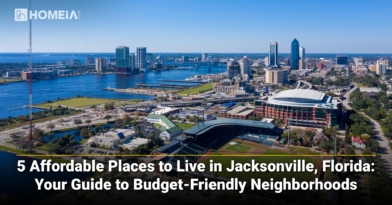
5 Affordable Places to Live in Jacksonville, Florida: Your Guide to Budget-Friendly Neighborhoods
Like any major city, finding affordable living spaces can be challenging. This article takes a look at the most budget-friendly neighborhoods in Jacksonville, offering a blend of low living costs and quality life…
I. Methodology: How We Evaluated Florida Communities
Our methodology applied a weighted scoring system across five factors that directly impact young professional success.
1. Employment & Career Opportunity (30% weight)
We evaluated employment diversity, major employers, industry growth rates, and median salaries. Communities with 400+ job openings, diversified sectors, and salary growth above inflation scored highest.
2. Housing Affordability & Cost (25% weight)
Our team researched median home prices, rental costs, and price-to-income ratios. Areas where housing consumes 28–32 percent of median household income and stays below state medians scored favorably.
3. Lifestyle & Amenities (20% weight)
We analyzed cultural programming, entertainment, parks, sports, and dining. Communities with diverse amenities and a young population demographic scored highly.
4. Safety & Community (15% weight)
We gathered statistics on violent crime rates, property crime, and community policing. Communities with violent crime below state and national averages received favorable ratings.
5. Access & Infrastructure (10% weight)
We reviewed highway access, public transit, broadband, and proximity to employment centers. This analysis draws from 2024–2026 sources including Zillow, Redfin, the U.S. Census Bureau, the Bureau of Labor Statistics, and the FBI Uniform Crime Reporting Program.
II. 8 Florida Communities: Quick Comparison Table
| City | Median Home Price | Monthly Rent (Avg) | Median Income | Cost of Living | Population | HOMEiA Score |
| Jacksonville | $305,000* | $1,511 | $69,872 | -2% | 1,032,061 | 72/100 |
| St. Petersburg | $495,000 | $3,117 | $68,000* | -8% | 265,351 | 74/100 |
| Tampa | $451,000 | $1,950 | $75,000* | -2% | 399,700 | 75/100 |
| Temple Terrace | $412,932 | $1,488 | $88,392 | -3% | 27,643 | 76/100 |
| Ocoee | $556,000* | $1,880* | $117,255 | +16% | 45,300+ | 77/100 |
| Doral | $468,800 | $2,393 | $95,000* | +37% | 65,000+ | 77/100 |
| Palm Bay | $315,000 | $1,535 | $72,614 | -11% | 103,190+ | 78/100 |
| Oviedo | $450,716 | $2,136 | $117,070 | +5% | 13,600 | 79/100 |
Related article
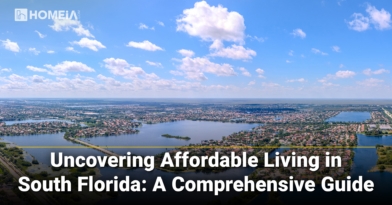
Uncovering Affordable & Safe Living in South Florida: A Comprehensive Guide
This guide is more than just a list of places; it’s a doorway to a variety of lifestyles and South Florida communities, proving that the dream of living in South Florida, with all its allure and charm, is not just a luxury for the few, but a feasible reality for many…
III. Detailed Community Analysis
1. Jacksonville: Major Metropolis with Strong Job Market and Affordability
HOMEiA Score: 72/100
- Cost of Living: -2% vs. U.S. average
- Monthly Rent: $1,511/mo
- Median Home Price: $305,000
- Median Income: $69,872
- Population: 1,032,061
A. Overview and Housing: Jacksonville is Florida’s largest city by area, offering reliable value with a median home price of $305,000 below the state median and an average rent of $1,511 per month.Cost of living runs slightly below the state average, and ongoing economic diversification positions the city as an emerging young professional hub when evaluating broader regional economics such as the cost of living in Illinois vs. Florida.
B. Employment and Career Opportunities: Jacksonville supports a diversified economy spanning finance, healthcare, military, transportation, and tech. Major employers include Naval Station Mayport, Mayo Clinic, Baptist Health, and Fidelity National Information Services. A growing tech startup scene adds to employment variety.
C. Lifestyle and Amenities: Riverside and San Marco neighborhoods offer walkable dining, bars, and cultural venues. Beaches, the St. Johns River, and professional and minor league sports (notably the Jaguars in the NFL) serve varied interests, alongside a particularly active live music scene.
D. Access and Infrastructure: Located on Florida’s northeast coast with I-95 (north-south) and I-10 (east-west) connectivity. Jacksonville International Airport (JAX) provides domestic and select international service.
E. Safety and Community: Duval faces notable public safety challenges, with over 30,000 property crimes and 5,866 violent crimes reported annually. Crime rates vary sharply by neighborhood; riverside and beach areas offer better safety profiles.
Related article
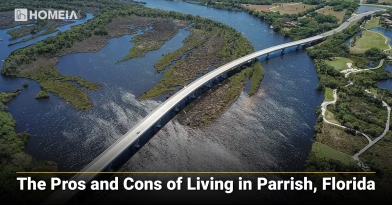
The Pros and Cons of Living in Parrish, Florida
Parrish combines affordable Florida living with a growing collection of master-planned communities, family-friendly amenities, and convenient access to Tampa and Sarasota. Its suburban-rural character attracts newcomers seeking space and value, though rapid growth and evolving infrastructure present challenges. This guide explores the benefits and trade-offs of living in Parrish…
2. St. Petersburg: Vibrant Waterfront Cultural Hub
HOMEiA Score: 74/100
- Cost of Living: -8% vs. U.S. average
- Monthly Rent: $3,117/mo
- Median Home Price: $495,000
- Median Income: $68,000*
- Population: 265,351
A. Overview and Housing: St. Petersburg commands higher housing costs. Their 2026 median of $495,000 is up 20.7 percent year-over-year, offset by exceptional amenities. Overall cost of living still runs 8 percent below the state average while its cultural density justifies its premium for the right professional.
B. Employment and Career Opportunities: Healthcare (Johns Hopkins All Children’s Hospital, Bay Area Healthcare System), a growing downtown tech and startup scene, arts and creative industries, and professional services collectively provide eclectic employment diversity.
C. Lifestyle and Amenities: The Salvador Dalí Museum, Tampa Bay Museum of Art, and Museum of Fine Arts head an extraordinary cultural scene. Historic downtown contains galleries, restaurants, and live music, while the Pier District waterfront adds dining and recreation. Known statewide for its LGBTQ+ inclusive community, St. Pete Pride attracts thousands to celebrate and embrace themselves.
D. Access and Infrastructure: I-275 links to Tampa and beyond. Tampa International Airport (TPA) is a 30 minute commute. The PSTA bus system serves local transit needs.
E. Safety and Community: Violent crime sits below state and national averages. Downtown revitalization and active community policing have further improved safety perception.
Related article
3. Tampa: Major City with Strong Job Market and Diverse Entertainment
HOMEiA Score: 75/100
- Cost of Living: -2% vs. U.S. average
- Monthly Rent: $1,950/mo
- Median Home Price: $451,000
- Median Income: $75,000*
- Population: 399,700
A. Overview and Housing: Tampa combines full metro amenities with a 2026 median home price of $451,000, up a modest 1.3 percent year-over-year. Average rent of $1,950 keeps urban living accessible, and the city’s varied housing stock. Young professionals can choose from downtown lofts to historic neighborhoods.
B. Employment and Career Opportunities: Healthcare (Moffitt Cancer Center, Tampa Bay Health), tech, financial services, professional services, cruise industry, and sports and entertainment employment (Buccaneers, Lightning, Rays) together create a robust, multi-sector job market.
C. Lifestyle and Amenities: Ybor City’s eclectic dining and nightlife, a lively downtown riverfront, Busch Gardens, and professional sports round out an excellent urban lifestyle. Gulf beaches are within 30 minutes.
D. Access and Infrastructure: I-75, I-4, and I-275 converge in Tampa, giving much-needed regional connectivity. Tampa International Airport (TPA) offers extensive domestic and international service, backed by HART bus/streetcar and Amtrak.
E. Safety and Community: Violent crime slightly exceeds national averages; neighborhood selection matters. River and historic-district areas generally offer bolstered safety profiles than inland communities.
Recommended for you




4. Temple Terrace: Suburban Hub with Professional Employment
HOMEiA Score: 76/100
- Cost of Living: -3% vs. U.S. average
- Monthly Rent: $1,488/mo
- Median Home Price: $412,932
- Median Income: $88,392
- Population: 27,643
A. Overview and Housing: Temple Terrace balances suburban comfort with ready access to Tampa Bay employment. A median home price of $412,932 sits above the state average but well below central Tampa, while the median household income of $88,392 reflects a highly professional workforce.
B. Employment and Career Opportunities: Proximity to Moffitt Cancer Center, the University of South Florida, and Tampa Bay area corporations provides noteworthy career access across tech, healthcare, academia, and professional services. The suburban setting also suits remote workers who want Tampa metro access without the city premium.
C. Lifestyle and Amenities: USF delivers cultural and athletic events nearby, while Ybor City and downtown Tampa are just 15–20 minutes away for vibrant nightlife and dining. Community parks and recreation facilities serve daily leisure.
D. Access and Infrastructure: I-75 and U.S. Route 301 provide easy connectivity. The HART bus system and TPA (30 minutes) handle broader transit needs.
E. Safety and Community: Violent crime falls below the Tampa Bay metro average, and active neighborhood associations reinforce safety in established residential areas.

Related article
The 6 Affordable Places to Live in St. Petersburg, Florida
Join us as we uncover the motives why St. Petersburg, with its blend of affordability, diverse neighborhoods, and high quality of life, is becoming one of Florida’s most coveted destinations for living, working, and playing. We’ll then present the best St. Pete communities you’ll want to consider for your Florida home…
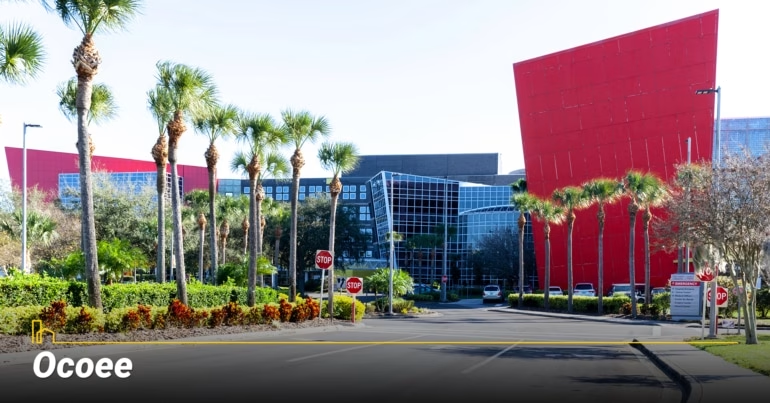
5. Ocoee: Growing Suburban Community with Tech Economy
HOMEiA Score: 77/100
- Cost of Living: +16% vs. U.S. average
- Monthly Rent: $1,880*
- Median Home Price: $556,000
- Median Income: $117,255
- Population: 45,300+
A. Overview and Housing: Ocoee is one of Central Florida’s fastest-growing suburban communities. The median home price reflects a premium for newer master-planned construction, while the average household income of $117,255 spotlights an affluent, professionally oriented demographic. Housing stock skews toward modern developments and planned communities.
B. Employment and Career Opportunities: The Orlando metro employment market provides access to theme parks (Disney, Universal), healthcare, professional services, and emerging medical device and tech clusters. Corporate campuses are increasingly relocating to the area.
C. Lifestyle and Amenities: Master-planned recreation amenities, community parks, and proximity to the City Beautiful entertainment and cultural offerings (20–30 minutes) make Ocoee a practical choice for young professionals who prefer suburban living.
D. Access and Infrastructure: I-4 provides direct Orlando access. U.S. Route 17/92 handles local connectivity. Orlando International Airport (MCO) is 30–40 minutes away.
E. Safety and Community: Low violent crime rates and active homeowner associations reflect a well-managed planned community. Ocoee consistently scores below state and national crime averages.

Related article
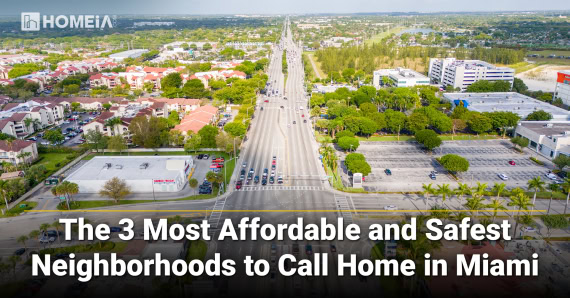
The 3 Most Affordable and Safest Neighborhoods to Call Home in Miami, Florida
Miami’s neighborhoods of Kendall, Westchester, and The Hammocks are among the cheapest places to live in the city. Each offers safe, affordable living with its own charm, Kendall’s rising home values, Westchester’s cultural richness, and The Hammocks’ natural appeal, making them ideal for budget-conscious residents seeking quality and security…
6. Doral: International Business Hub with Diverse Professional Opportunities
HOMEiA Score: 77/100
- Cost of Living: +37% vs. U.S. average
- Monthly Rent: $2,393/mo
- Median Home Price: $468,800
- Median Income: $95,000*
- Population: 65,000+
A. Overview and Housing: Doral is Miami’s premier corporate hub, attracting international professionals and executives. The median home value of $468,800 and a 37 percent cost of living premium reflect its Miami metro positioning. Modern residential developments and corporate housing cater to a rapidly growing professional population. For those seeking more affordable options in the Miami area, see our guide to the Cheapest Places to Live in Miami, Florida.
B. Employment and Career Opportunities: Microsoft, Google, Burger King, and numerous Latin American corporate headquarters are based here. Financial services, import/export, law, accounting, and an emerging tech sector support a bilingual international workforce.
C. Lifestyle and Amenities: Professional networking is a central lifestyle feature. Modern shopping, corporate-caliber dining, parks, golf courses, and proximity to Vice City’s international cultural scene balance the business-forward environment.
D. Access and Infrastructure: I-826 (Palmetto Expressway) and Florida’s Turnpike provide strong regional access. Miami International Airport (MIA) is only 15–20 minutes away, with Tri-Rail commuter service in development.
E. Safety and Community: Crime rates run lower than central Miami, supported by planned community design, corporate security presence, and active policing.
Related article
Areas that Make the Cost of Living More Affordable in Florida
Join us as we uncover the secrets to living and thriving in Florida, all while keeping an eye on your financial well-being. Let’s embark on this journey to understand the actual cost of living in the Sunshine State and how to make the most of every dollar spent…
7. Palm Bay: Affordable Space Coast Community with Growth Potential
HOMEiA Score: 78/100
- Cost of Living: -11% vs. U.S. average
- Monthly Rent: $1,535/mo
- Median Home Price: $315,000
- Median Income: $72,614
- Population: 103,190+
A. Overview and Housing: Palm Bay delivers an 11 percent cost of living advantage over the national average. The 2026 median home price of $315,000 is among FL’s lowest for a community this size, down 3.1 percent year-over-year. Population growth of 11.1 percent between 2010 and 2019 reflects sustained development momentum.
B. Employment and Career Opportunities: The nearby Space Coast employment cluster highlighted by Kennedy Space Center, aerospace contractors, and defense technology firms drives exponential salaried roles. Harris Corporation, healthcare facilities, and manufacturing operations round out local employment. Remote work flexibility further expands options beyond local markets.
C. Lifestyle and Amenities: Atlantic Ocean beaches lie within 20 minutes. Brevard Zoo, Indian Harbour Beach, Melbourne Beach, and Cocoa Beach give residents plentiful outdoor and recreational options. This tech-oriented demographic fosters an entrepreneurial community culture.
D. Access and Infrastructure: I-95 and U.S. Route 1 provide regional connectivity. Melbourne International Airport (MLB) provides limited regional service, with Brevard County Transit serving local needs.
E. Safety and Community: Violent crime rates fall below the state average, and property crime remains manageable. Police community-policing programs reinforce a positive safety perception.
Related article
10 Key Things to Know About Living in Florida. Embracing the Sunshine State
In this comprehensive guide, we delve into 10 key aspects of living in Florida. These include the state’s climate, its diverse natural and cultural landscapes, economic considerations (like the lack of state income tax), the reality of hurricanes and weather-related concerns, and the particularities of its real estate market. We also explore the outdoor lifestyle…
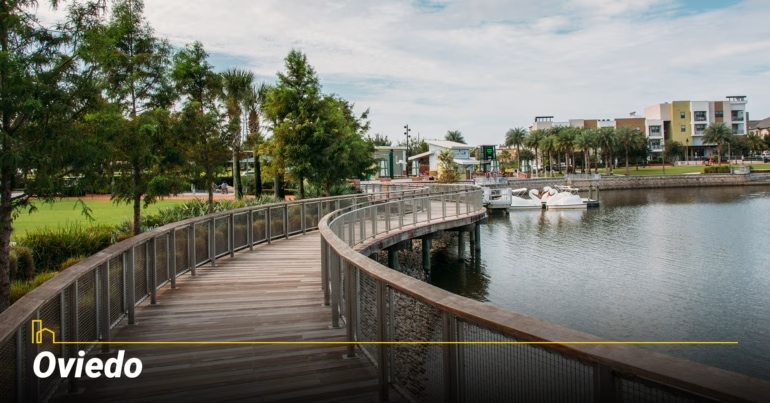
8. Oviedo: Affluent Suburban Community with Excellent Schools
HOMEiA Score: 79/100
- Cost of Living: +5% vs. U.S. average
- Monthly Rent: $2,136/mo
- Median Home Price: $450,716
- Median Income: $117,070
- Population: 13,600
A. Overview and Housing: Oviedo holds the highest HOMEiA score in this guide, reflecting standout schools, community safety, and upscale suburban living. The 2026 median home price of $450,716 (December: $455,000) represents a modest 5 percent cost of living premium over the national average. The high-earning professional demographic supports an affluent, stable community.
B. Employment and Career Opportunities: Proximity to the Orlando metro and the University of Central Florida campus drives employment in tech, professional services, healthcare, and finance. UCF research and corporate headquarters growth continue attracting well-paying jobs.
C. Lifestyle and Amenities: The Oviedo on the Park mixed-use development anchors local dining and entertainment. Golf courses, country clubs, and excellent parks round out a refined suburban lifestyle, and UCF hosts cultural programming.
D. Access and Infrastructure: SR-417 toll road and U.S. Route 17/92 connect to the broader metro. Orlando International Airport (MCO) is 20–30 minutes away.
E. Safety and Community: Violent and property crime rates sit well below state and national averages, reinforced by active neighborhood watch programs and strong school quality that attracts stability-oriented families.
IV. Young Professional Relocation Checklist
- Research employment opportunities in your industry through LinkedIn, Indeed, and company career pages to verify adequate openings and salary growth potential.
- Visit target cities multiple times, on different days and in varying seasons to assess neighborhood character, commute patterns, and personal comfort.
- Evaluate entertainment, nightlife, cultural programming, and community events for alignment with your lifestyle and social priorities.
- Calculate true monthly expenses, housing, utilities, transportation, dining, and entertainment, using location-specific cost of living tools.
Conclusion:
Florida’s eight featured communities offer diverse paths for young professionals balancing employment, affordability, lifestyle, and community. Jacksonville and Palm Bay lead on affordability. St. Petersburg delivers unmatched cultural vibrancy. Temple Terrace and Tampa pair professional employment with urban access. Ocoee and Oviedo appeal to suburban-minded professionals, while Doral serves international corporate ambitions. Success hinges on aligning personal priorities, career growth, cost minimization, lifestyle enrichment, or community scale, with the right city. The Sunshine State’s continued employment growth, zero state income tax, and improving infrastructure make it one of the nation’s most compelling destinations for young professional talent.
Recommended for you




FAQs About Best Places to Live in Florida for Young Professionals
1. What is the best Florida city for career growth?
Tampa, Jacksonville, and the Orlando area (Ocoee/Oviedo) offer the most decorated employment diversity, with 400+ job openings spanning technology, healthcare, and professional services. Doral excels for corporate and international careers; St. Petersburg suits creative industries. The best choice depends on your specific sector.
2. Which Florida city offers the best affordability?
Jacksonville, Palm Bay, and Temple Terrace lead on affordability. Palm Bay’s cost of living is 11 percent below the national average; Jacksonville combines city opportunity with a median home price below $310,000; Temple Terrace balances professional employment with manageable costs.
3. Are Florida cities safe for young professionals?
Safety varies considerably. Oviedo, Ocoee, and St. Petersburg maintain low violent crime rates. Jacksonville and Tampa require careful neighborhood selection. Always research specific neighborhoods and visit before moving.
4. How does Florida’s lack of state income tax affect living costs?
FL’s 0% state income tax provides meaningful savings, particularly for high earners. Combined with moderate property taxes and no estate taxes, professionals relocating from high-tax states can retain significantly more of their income for housing, savings, and quality of life.
5. What employment sectors are growing fastest in Florida?
Healthcare, construction, finance, and professional services show the most significant growth, with 31,500+ positions added recently. Tech hubs are expanding in Tampa Bay, Orlando, and Miami. Healthcare demand is strong statewide, and skilled trades continue to see rising opportunities.
Share