






Cost of Living in Florida vs. Arizona
- Local Editor:Local Editor: The HOMEiA Team


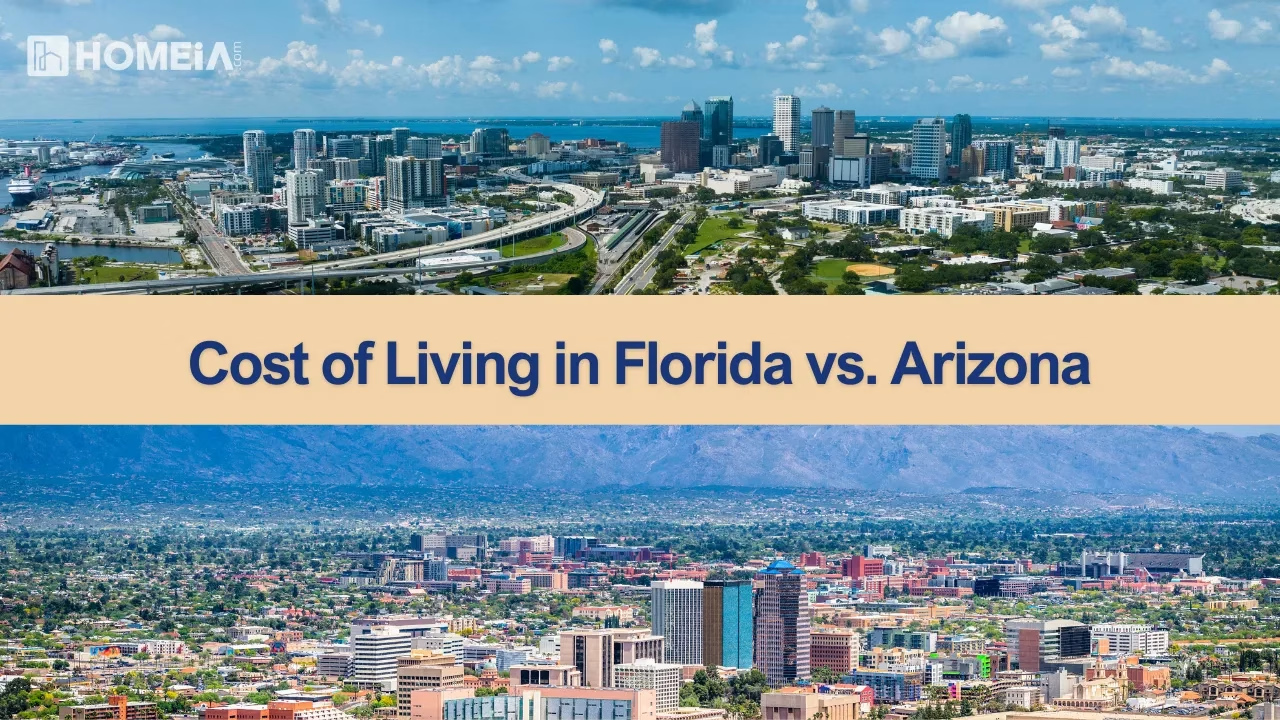
Cost of Living in Florida vs. Arizona: Florida and Arizona are two of the most popular Sun Belt destinations for retirees, remote workers, and families. Both offer warm climates, growing metros, and lower costs than many coastal states. However, these similarities end there as their expense profiles differ in important ways. Florida combines an above-average cost of living with zero state income tax and astronomical homeowners insurance. Arizona has higher overall living costs but lower insurance and more stable housing markets, while still taxing income at a modest flat rate.
This article about the cost of living in Florida vs. Arizona uses 2025–2026 data from the MIT Living Wage Calculator, World Population Review, Redfin, U.S. News, and other authoritative sources to compare wages, housing, taxes, and everyday expenses so you can see where each dollar goes further.
Key Takeaways
- Arizona’s cost of living index is about 110.7, versus 102.2 for Florida, making Arizona roughly 8 percent more expensive overall.
- Florida has no state income tax, while Arizona levies a flat rate near 2.5 percent, giving Florida a clear tax edge for higher earners.
- Median home prices are higher in Arizona, around 423,000 to 448,000 dollars, compared with roughly 372,000 to 378,000 dollars in Florida.
- Homeowners insurance is pricier in Florida due to hurricanes and flood risk. Arizona’s inland position keeps premiums low and stable.
- Living wage estimates for single adults are nearly identical in both states, but families often need more in Arizona due to higher housing and utility costs.
- Childcare and healthcare costs are broadly comparable, though Arizona’s Medicaid expansion improves access for low-income adults relative to Florida.
- Climate risks differ sharply: Florida faces hurricanes and coastal flooding, while Arizona contends with extreme heat, drought, and some wildfire risk.

Related article
10 Best Things to Do in Destin, Florida with Kids
This enchanting city, often called the “World’s Luckiest Fishing Village,” offers a unique blend of natural beauty, exciting outdoor activities, and mouth-watering culinary experiences that make it an ideal destination for all members of the family seeking adventure and tranquility…
At-a-Glance Comparison
| Metric | Florida | Arizona |
| Population (2026 est.) | ~23.5 million | ~7.5 million |
| Median Household Income | ~80,800 dollars | ~78,000–79,000 dollars |
| Median Home Price (statewide) | ~371,700–377,600 dollars | ~423,300–448,400 dollars |
| Avg. Rent (1 BR, statewide) | ~1,684 dollars per month | ~1,322 dollars per month |
| Cost of Living Index | 102.2 | 110.7 |
| State Income Tax | 0 percent | ~2.5 percent flat |
| Effective Property Tax Rate | ~0.83 percent | ~0.60–0.65 percent |
| Avg. Homeowners Insurance | ~5,800–8,400 dollars per year | ~1,500–2,000 dollars per year |
| Living Wage (Single Adult) | ~24.09 dollars per hour | ~24.47 dollars per hour |
| State Minimum Wage (2026) | 14.00 dollars per hour | ~14.35 dollars per hour |
1. Living Wage Comparison
MIT Living Wage data summarized by World Population Review found that single adults in Florida need about 24.09 dollars per hour to cover basic expenses, while their Arizona counterparts need roughly 24.47 dollars per hour. Baseline living costs for individuals are nearly identical in both states. Differences widen when children enter the picture. For single parents and two-adult households with children, AZ’s higher housing and utilities push required incomes slightly above those in FL, especially in metros such as Phoenix and Tucson.
Minimum wages remain below living wage levels in both states. The Sunshine State’s minimum wage is 14 dollars per hour on its path to 15 dollars, narrowing but not closing the gap for single adults. The Grand Canyon State’s inflation-indexed minimum wage sits in the mid-14-dollar range, likewise below living wage estimates for parents. Essentially, many lower-wage workers in both areas rely on multiple earners, overtime, or shared housing to meet essential costs.

Related article
12 Best Cities to Live in Arizona for Families
We took 4 main variables into consideration to determine the best places in Arizona to raise a family. The variables are quality of education, health care, personal safety, and recreational opportunities. Here you’ll find our list, along with the highlights that make each Arizona locale a special place to raise a family…
2. Housing Costs
Housing is a significant driver of cost differences between Florida and Arizona and shapes where each state feels affordable.
A. Home Prices: Florida’s median home price in 2026 sits around 372,000 to 378,000 dollars, slightly above the national average. Coastal markets including Miami-Dade and Palm Beach run much higher, while inland metros like Ocala and Lakeland are markedly cheaper. Arizona’s median home price is higher, near 423,000 to 448,000 dollars depending on the source, with Phoenix and its suburbs driving most of the increase. Prices cooled modestly in 2025–2026 but remain well above national norms, especially in fast-growing Phoenix-area suburbs.
B. Renting: Florida’s average rent for a roughly 700-square-foot apartment is about 1,684 dollars per month, while Arizona’s is 1,322 dollars. A roughly 360 dollars per month difference translates to more than 4,000 dollars per year for renters. Florida’s rents remain elevated after pandemic surges, though new supply in metros like Tampa and Orlando has recently softened prices. Arizona’s has risen sharply earlier in the decade but has since declined, especially in Phoenix.
C. Homeowners Insurance: Florida’s average homeowners insurance premium ranges from nearly 5,800 to over 8,400 dollars per year, the highest in the nation. Frequent hurricanes, flood risk, and insurer exits have pushed many households into Citizens, the state-backed insurer of last resort. Arizona homeowners typically pay 1,500 to 2,000 dollars per year, reflecting lower storm risk and a more stable insurance market. For similar homes, a Florida owner can easily pay 3,000 to 6,000 dollars more annually for insurance than an Arizona owner, a gap large enough to offset much of the former’s tax advantage.
D. Property Taxes: Property tax burdens are moderate in both states. Florida’s effective property tax rate averages around 0.83 percent, with homestead exemptions and the Save Our Homes assessment cap limiting annual increases for primary residences. On a 375,000-dollar home, the tax bill is nearly 3,100 dollars per year. Arizona’s effective rate is slightly lower, near 0.60 to 0.65 percent. On a 425,000-dollar home, that yields about 2,600 to 2,800 dollars annually. Property taxes do not create a dramatic gap, but AZ holds a modest advantage.

Related article
The 8 Best Places Near the Beach for Retirees in Florida
While some of these communities are affordable, others are more luxurious. We have presented options that will fit different budgets and needs, so there should be a choice for everyone…
3. Economy and Taxes
A. Economic Landscape: Florida’s economy is driven by tourism, real estate, logistics, and finance, with median household income around 80,800 dollars. Job growth remains available, with hospitality and construction sensitive to cycles and insurance-related housing pressures. Arizona combines growth in tech, logistics, and manufacturing with a large service sector, and its median household income sits in the high-70,000 to low-80,000 dollar range. Phoenix has been a particular magnet for jobs and migrants in recent years.
B. Tax Comparison
| Tax Category | Florida | Arizona |
| State Income Tax | 0 percent | ~2.5 percent flat |
| State Sales Tax (base) | 6.0 percent | 5.6 percent |
| Effective Property Tax Rate | ~0.83 percent | ~0.60–0.65 percent |
| Capital Gains Tax | 0 percent (no state tax) | Taxed as ordinary income |
| Estate / Inheritance Tax | None | None |
Florida’s zero income tax is its key advantage. Wages, pensions, and most investment income face no state levy, benefiting higher-income workers and retirees. Arizona taxes income at about 2.5 percent, so a 100,000-dollar earner pays roughly 2,500 dollars per year, and a 200,000-dollar earner about 5,000 dollars. For homeowners, Florida’s income tax savings must be weighed against higher insurance costs, while Arizona’s income tax is partly offset by lower insurance and somewhat lower property taxes.
4. Safety
Both states possess mixed safety profiles driven largely by urban concentrations. Florida’s larger metros, notably Miami, Orlando, and Jacksonville, report higher violent and property crime rates than smaller areas. Arizona’s crime patterns are concentrated in Phoenix and some border-adjacent areas, with many suburbs and small towns recording lower crime levels. National analyses indicate that violent crime has declined in many cities in both states since pandemic peaks, though improvements are not uniform.
Because statewide averages blur local variation, relocation decisions should rely on city and neighborhood-level data. Both offer reliable suburban and exurban communities, as well as neighborhoods where crime is a meaningful concern. Researching specific ZIP codes, rather than just statewide data, is essential for an accurate safety assessment.
Recommended for you




5. Climate and Geography
Florida hosts a humid subtropical to tropical climate with mild winters and long, humid summers. Their extensive coastline provides beaches and recreation but exposes nearly every region to hurricane and tropical storm risk. Repeated storms elevate insurance costs, disrupt infrastructure, and increase the risk of flood-related expenses, all financial consequences for homeowners.
Arizona provides a desert and semi-arid climate with hot summers, mild winters, and significant variation by elevation. Phoenix and Tucson regularly experience extreme heat, raising electricity usage for air conditioning. Northern and higher-elevation areas, including Flagstaff, see cooler temperatures and occasional snow. Arizona faces less storm and flood risk than Florida but contends with drought, water scarcity, and some wildfire risk in elevated regions. Climate shapes both direct costs such as utilities and insurance, and quality-of-life considerations.
6. Education
Florida ranks around the middle of U.S. states in overall public school quality but scores promisingly on school choice measures, with broad access to vouchers and education savings accounts. Graduation rates hover in the high 80 percent range, and in-state tuition at institutions like the University of Florida remains among the lowest in the country, often in the 6,000 to 7,000 dollar range for in-state students.
Arizona’s K-12 system experiences mixed performances. Suburban districts near Phoenix and Tucson perform well, while many rural and under-resourced districts face ongoing challenges. Government has expanded charter schools and school choice programs but continues to deal with teacher retention and funding issues. In-state tuition at Arizona public universities such as Arizona State and the University of Arizona tends to be higher than Florida’s but still below many coastal states.


Related article
The Pros and Cons of Moving to Arizona
If you are considering moving to Arizona, you’re in the right place! Known for its stunning desert landscapes, vibrant cities, and warm climate, Arizona offers a fantastic environment for living, working, and raising a family. State 48 has a diverse range of outdoor activities, from hiking in the Grand Canyon to exploring the red rocks of Sedona…
7. Childcare
| Care Type | Florida (Monthly) | Florida (Annual) | Arizona (Monthly) | Arizona (Annual) |
| Infant, center-based | 1,080–1,200 dollars | 12,960–14,400 dollars | 1,100–1,300 dollars | 13,200–15,600 dollars |
| Toddler, center-based | ~960 dollars | ~11,520 dollars | ~1,000 dollars | ~12,000 dollars |
| Preschool, center-based | 800–950 dollars | 9,600–11,400 dollars | 850–980 dollars | 10,200–11,760 dollars |
Childcare costs in both states are near national averages with modest differences. Over four years for two children, total childcare expenses in either state can easily exceed 60,000 dollars. Both states administer federal childcare subsidies for low-income families through the Child Care and Development Fund. Interestingly, most middle-income households pay full market rates.
8. Healthcare
Florida has not fully expanded Medicaid, leaving low-income adults in a coverage gap between traditional Medicaid and affordable private coverage. As a result, Florida’s uninsured rate is higher than the national average. Policy changes to ACA subsidies in 2025–2026 have heightened concerns about further increases in uninsured counts, with projections suggesting the uninsured rate could rise significantly in coming years.
Arizona expanded Medicaid early in the ACA era, reducing its uninsured rate and improved coverage access for low-income adults. Both states offer ACA Marketplace plans with income-based subsidies and host strong hospital networks in major metros. Locals in rural areas for both face provider shortages and extended commutes for specialized care. Regarding lower-income households and those with chronic conditions, Arizona’s expansion status provides a meaningful healthcare access advantage over Florida.

Related article
Top 10 Things to Do in Davenport, Florida
Davenport, Florida, may not headline the typical tourist brochures, yet it holds a charm and a host of attractions that make it a unique destination for visitors and a coveted haven for those looking to put down roots…
9. Additional Cost Considerations
- Utilities: Florida’s utilities are slightly below national averages overall, despite heavy summer air-conditioning, offset winters are mild. Arizona’s extreme heat drives high summer electricity use, so annual electric bills are substantial in both states, with Arizona’s prolonged heat roughly upends Florida’s humidity.
- Gas Prices: Gas prices in both states hover near or slightly below national averages. Differences of only a few cents per gallon translate to roughly 100 to 200 dollars per year for a typical driver, less than housing or insurance differences.
- Groceries: Florida’s grocery costs run a bit above national average, while Arizona’s are around or slightly below it. Over a year, this might save an AZ household a few hundred dollars relative to a comparable FL household.
- Transportation: Both are heavily car-dependent outside a few urban cores. Auto insurance premiums tend to be higher in Florida because of litigation and storm exposure, while Arizona’s are more moderate, creating another small recurring cost advantage for their drivers.
Conclusion
Florida and Arizona offer different Sun Belt value propositions with distinct tradeoffs. Arizona’s higher overall cost of living reflects elevated housing and utility costs, especially in Phoenix and Tucson, but its lower homeowners insurance, modest property taxes, and Medicaid expansion make household budgets more predictable for many residents. Florida’s lower cost index and zero income tax favor high earners, remote workers, and retirees with investment income, but extreme insurance costs and hurricane risk can erase much of that advantage for homeowners in coastal or high-risk areas. For renters and those not living paycheck-to-paycheck, Arizona’s lower average rents and stable insurance environment may outweigh its higher headline cost of living. The best choice depends on your income level, whether you plan to rent or buy, healthcare coverage needs, and how you weigh hurricanes versus extreme heat in your long-term quality of life.
Recommended for you




FAQs About the Cost of Living in Florida vs. Arizona
1. Is Arizona really more expensive than Florida in 2026?
Yes, on average. Cost of living indices place Arizona around 110.7 and Florida at about 102.2, on a national scale where 100 represents the U.S. average. That means Arizona is roughly 8 percent more expensive overall, driven by higher housing and utilities, especially in Phoenix and Tucson. However, Florida’s exponential homeowners insurance costs and hurricane risk reduce its apparent advantage for many homeowners. Renters in Arizona often pay less than renters in Florida, which adds a useful nuance to the headline comparison.
2. How much salary do you need in Florida vs. Arizona to maintain the same lifestyle?
For many, a salary that supports a given lifestyle in Florida will need to be slightly higher in Arizona, particularly for homeowners. Arizona’s higher housing prices and utilities push budgets up, even though rents can be lower in some metros. As a rough guide, a family comfortable on 90,000 dollars in Florida might need about 95,000 to 100,000 dollars in a comparable Arizona metro. The exact figure hinges on whether you buy or rent and which specific city you choose.
3. Which state is better for retirees in 2026: Florida or Arizona?
Retirees with substantial pensions or investment income often see Florida as attractive because the state has no income tax. Arizona taxes income at a low flat rate, which still adds up for higher-income retirees. On the other hand, Arizona offers lower homeowners insurance, somewhat lower property taxes, and expanded Medicaid, which can make healthcare and housing more predictable for retirees on moderate fixed incomes. Your ideal choice depends on whether tax savings or financial stability and healthcare access matter more.
4. Are people moving more to Florida or to Arizona in 2026?
Both regions continue to attract new residents, but Florida has historically drawn more domestic and international migrants because of its larger economy and coastline. However, high housing and insurance costs are starting to push some households toward alternative destinations, including Arizona’s growing metros. Arizona’s thriving job growth in Phoenix and its lower insurance and property tax burdens make it a rising competitor. Migration patterns are therefore shifting, with both states gaining residents but for slightly different reasons.
5. Which state is better for remote workers in 2026?
For remote workers, Florida offers a desirable tax advantage since wages and investment income are not subject to state income tax. This can significantly increase take-home pay, especially for high earners. Arizona provides lower insurance costs, stable housing markets, and lower property taxes, which may matter more once a remote worker buys a home. Remote employees focused on maximizing after-tax income may favor Florida, while those concerned about insurance volatility and long-term housing stability may lean toward Arizona.
Share