







Cost of Living in Texas vs Tennessee
- Local Editor:Local Editor: The HOMEiA Team


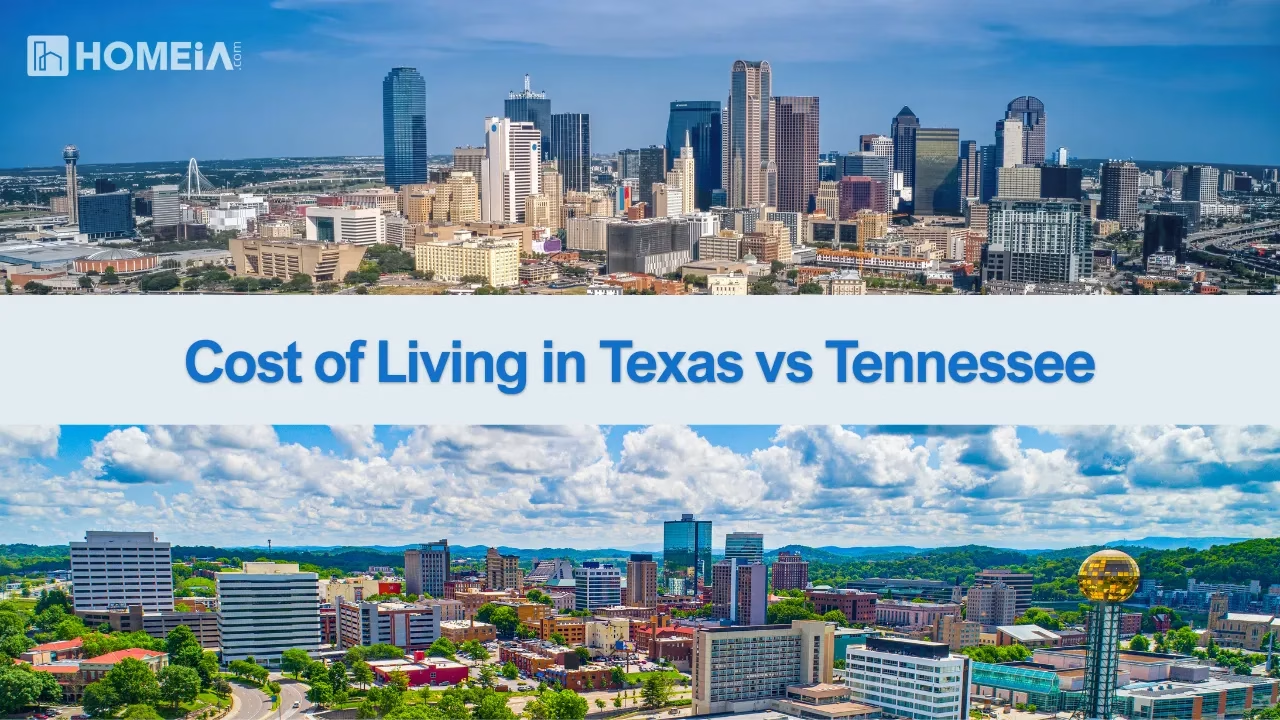
Cost of Living in Texas vs Tennessee: Texas and Tennessee look nearly identical on the surface as neither charges a state income tax, both are rapidly expanding, and each sits well below the national cost of living average. Yet, they diverge sharply on property taxes, homeowners insurance, and crime, and those differences can add up to thousands of dollars per year.
This 2026 Cost of Living in Texas vs Tennessee update draws on current data from MIT, Zillow, Redfin, the U.S. Census Bureau, the BLS, the FBI, the EIA, and the Dallas Federal Reserve to pinpoint where each state wins and where it falls short.
Key Takeaways
- Tennessee’s cost of living index is 90.3 versus Texas’s 92.1, making Tennessee modestly less expensive overall.
- Tennessee’s median home value of $336,445 (Zillow, May 2026) is close to Texas’s $343,800 (Redfin), but Tennessee’s property tax rate of 0.64% is far below Texas’s 1.68% average.
- Both states charge zero income tax, removing one of the most common differentiators in state comparisons.
- Texas averages $3,291 to $4,800 per year in homeowners insurance; Tennessee averages $1,700 to $3,408.
- Tennessee’s unemployment of 3.6% to 3.8% runs below Texas’s 4.3%, though both states posted near-zero net job growth in 2025.
- Tennessee added 63,785 residents in 2025 (8th nationally); Texas added 67,299 (2nd nationally), both driven primarily by domestic migration.
- Tennessee’s combined sales tax of 9.55% is the highest of any state without an income tax; Texas averages 8.2%, and Texas exempts most groceries while Tennessee taxes them at 4%.


Related article
The 7 Best Places to Live in Nashville, Tennessee
In this comprehensive article, we’ll visit the best places to live in Nashville, TN, exploring each neighborhood’s distinct personality, available amenities, and why it might be the perfect fit for your family’s next home. We’ll also provide specific neighborhood suggestions for dog parents, shopping enthusiasts, and also for arts and music lovers…
Texas vs Tennessee at a Glance
| Category | Texas | Tennessee |
| Population (2025 Census Est.) | ~31.3 million | ~7.32 million |
| Median Household Income (2024) | $79,700-$81,490 | $69,595-$75,860 |
| Median Home Value (May 2026) | $343,800 (Redfin) | $336,445 (Zillow) / $328,283 (Redfin) |
| Average Rent (1-BR, statewide) | $1,237/mo | $1,352/mo |
| Cost of Living Index | 92.1 | 90.3 |
| State Income Tax | None | None |
| Effective Property Tax Rate | ~1.68% avg | ~0.64% avg |
| Avg. Homeowners Insurance | $3,291-$4,800/yr | $1,700-$3,408/yr |
| Living Wage (Single Adult) | $21.77/hr ($45,282/yr) | ~$21.60/hr ($44,928/yr) |
| State Minimum Wage | $7.25/hr (federal floor) | $7.25/hr (federal floor) |
1. Living Wage Comparison
The MIT Living Wage Calculator, updated February 2026, measures the hourly income a full-time worker needs to cover basic living costs without public assistance.
A single adult in Texas needs $21.77 per hour ($45,282 annually). Tennessee’s statewide living wage runs around $21.60 per hour ($44,928 annually), essentially identical. These figures mask significant regional variation. Austin requires $25.85 per hour; the Murfreesboro-Franklin metro near Nashville requires $24.56. Rural areas throughout fall well below $21.
For families, the comparison remains close. A dual-income couple with two children must bring in about $29.51 per hour each in Texas and approximately $28.50 to $30 per hour in comparable Tennessee markets. The Lone Star State and Volunteer State set their minimum wage at the federal floor of $7.25 per hour.

Related article
5 Things That Make Houston, Texas Suited for Young Families
Known for its affordability, exceptional healthcare, diverse culinary scene, and a balance between urban and suburban living, Houston is a city that caters to a variety of lifestyles and preferences. Let’s explore what makes Houston a perfect choice for families…
2. Housing Costs
Housing prices are broadly similar statewide, but the property tax gap is significant of any two-state comparison in the Southeast, strongly favoring Tennessee.
A. Home Prices: Texas’s statewide median was $343,800 (Redfin, May 2026). Metros shift with Austin at $524,000, Dallas being $419,000, Houston having $318,000, and San Antonio with $261,000. Texas’ market has cooled from its 2022 peak, with rising inventory and increasing buyer leverage across most metros.
Tennessee’s Zillow average was $336,445 in May 2026 with Redfin’s median sale price was $328,283. Nashville’s median reached $481,000, Chattanooga was $355,787, Knoxville stayed at approximately $350,000, and Memphis was the most affordable at nearly $208,000. Statewide prices are broadly in line with Texas, but individual market comparisons matter more than the modest statewide gap.
B. Renting: Texas’s statewide one-bedroom average was $1,237 per month (Apartments.com, June 2026), with rents falling in major markets. San Antonio dropped 10.4% to $950, Dallas $1,350, Houston $1,130, and Austin $1,420. New apartment supply has driven Texas rents broadly lower since mid-2023.
Tennessee’s statewide one-bedroom averaged $1,352 per month. Nashville ran approximately $1,570, Chattanooga was $1,200 to $1,350, Knoxville stayed within $1,150 to $1,300, and Memphis finished at $900 to $1,100. Tennessee rent runs modestly higher than Texas statewide, driven almost entirely by Nashville’s premium.
C. Homeowners Insurance: Texas homeowners insurance averaged $3,291 per year (Texas Department of Insurance, 2024), with private market quotes often running $3,300 to $4,800. Rates rose 58% over the past five years, driven by severe hail, flooding, and construction cost inflation.
Tennessee’s average runs $1,700 to $2,300 for a mid-value home by most 2026 sources, though LendingTree’s 2026 report places Tennessee 7th nationally at $3,408 due to tornadoes and severe weather exposure in West Tennessee. For a buyer comparing comparable homes, realistic annual insurance savings in Tennessee range from $1,000 to $2,000, though each option faces continuing rate pressure from severe weather events.
D. Property Taxes: Texas’s average effective property tax rate is approximately 1.68%, among the highest in the nation. On a $343,800 home, annual taxes average approximately $5,776. Texas offers a $100,000 homestead exemption for school district taxes and a school district tax freeze for homeowners over 65.
Tennessee’s average effective rate is approximately 0.64%. On a $336,445 home, annual taxes average approximately $2,153. The annual difference of $3,000 to $4,000 on comparable homes compounds to $60,000 to $80,000 over a 20-year ownership horizon. Here lies the single strongest financial argument for Tennessee over Texas among homebuyers.

Related article
Living in Tennessee: A Visitor’s Guide for Prospective Residents
Tennessee is a wonderful place to visit, and for those who live here, the good appears to outweigh the bad. The heart of this state will just make y’all want to stick around past supper…
3. Economy and Taxes
A. Growth and Employment: Texas’s $2.7 trillion economy is the second largest in the nation. However, 2025 was an unusual year: The Lone Star State only added 10,700 net jobs, near-zero growth for the first time since the dot-com bust. The Dallas Fed projects 1.1% job growth in 2026, implying approximately 154,600 new jobs. Unemployment stood at 4.3% in December 2025.
Tennessee’s real GDP grew 1.7% in 2025 and is projected at 2.0% in 2026. Nonfarm employment added just 1,400 net jobs in 2025, but unemployment at 3.6% remained comfortably below the national rate. The Boyd Center projects 31,000 new jobs in 2026. Their economy is led by automotive manufacturing (Volkswagen, GM, Nissan, Ford), healthcare, logistics, and Nashville’s growing entertainment and professional services sector.
B. Income and Purchasing Power: Texas’s median household income of $79,700 to $81,490 in 2024 runs nearly $6,000 to $10,000 above Tennessee’s $69,595 to $75,860. After adjusting for regional price parity (Tennessee 91.9 vs. Texas 92.1 below the national average), real purchasing power between each is closer than the nominal income gap suggests.
C. Tax Comparison
| Tax Category | Texas | Tennessee |
| State income tax | None | None |
| Sales tax (state) | 6.25% | 7.0% |
| Combined sales tax (avg.) | 8.2% | 9.55% |
| Grocery tax | Exempt (most items) | 4% state rate |
| Effective property tax | ~1.68% avg | ~0.64% avg |
| Corporate income tax | None | 6.5% (C-corps) |
Both charge zero income tax. Tennessee’s 9.55% combined sales tax is the highest of any no-income-tax state. Tennessee’s 4% grocery tax adds approximately $384 per year for a household spending $800 per month on food, a consistent annual cost Texas families avoid. Their property tax difference remains the dominant financial factor for homeowners in both states.
Recommended for you




4. Safety
Using 2024 FBI crime data, Tennessee’s crime picture is mixed. CrimeByCity.com places Tennessee’s violent crime rate at 916.8 per 100,000, 94% above the national average, while CrimeContext.com‘s FBI UCR methodology places it at 359.7, slightly below the national rate of 363.8. The wide divergence reflects methodological differences in agency reporting. Their safest communities, including Nolensville, Brentwood, and Collierville, rank among the best in the Southeast.
Texas’s violent crime rate was approximately 396 to 420 per 100,000, near the national average, with property crime around 2,060 per 100,000. Texas contains dependable suburbs (Frisco, Allen, Sugar Land, The Woodlands) and elevated-crime urban cores. Buyers weighing either option should research specific cities and ZIP codes rather than relying on statewide averages.
5. Climate and Geography
Texas spans hot, humid Gulf Coast conditions, dry Central and West Texas summers exceeding 100 degrees Fahrenheit for weeks at a time, and a more temperate Panhandle. Natural disaster risk includes Gulf Coast hurricanes, hail storms, inland flooding, and severe winter ice events. Tennessee hosts four distinct seasons with shorter and milder summers. East Tennessee’s Smoky Mountains provide a cooler, scenery-rich environment unavailable anywhere in Texas. West Tennessee carries meaningful tornado risk. For households valuing seasonal variety and mountain access, TN offers a lifestyle dimension Texas cannot replicate.

Related article
The 10 Cheapest Places to Live in Texas
They say everything is bigger in Texas, and for good reason. From some of America’s largest and active metropolitan cities to the host of recreational activities for people of all ages across the state to the many bigger-than-life personalities who call Texas home, Texas has plenty to offer for everyone. here’s the list of 10 lowest cost of living places…
6. Education
Tennessee’s 2024-25 graduation rate reached 86.7%, a 10-year high, with celebrated suburban districts in Williamson County and Knox County outperforming national benchmarks. Texas’s graduation rate was approximately 90%, with per-pupil spending averaging $13,700, slightly above Tennessee’s $12,000 to $13,000.
For higher education, the University of Texas at Austin charges approximately $11,450 per year in-state tuition, below the University of Tennessee’s approximately $13,304 and Texas A&M’s $13,239. Texas boasts a modest tuition advantage at its flagship public universities.
7. Childcare
Both rank below the national average in childcare costs, making the gap between them relative to comparisons with high-cost states.
| Care Type | Texas | Tennessee |
| Infant, center | ~$1,190/mo ($14,280/yr) | ~$1,018/mo ($12,216/yr) |
| Toddler, center | ~$1,040/mo ($12,480/yr) | ~$900/mo ($10,800/yr) |
| Preschool, center | ~$880/mo ($10,560/yr) | ~$760/mo ($9,120/yr) |
Tennessee holds a consistent 10% to 15% childcare cost advantage across all age groups. For a family with an infant in full-time center care, annual savings in Tennessee run approximately $2,000 to $2,500 versus Texas.

Related article
5 Best Places to Live in Tennessee for Retirees
Tennessee is a vibrant and surprisingly diverse state that is increasingly becoming a hotspot for other states’ emigrants, tourists, and retirees. Job openings, tourist attractions, and the population at-large are expanding at a remarkable pace…
8. Healthcare
Texas has not adopted Medicaid expansion and carries an uninsured rate of approximately 14% to 16%, the highest of any state in the nation, leaving more than 5 million Texans without health coverage. Tennessee has also not adopted Medicaid expansion, with an uninsured rate of approximately 9% to 10%, outperforming Texas but still above the national average of 8.2%. For employer-insured workers and Medicare retirees, healthcare quality is broadly comparable, with each offering commendable major-metro hospital systems. Tennessee’s Vanderbilt Health and HCA Healthcare (headquartered in Nashville) anchor a robust healthcare infrastructure.
9. Additional Cost Considerations
- Utilities: Texas’s average residential electricity rate was approximately 14.41 to 15.54 cents per kWh in early 2026, whereas Tennessee’s was approximately 14.10 to 14.41 cents. The difference is negligible, under $100 per year for a typical household. Texas’s deregulated electricity market in most areas allows competitive price shopping.
- Gas Prices: Texas averaged approximately $2.80 per gallon in mid-2026 while Tennessee averaged $2.85. Effectively identical at the household level.
- Groceries: Texas exempts most groceries from sales tax. Tennessee charges 4% state tax. Texas’s grocery price index also runs approximately 8% below Tennessee’s. The combined difference adds approximately $700 to $900 per year for a household spending $800 per month on food.
This modest grocery variation is a textbook example of how tradable goods stay relatively stable across markets; this breakdown of housing versus groceries costs explains why housing drives most relocation savings while everyday goods barely budge. - Transportation: Both states are entirely car-dependent outside a few urban centers. Texas’s Dallas (DART) and Houston (Metro) transit systems offer more coverage than any Tennessee city, though neither rivals major Northeastern networks.
Conclusion
Tennessee’s property tax and insurance savings make it the ideal financial choice for most homebuyers and retirees, often offsetting its lower median income compared to Texas. For career-focused households, Texas’s larger metro economies in Houston, Dallas, and Austin offer scale and opportunity that Tennessee cannot match. These options deliver a genuinely lower cost of living than most of the country, and the right choice comes down to where you want to build your career and your community.
Recommended for you




FAQs About the Cost of Living in Texas vs Tennessee
1. Which state is cheaper overall?
Tennessee’s cost of living index of 90.3 edges Texas’s 92.1. The most significant differences are property taxes (0.64% versus 1.68%), homeowners insurance ($1,000 to $2,000 less per year), and childcare (10% to 15% lower). Texas holds advantages in grocery costs (no grocery tax, lower prices) and a bulky job market with higher median incomes. For homebuyers, Tennessee’s fixed housing costs are meaningfully lower over time. For renters in major Texas metros, the gap narrows considerably.
2. Does Texas’s higher income offset its higher property taxes?
Partially. Texas’s median household income runs $6,000 to $10,000 above Tennessee’s, but a Texas homeowner pays approximately $3,600 more per year in property taxes on a comparable home, plus $1,000 to $2,000 more in insurance. At incomes below $100,000, Tennessee’s lower fixed housing costs offset or exceed the income gap. Higher earners in their large metro labor markets benefit more from the income premium.
3. Which state is better for retirees?
Tennessee holds the stronger case for most retirees. Lower property taxes save a typical homeowner $3,000 to $4,000 per year, with lower homeowners insurance adding another $1,000 to $2,000. Both states charge zero income tax on retirement income, so neither holds an advantage there. Texas’s school district property tax freeze for homeowners over 65 narrows the gap for qualifying seniors. However, Tennessee’s overall lower cost of ownership remains the deciding factor for most retirees not dependent on a large Texas labor market.
4. Are both states still growing in 2026?
Yes. Texas added approximately 67,299 net domestic migrants in 2025 (2nd nationally); Tennessee added 42,389 (4th nationally). Both states experienced near-zero net job growth in 2025, a shared challenge attributed to productivity gains, slower immigration, and policy uncertainty. Both projects enhanced job growth in 2026, with the Dallas Fed forecasting 1.1% for Texas and UT’s Boyd Center projecting 31,000 new Tennessee jobs.
5. Which state is better for remote workers?
Tennessee edges Texas for most fully remote workers due to lower property taxes and homeowners insurance, saving $3,000 to $5,000 per year for homeowners. Nashville has built a well-respected remote and entrepreneur community with quality-of-life, walkability, and coworking infrastructure. Texas hosts greater metro options with larger professional networks in Austin, Dallas, and Houston, making it the stronger choice for remote workers who value proximity to developed ecosystems despite higher homeownership costs.
Share