







Cost of Living in Florida vs. North Carolina
- Local Editor:Local Editor: The HOMEiA Team


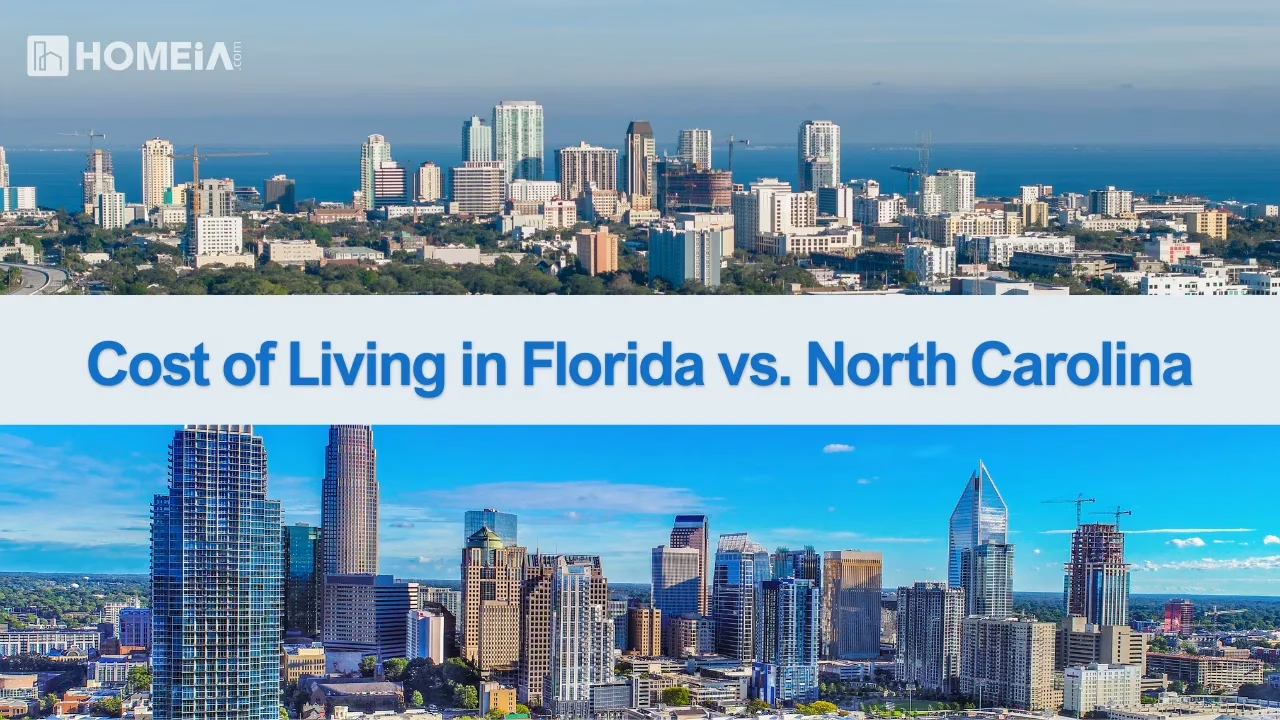
Cost of Living in Florida vs. North Carolina: Florida and North Carolina are two of the most sought-after relocation destinations in the American South. Florida draws retirees, remote workers, and sun-seekers with its zero income tax and coastal lifestyle. North Carolina, led by the Research Triangle and Charlotte metro, has quietly become the nation’s top domestic migration destination, attracting families and businesses with lower housing costs and bustling economic opportunities.
This comparison of the cost of living in Florida vs. North Carolina draws on 2025–2026 data from the MIT Living Wage Calculator, Redfin, Zillow, the U.S. Census Bureau, the EIA, FBI crime data, and Insurify to provide readers a data-driven picture of where each dollar stretches further.
Key Takeaways
- North Carolina is slightly more affordable overall, with a cost of living index of 96.6–97.8 versus Florida’s 100.7–102.2, placing it modestly below the national average and FL modestly above it
- Florida has no state income tax, saving a $100,000 earner roughly $3,990 per year compared to North Carolina’s flat 3.99% rate
- Florida’s homeowners insurance averages $5,800–$8,292 per year, more than twice North Carolina’s $2,900–$2,951, dramatically reshaping total housing costs for homeowners
- North Carolina led all 50 states in domestic net migration in 2025, attracting 84,000 new residents; Florida dropped to 8th after years at the top
- Florida has not expanded Medicaid, leaving roughly 10.7% of residents uninsured; North Carolina expanded Medicaid in 2023, cutting its uninsured rate significantly
- Childcare is modestly cheaper in North Carolina, with infant center-based care averaging $950–$1,031/month versus Florida’s $1,084–$1,085/month
- Both states have similar property tax rates of approximately 0.66%–0.83%, making property taxes a near-wash between the two

Related article
Areas that Make the Cost of Living More Affordable in Florida
Join us as we uncover the secrets to living and thriving in Florida, all while keeping an eye on your financial well-being. Let’s embark on this journey to understand the actual cost of living in the Sunshine State and how to make the most of every dollar spent…
At-a-Glance Comparison
| Metric | Florida | North Carolina |
| Population (2025 est.) | 23,462,518 | ~11,067,000 |
| Median Household Income | ~$80,838 | ~$80,086 |
| Median Home Price | ~$395,595 (May 2026) | ~$378,655 (May 2026) |
| Average Rent (1-BR, statewide) | ~$1,259–$1,962/mo | ~$1,084–$1,352/mo |
| Cost of Living Index | 100.7–102.2 | 96.6–97.8 |
| State Income Tax | 0% (none) | 3.99% (flat) |
| Effective Property Tax Rate | ~0.83% of assessed value | ~0.66% of assessed value |
| Avg. Homeowners Insurance | ~$5,800–$8,292/yr | ~$2,900–$2,951/yr |
| Living Wage (Single Adult) | ~$22.40/hr (~$46,600/yr) | ~$22.47/hr (~$46,745/yr) |
| State Minimum Wage | $14.00/hr | $7.25/hr |
1. Living Wage Comparison
According to the MIT Living Wage Calculator (updated February 2026), a single adult in North Carolina needs approximately $22.47 per hour ($46,745/year) to cover basic necessities. In Florida, they need roughly $22.40 per hour ($46,600/year), a near-identical figure. The two states track closely near the national average, though regional variation within each state is significant. Coastal Florida metros and Charlotte’s urban core inflate living costs well above their respective statewide figures.
The gap widens for families. Single parents with one child in North Carolina require $37.54/hour ($78,087/year), versus approximately $40.25/hour in the Orlando area of Florida, where childcare and housing run higher. For dual-income households with two children, NC requires $25.53/hour per worker, while comparable FL households in major metros need meaningfully more. Housing costs in Florida’s coastal urban centers are the main driver.
The Tar Heel State’s minimum wage remains at $7.25/hour, well below the $22.47 living wage. The Sunshine State’s $14.00/hour minimum is nearly double its opposition’s floor, reducing the wage gap for lower-income workers. However, both states fall far short of what a single adult needs to cover basic expenses.

Related article
7 Most Affordable Places to Live in North Carolina
Dreaming of North Carolina life on a budget? Beyond pricey metros like Charlotte and the Triangle, the Tar Heel State offers affordable, vibrant cities rich in charm and opportunity. This guide reveals seven budget-friendly NC spots, balancing housing, jobs, safety, and community—where your dollar truly goes further…
2. Housing Costs
Housing is the most consequential cost category and the clearest differentiator between these two states in 2026.
A. Home Prices: Florida’s statewide median home price reached $395,595 in May 2026 per Redfin, up 1.7% year-over-year, though Zillow’s index shows $377,578, down 3.3%, reflecting softening in some markets. The market is highly bifurcated as Miami-Dade and Palm Beach medians range from $457,000 to over $510,000, Orlando’s Redfin median sits near $410,000, and inland Ocala is closer to $265,000.
North Carolina’s statewide median is approximately $378,655–$385,000 in 2026, up roughly 1.0%–3.2% year-over-year. Charlotte medians run $417,000–$425,000, the Research Triangle sits at $422,750–$445,000, while Winston-Salem and Greensboro offer medians of $260,000–$310,000, well below comparable Florida interior markets.
B. Renting: The southernmost state’s rental market is in active correction in 2026. Their median rents dropped to approximately $1,672/month by February, down 1.1% year-over-year, as record new apartment supply flooded Tampa, Orlando, and Jacksonville. One-bedroom rents average $1,259–$1,492/month depending on source. On the other hand,average one-bedrooms in North Carolina run $1,084–$1,352/month, modestly lower. Charlotte one-bedrooms average approximately $1,475/month, competitive with mid-tier Florida metros.
C. Homeowners Insurance: This is where the two states diverge most dramatically. FLA homeowners insurance is the most expensive in the nation, with average annual premiums of $5,800–$8,292, and some analyses placing the statewide average as high as $11,759 for $300,000 in dwelling coverage. Hurricane exposure, coastal flooding, and repeated catastrophic losses have driven multiple major insurers to exit the market, leaving many in Citizens Property Insurance, the state-backed insurer of last resort.
NC homeowners pay an average of $2,900–$2,951 per year in 2026, about $500 above the national average but a fraction of Florida’s cost. Premiums have risen sharply after two consecutive 7.5% statewide rate increases in 2025 and 2026, driven by hurricane risk, hail events, and reinsurance hardening. For homeowners comparing equivalent $400,000 properties, the annual insurance gap between these two states can easily reach $3,000–$5,000.
D. Property Taxes: Both states have moderate property tax rates. Florida’s effective rate averages approximately 0.83%, with a Save Our Homes cap limiting annual assessment increases to 3% or CPI for homesteaded properties. North Carolina’s effective rate averages 0.66%, with county-level variation from 0.22% to 0.96%. On a $400,000 home, Florida’s annual tax bill is nearly $3,320 versus $2,640 in North Carolina, a difference of $680 per year. Neither state’s property tax burden is a major differentiator in the overall comparison.


Related article
5 Affordable Places to Live in Jacksonville, Florida: Your Guide to Budget-Friendly Neighborhoods
Like any major city, finding affordable living spaces can be challenging. This article takes a look at the most budget-friendly neighborhoods in Jacksonville, offering a blend of low living costs and quality life…
3. Economy and Taxes
A. Economic Landscape: Florida’s economy is the fourth-largest in the U.S., with major industries in tourism, international trade, finance, real estate, and aerospace. Unemployment rose to almost 4.3% by early 2026, in-line with the national average. Median household income is approximately $80,838, nearly identical to North Carolina’s $80,086, though the similarity in nominal income masks important differences in insurance costs and taxes.
North Carolina’s economy is diversifying rapidly, headed by semiconductor manufacturing, life sciences, tech, and finance. An unemployment rate of approximately 3.9%–4.0% is below both Florida’s and the national average. Employment grew 1.4% year-on-year as of late 2025, the second-best performance on the East Coast, driven largely by continued investment in the Research Triangle corridor.
B. Tax Comparison
| Tax Category | Florida | North Carolina |
| State Income Tax | 0% | 3.99% flat |
| State Sales Tax (base) | 6.0% | 4.75% |
| Effective Property Tax Rate | ~0.83% | ~0.66% |
| Capital Gains Tax | 0% | 3.99% |
| Estate/Inheritance Tax | None | None |
Florida’s well-known zero income tax is its most compelling financial advantage. At $100,000, a resident saves $3,990 per year versus those in North Carolina. At $150,000, savings grow to $5,985; at $200,000, to $7,980. However, for homeowners, these savings are largely or entirely eroded by Florida’s higher insurance premiums. North Carolina’s rate is also scheduled to decline further, dropping to 3.49% in 2027 and potentially to 2.49% by 2030 if state revenue triggers are met.
Recommended for you




4. Safety
According to 2024 FBI crime data, Florida reported a violent crime rate of approximately 359.6 per 100,000 residents and a property crime rate of almost 1,794 per 100,000. North Carolina reported a violent crime rate of approximately 375.8–556.7 per 100,000 and a property crime rate of about 1,968–2,951 per 100,000, depending on reporting methodology. Florida’s violent crime rate has declined 54.1% from 2014 to 2024, while North Carolina’s has risen 23.2% over the same period. Both states saw continued property crime improvements in 2024.
Wide internal variation exists throughout, South Florida metros carry higher crime rates than suburban Florida. In North Carolina, rural eastern counties and parts of Charlotte and Durham show above-average violent crime, while Research Triangle suburbs and western mountain communities are among the safest areas in the Southeast. Prospective movers should research specific ZIP codes rather than relying on statewide averages.
5. Climate and Geography
Florida’s climate is one of its most powerful draws. Warm, sunny weather year-round with mild winters statewide await. However, the same geography makes it the most hurricane-exposed state in the nation, driving the homeowners insurance crisis outlined in Section 2. Extreme heat from June through September, high humidity, and flood risk are additional drawbacks. Florida’s advantage for retirees and outdoor enthusiasts remains consistent.
North Carolina hosts four distinct seasons, with mild winters in the Piedmont, significant snowfall in the mountains, and hot but not extreme summers. The state was significantly impacted by Hurricane Helene in 2024, which caused severe flooding in western NC. Coastal regions face increasing hurricane risk, while the mountains offer cooler temperatures and strong outdoor recreation appeal. Experiencing beach and mountain environments within a few hours’ drive is a frequently cited quality of life advantage.

Related article
7 Most Affordable and Safe Places for Young Professionals to Live in North Carolina
In all the cities included in this list, there is a wide range of safe, affordable, and conveniently located housing options, whether the young professional prefers city life or the suburbs. These North Carolina communities are not only inexpensive, but they also offer appealing amenities and access to the mountains and the seashore…
6. Education
Florida ranks 24th nationally in overall public school quality in 2026 per World Population Review’s composite rankings, an improvement of 17 places from the prior year. It holds the No. 1 ranking in education freedom nationally per the 2025 ALEC Education Freedom Report Card, with broad school choice infrastructure including ESAs, charter, and voucher programs. In-state tuition at Florida State and the University of Florida runs approximately $6,000–$7,000 per year, among the lowest public university costs in the country.
North Carolina ranks 30th nationally in overall public school quality, but performs near the national median on academic outcome metrics. NC made significant gains in education freedom, jumping 23 spots to 12th nationally in 2025. In-state tuition at UNC-Chapel Hill is around $9,000–$9,500 per year. Florida holds a modest advantage in school choice infrastructure and university affordability, while North Carolina performs comparably on academic achievement metrics.

Related article
10 Most Affordable Places to Live in Florida: Discovering Florida’s Hidden Gems
Florida, known for its sunny beaches, vibrant culture and diverse communities, is a dream destination for many. But living in this paradise doesn’t have to break the bank. In this article, we’ll explore some of the most affordable places in Florida that offer a great quality of life without the hefty price tag…
7. Childcare
| Care Type | Florida (Monthly) | Florida (Annual) | North Carolina (Monthly) | North Carolina (Annual) |
| Infant (center-based) | $1,084–$1,085 | $13,011–$13,021 | $950–$1,031 | $11,400–$12,370 |
| Toddler (center-based) | ~$960 | ~$11,520 | $840 | $10,080 |
| Preschool (center-based) | ~$800 | ~$9,600 | $720 | $8,640 |
For a family with one infant and one preschooler in center-based care, annual costs in Florida run approximately $22,600, compared to approximately $20,000 in North Carolina, a difference of roughly $2,600 per year. Over five years, that compounds to somewhere in the ballpark of $13,000 in cumulative savings for North Carolina families. The childcare gap between these states is real.
Both states offer CCDF-funded subsidies with eligibility typically at or below 85% of state median income. Florida also operates the School Readiness program for income-qualified families. Neither state provides universal childcare subsidies, meaning most middle-income families pay full market rates.
8. Healthcare
Florida and North Carolina differ sharply on Medicaid expansion. This remains one of only ten states that have not expanded Medicaid under the ACA, leaving approximately 10.7% of Florida residents uninsured, the fourth-highest rate in the country. The 2025 reconciliation law’s changes to Medicaid and ACA premium tax credits are projected to cause Florida’s uninsured rate to double from 10% to as high as 19% by 2027, with 1.4 to 1.9 million more residents expected to lose coverage. A ballot initiative to expand Medicaid is supported by Florida voters but implementation remains uncertain.
North Carolina expanded Medicaid in 2023, enrolling hundreds of thousands of previously uninsured adults and significantly lowering the state’s uninsured rate. For retirees, lower-income households, and independently insured workers, North Carolina’s Medicaid expansion is a substantial healthcare access advantage. Both states have ACA Marketplace plan access, though premium costs are rising in both following the 2025 federal legislative changes.

Related article
Living in Charlotte, North Carolina: A Tapestry of Culture, Innovation and Community
Join us in exploring life in Charlotte; we will journey through the many experiences and opportunities the city has to offer. From its commitment to green spaces and its fascinating culinary landscape to its mosaic of cultures, Charlotte offers a lifestyle filled with enriching experiences that are unique and inclusive…
9. Additional Cost Considerations
- Utilities: Florida’s residential electricity rate averages 14.86¢/kWh per EIA data, lower than North Carolina’s 16.00¢/kWh. However, Florida’s significantly higher consumption from year-round air conditioning means total annual electricity bills can be comparable or higher. A typical household uses nearly 1,630 kWh/month versus 1,374 kWh in North Carolina, producing average monthly bills of approximately $242 in Florida and $194 in North Carolina.
- Gas Prices: As of mid-June 2026, Florida averages $3.65–$3.78/gallon per AAA and EIA data. North Carolina averages $3.56–$3.73/gallon, modestly lower. Narrowly, roughly 10–20 cents per gallon, translating to approximately $90–$180 in annual fuel savings for a typical driver choosing North Carolina over Florida.
- Groceries: Florida’s grocery cost index is approximately 105.7, modestly above the national average, while North Carolina’s sits near 94.3–100, at or slightly below average. These households spend an estimated $127–$131 per week on groceries versus $119–$124 in North Carolina, a difference of roughly $400–$600 per year.
- Transportation: Both are heavily car-dependent outside a few urban cores. Vehicle insurance costs are exorbitant in Florida, reflecting the state’s high-litigation environment and weather-related claims. Registration fees and overall vehicle operating costs are modestly higher in Florida, adding several hundred dollars per year to the transportation gap.
Conclusion:
These two Southern states are far closer in overall cost of living than many expect, making the choice between them more nuanced than a simple price comparison. Florida’s zero income tax is a genuine advantage, especially for high earners and retirees with investment income. But extraordinary homeowners insurance costs, often $3,000–$5,000 more per year than North Carolina, substantially erode that benefit for most homeowners. North Carolina provides a compelling financial case: modestly lower home prices, far lower insurance costs, a declining income tax rate, expanded Medicaid access, and the nation’s strongest domestic migration momentum. For families, remote workers, and healthcare-sensitive households, North Carolina often wins on total cost. For high-income earners, retirees with significant portfolios, and those who prioritize Florida’s climate, the Sunshine State still makes a strong case.
Recommended for you




FAQs About the Cost of Living in Florida vs. North Carolina
1. Is Florida or North Carolina cheaper to live in overall in 2026?
North Carolina is modestly cheaper on a composite basis, with a cost of living index of 96.6–97.8 versus Florida’s 100.7–102.2, placing NC slightly below the national average and FL slightly above it. The headline difference is smaller than many expect. Florida saves money on income taxes but costs significantly more in homeowners insurance. For a homeowner in a hurricane-exposed area paying $6,000–$8,000 per year in insurance, Florida’s total housing cost can easily exceed North Carolina’s even after accounting for the income tax advantage.
2. How much does Florida’s zero income tax actually save compared to North Carolina?
At $100,000 of income, Floridians saved $3,990 per year versus North Carolinians at the flat 3.99% rate. At $150,000, the savings is $5,985; at $200,000, it is $7,980. These are meaningful amounts, but for homeowners, Florida’s higher insurance costs can partially or fully offset the savings. North Carolina’s rate is also scheduled to fall to 3.49% in 2027 and potentially to 2.49% by 2030, which will narrow Florida’s tax advantage over time.
3. Which state is better for retirees in 2026?
Florida’s zero income tax benefits retirees with Social Security income, pensions, and investment distributions, as none of that income is taxed at the state level. North Carolina taxes retirement income at 3.99%. However, North Carolina’s Medicaid expansion provides a major healthcare access advantage for retirees with moderate income. Florida’s non-expansion status and rising uninsured rates create real financial risk. For retirees with higher incomes and solid private health insurance, Florida’s tax advantage is compelling. For those with moderate fixed income or variable health needs, North Carolina’s healthcare safety net is a significant counterweight.
4. Is the migration shift toward North Carolina permanent in 2026?
North Carolina’s rise to the No. 1 domestic migration destination in 2025, with 84,000 net domestic movers, reflects a durable trend driven by affordability relative to Florida, a thriving Research Triangle tech economy, and four-season climate appeal. Florida’s fall from grace reflects its housing costs, insurance crisis, and softening labor market. Both states will continue to grow, but migration momentum clearly favors North Carolina in the near term.
5. Which state is better for remote workers in 2026?
Florida offers the clearest financial advantage for remote workers who own a home in an inland or non-coastal area where insurance costs remain manageable. An absence of state income tax on a portable salary provides immediate, recurring savings. North Carolina counters with lower homeowners insurance costs, strong co-working infrastructure in Raleigh, Durham, and Charlotte, and lower rents in secondary markets like Greensboro, Winston-Salem, and Asheville. For remote workers renting, the financial gap narrows considerably and North Carolina becomes significant overall value.
Share