







The Complete Pricing Guide to Moving Service Cost by Home Size and Distance
- Local Editor:Local Editor: The HOMEiA Team
- Category: Moving


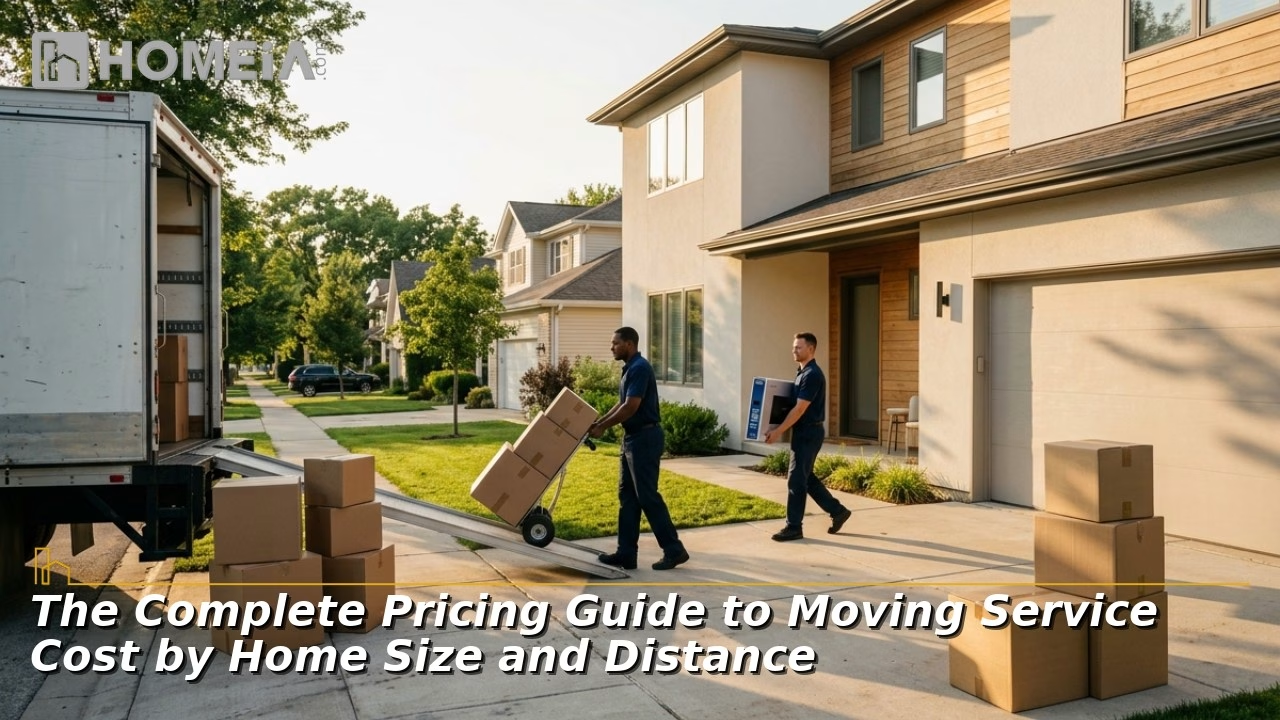
The moving service cost by home size and distance is determined by two primary pillars, with one being the total volume of household goods and the other specific mileage between the origin and destination. These two variables account for 70 to 80 percent of a final moving invoice. In the current market, homeowners and renters must navigate a pricing landscape that is increasingly transparent but heavily influenced by rising labor and insurance overhead. Understanding how these factors interact is the first step toward building a realistic relocation budget.
Table of Contents:
- Key Takeaways
- 1. Why Home Size and Distance Are the Two Biggest Cost Drivers
- 2. Moving Cost by Home Size: Local Moves
- 3. Moving Cost by Distance: Long-Distance Moves
- 4. The Hidden Cost Multipliers Most People Overlook
- 5. Local vs. Long-Distance: Which Pricing Model Works in Your Favor?
- 6. How to Use These Numbers to Build Your Moving Budget
- 7. Cost-Saving Strategies by Move Type
- FAQs About Moving Service Cost by Home Size and Distance
Key Takeaways
- Billing Foundations: Local moves (under 50 to 100 miles) are billed by the hour, whereas long-distance moves (over 100 miles) use a weight-and-mileage formula.
- Budget Benchmarks: A local 3-bedroom move ranges from $960 to $2,640, while a cross-country move for the same home size averages $7,000 to $15,000.
- Weight Matters: A standard 3-bedroom home usually weighs between 5,500 and 8,500 pounds, a critical factor in long-distance tariff rates.
- Hidden Multipliers: Professional packing, specialty items, and difficult property access can add $1,000 or more to the base moving cost.
- Regulation: Interstate moves are federally regulated by the FMCSA: ensuring consumers receive written estimates and specific legal protections.

Related article
How Much Does It Cost to Move a 3-Bedroom Home Locally? A Pricing Guide
The moving industry has modernized with digital estimates and AI-powered surveys, yet three-bedroom moves remain deceptively complex. They often require professional crews despite being underestimated by homeowners. While pricing transparency has improved, costs continue rising due to higher labor rates, insurance expenses, and strong demand for experienced, vetted movers…
1. Why Home Size and Distance Are the Two Biggest Cost Drivers

The moving service cost by home size and distance is the foundation of every professional estimate because these dictate the resources required for a safe relocation. Square footage and bedroom count determine the size of the crew and capacity of the truck, while miles traveled determine fuel consumption, driver hours, and equipment maintenance.
There are two primary billing models used by professional moving companies:
- Local moves (under 50 to 100 miles): These are billed based on the hourly rate per mover multiplied by the number of movers in the crew.
- Long-distance moves (over 100 miles): These are billed by a weight-and-mileage formula, often referred to as a tariff rate.
This article serves as a comprehensive reference guide for current pricing standards. Whether a move involves a small studio across town or a sprawling estate crossing state lines, the following data helps set realistic financial expectations.

Related article
Senior Moving Services: A Complete Guide to Downsizing, Assisted Living Transitions & Relocation
Moving is one of the most emotionally complex events a family will ever go through. It goes beyond the surface of packing boxes, it is about closing a chapter of someone’s life. Today, roughly 51 percent of Baby Boomers have downsized or plan to do so in retirement…
2. Moving Cost by Home Size: Local Moves

Local moves are priced using an hourly labor model where the total cost is a direct reflection of how long the crew is on the clock. Average moving cost by home size increases with each additional bedroom because larger homes require more inventory protection, additional trips to the truck, and increased professional teams.
| Home Size | Crew Needed | Est. Hours | Hourly Rate Range | Total Estimated Cost |
| Studio / 1-BR | 2 movers | 2–4 hrs | $105–$165/hr | $210–$660 |
| 2-Bedroom | 2–3 movers | 4–6 hrs | $105–$290/hr | $420–$1,740 |
| 3-Bedroom | 3–4 movers | 6–8 hrs | $160–$330/hr | $960–$2,640 |
| 4-Bedroom | 4 movers | 8–10 hrs | $210–$330/hr | $1,680–$3,300 |
| 5-Bedroom+ | 4–5 movers | 10–14 hrs | $260–$415/hr | $2,600–$5,810 |
A. Understanding Base Costs
The local moving cost per hour covers the professional labor and the provision of a fully equipped moving truck. It is vital to understand that these figures represent base labor only. Services such as professional packing, handling specialty items, and navigating multiple flights of stairs will incur separate surcharges.
B. Industry Minimums
Most reputable moving companies enforce a 2 to 4 hour minimum charge to cover dispatch and operational costs. Even if a move only takes 90 minutes, homeowner(s) will likely be billed the company minimum.
C. Regional Variations
Pricing varies significantly by geography. High-cost metropolitan areas, including New York City, Los Angeles, and San Francisco, often see rates 20 to 40 percent above the national averages listed above. California long-distance movers, in particular, operate under some of the highest combined labor, fuel, and insurance overhead in the country, which is reflected in both intrastate and interstate rate schedules originating from or terminating in the state. Conversely, moves in the Midwest and South typically run 15 to 20 percent below these benchmarks.

Related article
Moving Container Value Guide: PODS, U-Pack and PACK-RAT
This comprehensive comparison of the three industry leaders—PODS, U-Pack, and 1-800-PACK-RAT; examines which company might best suit your specific moving and storage needs. We’ve analyzed pricing, container quality, availability, storage options, and customer experiences to help you make an informed decision…
3. Moving Cost by Distance: Long-Distance Moves
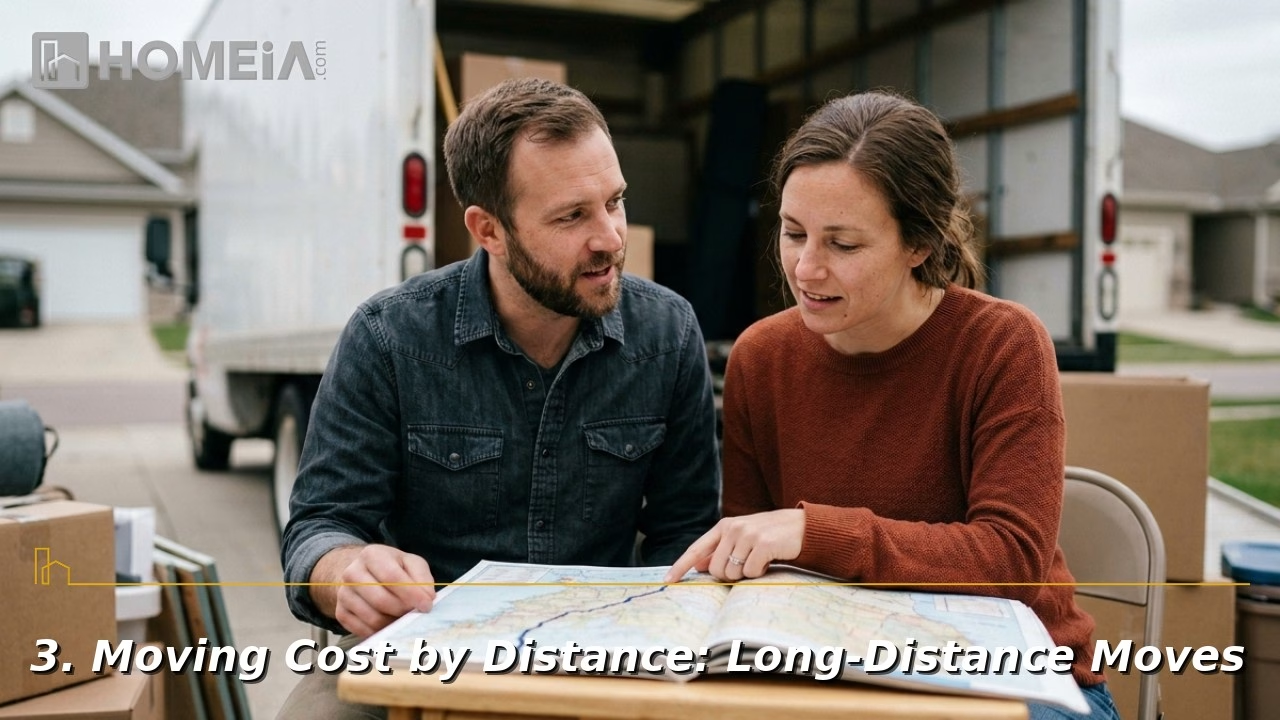
Relocations crossing the 100-mile threshold shift from hourly billing to a formula-based weight and mileage model. This transition provides better predictability for consumers because the final long distance moving cost by weight and mileage is determined by certified scales and mapped distance rather than the speed of the workers.
| Distance | 2-BR Home (est.) | 3-BR Home (est.) | 4-BR Home (est.) |
| Under 100 miles (local) | $800–$1,800 | $1,200–$2,800 | $2,000–$4,500 |
| 100–500 miles | $1,500–$3,500 | $2,500–$5,500 | $4,000–$8,000 |
| 500–1,000 miles | $2,500–$5,000 | $4,000–$8,000 | $6,500–$12,000 |
| 1,000–2,000 miles | $3,500–$7,000 | $5,500–$11,000 | $9,000–$16,000 |
| 2,000+ miles (cross-country) | $5,000–$10,000 | $7,000–$15,000 | $12,000–$20,000+ |
A. The Weight-Based Tariff Model
Long-distance carriers utilize a standardized tariff rate of a price per 100 pounds for every 100 miles traveled. This means the heavier the shipment, the more expensive the transport.
B. Typical Shipment Weights
When estimating long-distance costs for a 3-bedroom move, it helps to have a sense of the standard weight of household goods by bedroom count:
- 1-BR: Approximately 2,000 to 3,500 lbs.
- 2-BR: Approximately 3,500 to 5,500 lbs.
- 3-BR: Approximately 5,500 to 8,500 lbs.
- 4-BR: Approximately 8,500 to 12,500 lbs.
C. Securing Accuracy
A binding estimate based on a virtual or in-home survey is the only reliable way to lock in an accurate price. Here, movers visually assess the inventory while confirming a weight prediction before moving day.
Recommended for you





While size and distance are the pillars of a quote, secondary factors can act as multipliers significantly increasing the final bill regardless of home size.
- Packing services: Professional packing for a 3-bedroom home usually adds $800 to $1,800 to the base move cost.
- Packing materials: Boxes, tape, bubble wrap, and wardrobe boxes often cost between $150 and $500 or more if purchased through the mover.
- Stairs and elevator access: Surcharges of $50 to $150 per flight are common. Some companies also charge per heavy item carried up or down.
- Long carry: If the moving truck cannot park within 75 feet of the entrance, extra labor fees will apply for the additional walking distance.
- Specialty items: Pianos ($200 to $600): pool tables ($300 to $800): and gun safes ($200 to $500) require extra equipment and specialized training.
- Storage-in-transit: If a new home is not ready for move-in, temporary storage-in-transit costs between $150 and $500 per month depending on shipment volume, with carrier-managed SIT for a 3-bedroom load generally landing in the upper half of that range.
- Peak season premium: Relocations between May and September are about 15 to 30 percent more than off-peak winter dates.
- Fuel surcharges: On long-distance moves, fuel surcharges are standard, typically adding 5 to 15 percent to the base rate.

Related article
15 Essential Steps for Moving to a New City
If you’re moving to a new city, though, the process is even more complicated. Without the ability to make a quick trip here and there, you’ll need a detailed plan to keep everything running smoothly. This guide to relocation will help you make a plan and check all the boxes so your move will be as painless as possible…
5. Local vs. Long-Distance: Which Pricing Model Works in Your Favor?

Determining which pricing model applies is usually decided by the 50-mile or 100-mile thresholds used by most carriers to define a move as local versus interstate. Understanding these definitions are vital for consumer protection and budgeting accuracy.
Interstate moves (crossing state lines) are federally regulated by the Federal Motor Carrier Safety Administration (FMCSA). Carriers must provide a written binding or non-binding estimate and a booklet titled, “Your Rights and Responsibilities When You Move.” Intrastate long-distance moves (long distances within the same state) are regulated at the state level, where rules and pricing models vary by jurisdiction.
For moves near the borderline such as an 80-mile relocation, it is worth confirming with carriers how they classify the job. In certain instances, an hourly rate is more cost-effective, while in others a weight-based flat fee provides more protection against unforeseen delays or traffic issues.

Related article
Important Things to Consider Before Hiring a Moving Company
Whether you’re moving from state to state or just across town, hiring the right moving company will make a world of difference. So, before you hire just anyone, here are a few things that you should definitely consider…
6. How to Use These Numbers to Build Your Moving Budget

A reliable relocation budget can be constructed using a simple four-step framework:
- Identify home size: Match the bedroom count or square footage to the tables in this guide to find your baseline labor or weight range.
- Calculate distance: Use mapping software to find the exact door-to-door mileage for your route.
- Add known extras: Account for packing services, specialty items, and access issues like multiple flights of stairs or long carries.
- Get 3 written quotes: Use the tables above as a benchmark. Any quote exceeding 30 to 40 percent below these ranges should be scrutinized for potential bait and switch tactics from unlicensed operators.
Homeowners should prioritize Binding Not-to-Exceed estimates, which ensure the final bill never exceeds the quote while allowing the price to decrease if the shipment is lighter than expected. Securing quotes in the January to March window for a summer move often results in more favorable rates.

Related article
Remote Work Relocation Tax Guide: Moving to Tax-Free States
Remote work has freed professionals to choose where to live, making tax strategy a major factor. States with no personal income tax offer high earners significant financial advantages, but decisions must consider more than taxes. This guide evaluates all nine no-tax states using the HOMEiA Score to balance savings with overall livability.
7. Cost-Saving Strategies by Move Type
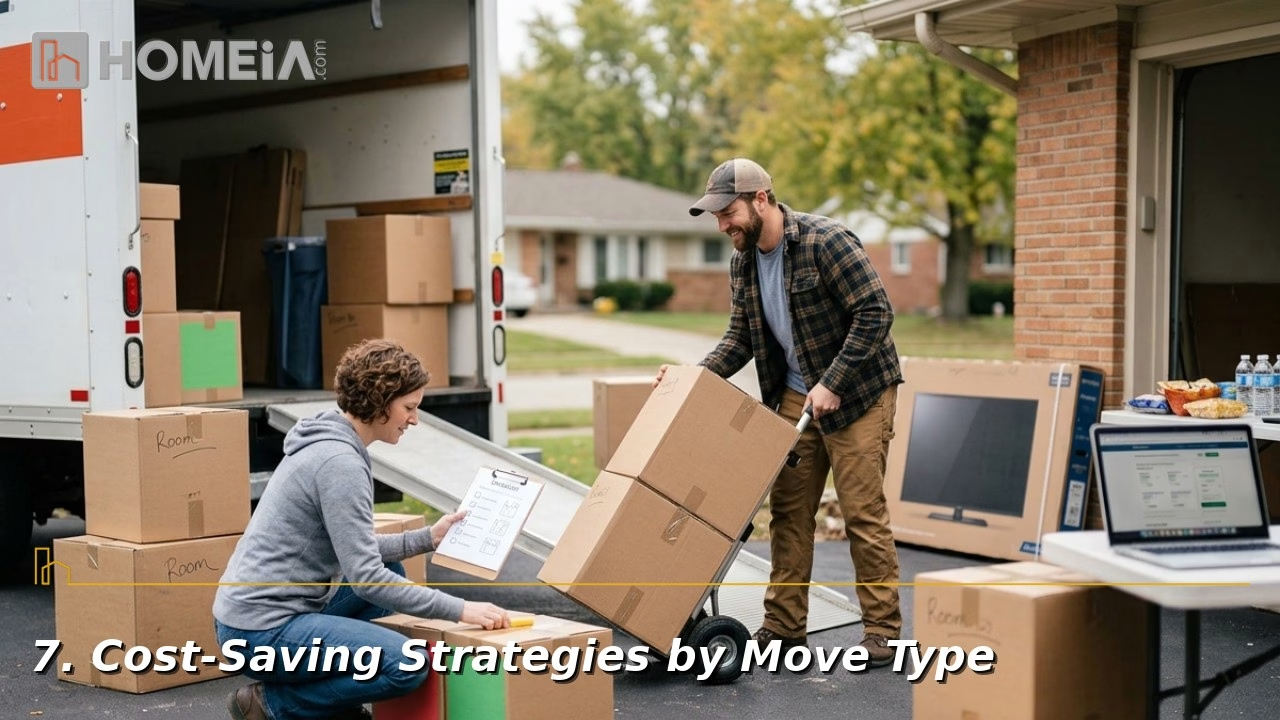
Strategic planning can significantly lower the moving service cost by home size and distance regardless of move type.
A. Local Moves: Reducing the Hourly Bill
- Declutter aggressively: Fewer items translate directly to fewer billable hours on the clock.
- DIY disassembly: Take apart IKEA or flat-pack furniture the day before the crew arrives to save 45 to 60 minutes of labor.
- Stage boxes: Keep all packed and labeled boxes in a central location near the door, like a garage or main living area.
- Time the move: Select a mid-week, mid-month date to avoid end-of-month demand spikes when labor rates are highest.
B. Long-Distance Moves: Reducing Weight and Mileage Costs
- Request a re-weigh: Consumers are entitled to a re-weigh if the shipment appears lighter than the estimate upon delivery.
- Separate heavy items: Books and heavy media can be shipped via USPS Media Mail for significantly less than weight-based moving rates.
- Hybrid approach: Hire professional movers for heavy furniture but rent a trailer for smaller boxes and personal items.
- Consolidated loads: Ask about shared truckloads, which can cut costs by 20 to 35 percent for households with flexible delivery dates.
Conclusion
Calculating the moving service cost by home size and distance is the first step toward a successful relocation. By utilizing current market benchmarks, consumers can approach the quoting process with the data needed to avoid unexpected fees.
The most accurate way to secure a final number is through a comprehensive virtual or in-home survey. Professional moving companies provide these assessments at no cost to ensure a binding estimate respecting the homeowner’s budget. Planning early and understanding the billing model is the best defense against moving day stress.
Recommended for you




FAQs About Moving Service Cost by Home Size and Distance
1. Is it cheaper to move a 2-bedroom or 3-bedroom home yourself vs. hiring movers?
While DIY appears less on paper, the true cost of truck rental, fuel, and equipment combined with 20 to 30 hours of physical labor often makes professional moving a better value for homes larger than two bedrooms. The risk of injury or property damage in a large DIY move frequently outweighs the initial savings.
2. How much does it cost to move across the country with a 3-bedroom home?
A 2,000-mile cross-country move for a 3-bedroom home ranges from $7,000 to $15,000 depending on the final shipment weight and additional services like packing. Heavily furnished homes can exceed the higher range.
3. Do moving costs vary by state or city?
Yes. High-cost metropolitan areas like NYC or Chicago have expensive labor rates and stricter parking fees. Moves in the Midwest or South generally benefit from lower overhead costs and more favorable regional pricing.
4. How are long-distance moving costs calculated?
These are based on a weight plus mileage formula. Movers weigh the truck empty and then weigh it again after loading to determine the precise weight of the goods in pounds.
5. What is the cheapest way to travel long distances?
The most affordable options include container/pod services, consolidated truckloads, or a hybrid DIY approach where a professional handles only the heavy lifting or the driving.
6. What is the “Box Test” for decluttering before a move?
The box test involves packing questionable items and sealing the box. If it remains unopened for a set period after the move, it signals that those items are non-essential and could be donated before moving to save on labor hours and weight costs.
7. Can clothes stay in dresser drawers during a local move?
For standard dressers, soft items like clothing can usually remain inside. However, for oversized triple dressers or delicate armoires, it is recommended to empty contents to prevent structural strain during the carry.
8. What is the 110 percent rule for moving estimates?
For interstate moves with non-binding estimates, federal regulations under 49 CFR Part 375 prohibit movers from demanding more than 110 percent of the original quoted charges at the time of delivery. Any balance above that threshold must be billed at least 30 days after delivery. Note that intrastate moves are governed by individual state law. Consumers should verify local protections for moves that stay within state lines.
9. Do movers transport houseplants across state lines?
Generally, professional movers transport plants only if the distance is below 150 miles and the trip is under 8 hours, as moving trucks are not climate-controlled. For interstate moves, homeowners must also navigate strict agricultural laws designed to prevent the spread of pests and invasive species.
10. How are high-wattage lithium batteries handled this year?
Most professional movers prohibit high-wattage lithium batteries (such as those found in e-bikes or power stations) due to the risk of thermal runaway and fire in a non-climate-controlled trailer. These items are best transported in a personal vehicle or shipped separately via specialized carriers.
Share