






Cost of Living in Florida vs. Virginia
- Local Editor:Local Editor: The HOMEiA Team


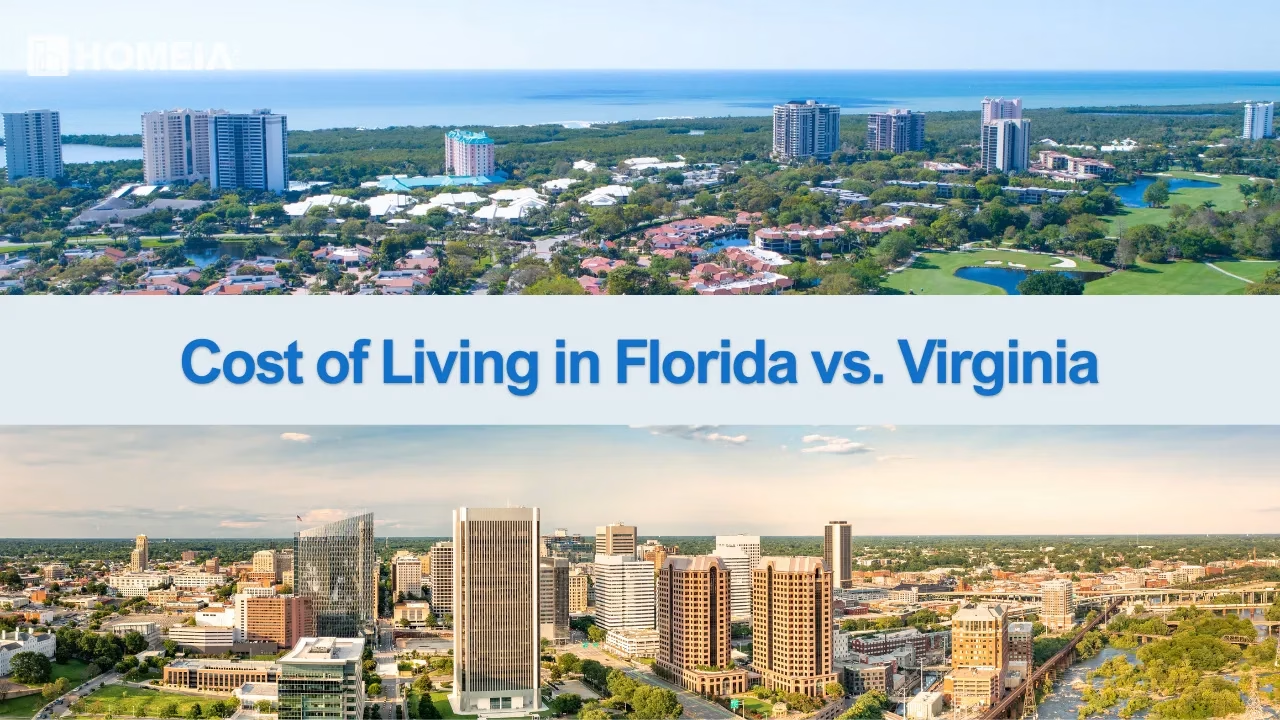
Cost of Living in Florida vs. Virginia: Florida and Virginia attract relocating households for different reasons. The former offers beaches, year-round warmth, and no state income tax, while its southern counterpart provides proximity to the nation’s capital, a diversified economy, and strong public schools.
Both have become more expensive in recent years, but their cost structures diverge meaningfully. Florida’s insurance premiums have surged, while Virginia’s income tax and high Northern Virginia home prices create a different set of financial pressures.
This 2026 update draws on MIT Living Wage, Tax Foundation, Zillow, Census, and KFF data to help determine which state fits a given budget and lifestyle.
Key Takeaways
- Florida’s cost of living index runs roughly 100.7 to 103, modestly above the national average, while Virginia’s runs roughly 101 to 104, a close overall match, though the composition of costs differs sharply.
- Florida homeowners face some of the nation’s highest insurance premiums, averaging roughly 3,200 to 5,500 dollars annually statewide (with coastal counties often exceeding 8,000 to 10,000 dollars), versus Virginia’s roughly 1,700 to 2,300 dollars, a gap that can exceed 2,000 dollars per year for many homeowners.
- Florida home prices range from roughly 375,000 to 400,000 dollars statewide, while Virginia’s median runs roughly 385,000 to 405,000 dollars, a modest and narrowing difference that varies widely by metro.
- The MIT Living Wage (February 2026) places the single adult income needed at roughly 50,100 dollars in Florida versus roughly 45,000 to 52,400 dollars in Virginia depending on location, a gap that narrows or reverses significantly by region.
- Florida has no state income tax, while Virginia taxes income at graduated rates from 2.00 percent to 5.75 percent. Virginia does not tax Social Security benefits but taxes pensions and retirement distributions, with a deduction of up to 12,000 dollars for seniors.
- Florida’s homeowners insurance costs are driven by hurricane, flood, and storm exposure; Virginia’s lower premiums reflect milder weather risk, though coastal Virginia faces some storm exposure.
- Migration to Florida has slowed sharply. Domestic migration lowered to roughly 22,500 in 2025 from over 310,000 at the 2022 peak, though international migration of about 178,700 kept total net migration near 201,000. Virginia’s migration has stayed comparatively flat, driven mostly by international arrivals.

Related article
8 Best Places to Live in Florida for Young Professionals
Florida offers young professionals a compelling mix of career opportunities, warm weather, and no state income tax. Growing industries such as healthcare, technology, finance, and professional services support strong employment prospects across the state. This 2026 guide highlights eight of the best places for young professionals to build careers and enjoy a high quality of life…
At a Glance Comparison
| Category | Florida | Virginia |
| Population (2025 Est.) | ~23.5 million | ~8.9 million |
| Median Household Income | ~$63,000–$74,000 | ~$80,600–$93,000 |
| Median Home Price (2026) | ~$375,000–$400,000 | ~$385,000–$405,000 |
| Average Rent (1-BR statewide) | ~$1,350–$1,500/mo | ~$1,400–$1,600/mo |
| Cost of Living Index | ~100.7–103 | ~101–104 |
| State Income Tax | None | 2%–5.75% graduated |
| Effective Property Tax Rate | ~0.78% | ~0.74%–0.78% |
| Average Homeowners Insurance | ~$3,200–$5,500/yr (coastal much higher) | ~$1,700–$2,300/yr |
| Living Wage (Single Adult, annual) | ~$50,100 | ~$45,000–$52,400 |
| State Minimum Wage | $14.00/hr (rising to $15.00 on 9/30/26) | $12.77/hr |
Note: Income and home price ranges vary by source (Census ACS vs. private aggregators); ranges reflect that spread rather than measurement error.
1. Living Wage Comparison
The MIT Living Wage Calculator’s February 2026 update found a single Florida adult needs roughly 24.09 dollars per hour (about 50,100 dollars annually) to cover basic expenses. In Virginia, the requirement varies by region. A single adult in the Petersburg area needs about 21.64 dollars per hour (45,000 dollars annually), while in Richmond, the figure climbs to 25.21 dollars per hour (52,400 dollars).
This difference increases for families. A single parent with one child in Florida needs roughly 42.73 dollars per hour, while the same household in the Petersburg, Virginia area needs about 33.72 dollars per hour. Housing is the primary driver of Florida’s higher threshold, though childcare contributes meaningfully. For two working adults with two children, Florida needs 28.51 dollars per hour per adult, while Virginia’s requirement runs closer to 22.65 dollars per hour in lower cost regions.
Florida’s minimum wage stands at 14 dollars per hour through September 29, 2026, then rises to 15 dollars on September 30, 2026 under a voter-approved constitutional schedule. Virginia’s minimum wage is 12.77 dollars per hour as of January 2026, with a further increase to 13.75 dollars scheduled for January 2027. In neither state does the minimum wage meet the living wage threshold for most household types.


Related article
7 Most Affordable Places to Live in Virginia
Virginia holds a prominent place in our nation as one of the original 13 Colonies and the birthplace of eight U.S. presidents. The state offers diverse natural beauty, from the Blue Ridge Mountains and Shenandoah National Park to the beaches of the Atlantic coast and the Chesapeake Bay.
2. Housing Costs
A. Home Prices
Florida’s statewide median home value runs approximately 375,000 to 400,000 dollars as of mid 2026, depending on source, with Zillow’s typical value near 378,000 dollars. Miami Dade County commands a premium near 500,000 dollars or more, while Jacksonville offers affordable options in the low 300,000s. The Florida market has cooled, with statewide values down roughly 3 percent over the past year.
Virginia’s statewide median lands between roughly 385,000 and 405,000 dollars. Northern Virginia near Washington, D.C. increases prices, with Arlington and Fairfax counties often exceeding 700,000 to 850,000 dollars, while Richmond and Hampton Roads offer more affordable options near 340,000 to 375,000 dollars. Virginia’s market has remained relatively stable, with statewide values up modestly over the past year.
B. Renting
Rents in both states have stabilized as new supply comes online. Florida one bedroom units average roughly 1,350 to 1,500 dollars per month, while Virginia one bedroom rents run closer to 1,400 to 1,600 dollars, with Northern Virginia commanding the highest prices. Each provides relatively favorable conditions for renters compared to pandemic era peaks, though Florida’s rental market remains somewhat tighter in coastal metros.
C. Homeowners Insurance
Insurance is where Florida’s cost disadvantage is most consequential. Florida homeowners insurance averages roughly 3,200 to 5,500 dollars annually statewide by most 2026 estimates, the highest in the nation, driven by hurricanes, flood exposure, fraud-related litigation, and rising rebuilding costs. High-risk coastal counties of Miami-Dade and Monroe see premiums exceeding 8,000 to 15,000 dollars annually, though tort reform has begun stabilizing rates in some inland areas.
Virginia insurance averages roughly 1,700 to 2,300 dollars annually, with lower premiums reflecting milder weather risk. The resulting gap, often 1,500 dollars or more per year and considerably wider for coastal Florida properties, means their true housing cost runs well above list price alone.
Florida’s effective property tax rate averages about 0.78 percent, near the middle nationally. On a 400,000 dollar Florida home, annual taxes run roughly 3,120 dollars. Virginia’s effective rate averages about 0.74 to 0.78 percent, though actual rates vary significantly by locality, with Northern Virginia jurisdictions often charging more. For example, on a 400,000 dollar home, annual taxes run in a similar range to Florida’s, though Virginia homeowners avoid Florida’s steep insurance premium penalty.

Related article
7 Best Places to Live in Florida
Florida continues to attract a record number of newcomers with its diverse metropolitan markets offering something for everyone. From Naples’ luxurious Gulf Coast lifestyle to Jacksonville’s urban-suburban blend, from the military enclaves of Pensacola to the tourism destinations in Orlando, each locale provides unique advantages…
3. Economy and Taxes
A. Economic Landscape
Florida’s economy is driven by tourism, trade, real estate development, and a growing tech sector, with unemployment running near 4.8 percent in mid 2026. Old Dominion’s economy spans federal government, defense contracting, technology, and professional services, with unemployment near 3.8 percent, below Florida’s rate. Virginia’s growth has slowed considerably as federal spending patterns shift, while Florida’s economy remains more consumer and tourism driven.
B. Tax Comparison
| Tax Category | Florida | Virginia |
| State Income Tax | None | 2.00%–5.75% graduated |
| Sales Tax (state + avg. local) | 6.00% + local surtaxes (avg. ~7.02%) | 5.30% (includes mandatory 1% local add-on, avg. ~5.77%) |
| Effective Property Tax Rate | ~0.78% | ~0.74%–0.78% |
| Estate/Inheritance Tax | None | None |
For a household earning 100,000 dollars, Florida’s lack of income tax saves roughly 3,000 to 5,000 dollars annually compared to Virginia’s graduated tax. At 150,000 dollars, savings grow to roughly 5,000 to 7,500 dollars. With 200,000 dollars, the difference reaches roughly 7,000 to 10,000 dollars. Florida’s higher insurance premiums offset a meaningful share of this advantage for homeowners, while renters capture more of the income tax benefit outright.
Recommended for you




4. Safety
Using 2024 FBI data, Florida’s violent crime rate runs roughly 146 to 267 per 100,000 residents depending on the measure. Virginia’s violent crime rate runs roughly 190 per 100,000 residents, placing it moderately below Florida’s rate on most measures. Virginia experienced a meaningful decrease in violent crime from 2023 to 2024, while Florida’s rates have stayed relatively stable.
Both contain some of the nation’s safest suburbs, Naples and Weston in Florida, Vienna and McLean in Virginia, alongside higher crime urban cores. Prospective movers should research specific cities and ZIP codes rather than relying on statewide averages.
5. Climate and Geography
The Sunshine State spans subtropical and tropical climates, with warm winters, scorching summers, and abundant rainfall. The state faces significant natural disaster risk from hurricanes along both coasts, flooding, tornadoes, and extreme heat. These patterns directly drive Florida’s high homeowners insurance premiums.
Virginia covers coastal plains, the Chesapeake Bay region, Piedmont, and the Blue Ridge Mountains. Winters are cooler than Florida’s, with occasional snow inland. Climate risks include less frequent coastal hurricanes, flooding, and occasional tornadoes. Virginia’s milder storm exposure is the core reason for its generous homeowners insurance.

Related article
20 Cool Things to do in Fredericksburg, Virginia (updated)
Fredericksburg, Virginia blends American history, outdoor recreation, and small-city charm along the Rappahannock River. This guide highlights 20 things to see and do, from George Washington sites and Civil War battlefields to craft breweries, kayaking, museums, and family-friendly attractions.
6. Education
Florida’s K-12 system ranks roughly 13th nationally in recent WalletHub assessments, though other reports place it lower for public school funding commitment. Florida’s graduation rate and digital learning infrastructure receive positive marks, while funding and equity remain concerns. Virginia’s K-12 system ranks among the nation’s best, sixth overall in recent WalletHub rankings, with strong performance in quality and safety. Its graduation rate runs roughly 83 to 84 percent.
Higher education tuition tells a different story. Florida’s public university in state tuition runs roughly 6,000 to 7,000 dollars annually, among the lowest in the nation. Virginia’s public university in-state tuition ranges from roughly 9,860 to 16,492 dollars, with UVA and William and Mary demanding premiums. Florida residents generally pay far less for a four year degree, though Virginia’s K-12 system outperforms Florida’s.
7. Childcare
Childcare is a significant, often underappreciated cost gap between these states.
| Age Group | Florida Average | Virginia Average |
| Infant (center) | ~$14,200/yr | ~$16,800/yr |
| Toddler (center) | ~$12,300/yr | ~$13,500–$16,800/yr |
| Preschool (center) | ~$10,800/yr (estimated) | ~$11,500–$14,000/yr |
For one infant in full time center care, Virginia families may pay 2,000 to 3,000 dollars more per year than Florida families; with two young children, the gap doubles. Both offer subsidized childcare for income eligible families, though waitlists are common in major metros and most middle income families pay full market rates.

Related article
5 Best Places to Live in Fort Lauderdale, Florida
This lovely region on Florida’s southeastern coast is gaining acclaim as a premier destination for families looking to plant roots in a locale that promises a high quality of life, economic prosperity, and a warm, inclusive community…
8. Healthcare
Florida has not expanded Medicaid, leaving a coverage gap for low income childless adults. The state’s uninsured rate runs in the low double digits, among the highest in the nation and well above the national average. Virginia expanded Medicaid in 2019, covering adults with income up to 138 percent of the federal poverty level, and its uninsured rate sits closer to the national average, meaningfully below Florida’s.
For Medicare covered retirees, both offer reasonable access to care in urban and suburban areas, though Florida’s healthcare infrastructure concentrates in its major metros while Virginia’s is more distributed, particularly around the D.C. suburbs.
9. Additional Cost Considerations
- Utilities: Florida electricity averages 14 to 16 cents per kilowatt hour, with summer cooling driving higher bills. Virginia electricity sits between 15 to 17 cents per kilowatt hour. Monthly electric bills run are 130 to 150 dollars in Florida for typical usage, versus roughly 130 to 160 dollars in Virginia depending on the utility.
- Gas Prices: Florida gas runs higher than Virginia, about 3.80 to 4.35 dollars per gallon versus roughly 3.70 to 3.90 dollars in Virginia as of mid 2026. Over 15,000 annual miles, that increases from 100 to 300 dollars per year.
- Groceries: Florida grocery costs run moderately above the national average, while Virginia’s grocery index sits near or slightly below average. A family of four spends 800 to 1,200 dollars monthly in Florida versus 700 to 1,100 dollars in Virginia, a gap near 1,000 to 2,000 dollars annually.
- Transportation: Florida vehicle registration and insurance costs vary by county and generally exceed Virginia’s. Florida’s extensive toll road network around Miami, Orlando, and Tampa adds commuting costs that Virginia’s more limited toll system does not match. Virginia’s auto insurance rates run generally lower than Florida’s.

Related article
Pros and Cons of Living in Virginia
In this article, we will discuss some of the advantages and drawbacks of life in Virginia. We will also explore some of the best cities in Virginia for different types of individuals and families…
Conclusion
Neither state is a clear universal winner. Florida offers no income tax, lower public university tuition, and warmer weather, but its homeowners insurance premiums, now among the steepest in the nation, and elevated coastal home prices erode much of that tax advantage, especially for owners in storm-exposed regions. Virginia provides standout education opportunities across all levels, far lower insurance costs, and a more diversified economy, but its income tax and high Northern Virginia home prices create a different set of financial pressures.
Renters find better success in Florida, capturing the income tax benefit without the insurance penalty. Retirees face a real tradeoff. Florida’s tax free retirement income is attractive, but insurance costs can overwhelm the savings for homeowners. Families prioritizing schools often lean toward Virginia, while those seeking lower day to day costs may prefer Florida’s no income tax environment. The right choice depends heavily on homeownership status, family composition, and sensitivity to insurance and tax volatility versus purchase price.
Recommended for you




FAQs About the Cost of Living in Florida vs. Virginia
1. Is Florida really that much more expensive than Virginia in 2026?
Not dramatically overall. Florida’s cost of living index runs roughly 100.7 to 103 versus Virginia’s roughly 101 to 104, a modest and roughly comparable gap. The major reversal is homeowners insurance, as Florida averages 3,200 to 5,500 dollars per year (far more on the coast), while Virginia averages 1,700 to 2,300 dollars. The total cost comparison narrows for renters and widens sharply for owners in storm-exposed Florida regions.
2. How much salary do you need in Virginia to match a Florida lifestyle?
Because the two states’ overall cost of living indexes are close, most households need roughly similar gross income in either state. The precise figure depends on housing choices, since Florida’s insurance premiums and coastal home prices offset its income tax advantage, while Virginia’s income tax partially offsets its much lower insurance costs.
3. Which state is better for retirees in 2026?
Florida generally offers a better financial case for retirees, since no state income tax means pensions, IRA withdrawals, and Social Security go untaxed. However, Florida’s insurance premiums, often 3,200 to 5,500 dollars a year and much higher on the coast, erode some of that advantage. Virginia taxes pensions and retirement distributions, with a 12,000 dollar deduction for seniors, but offers far cheaper insurance and stronger healthcare access.
4. Are people still moving to Florida and Virginia in 2026?
Migration has slowed considerably. Florida’s domestic migration collapsed to about 22,500 in 2025, down from over 310,000 at the 2022 peak, though international migration of roughly 178,700 kept the state’s total net migration around 201,000. Virginia’s migration has stayed comparatively flat, with international arrivals driving most of its growth.
5. Which state is better for remote workers in 2026?
Florida offers a significant tax case for most remote workers, since no income tax lets them keep more of their location-independent earnings, and lower rents in many metros stretch budgets further. Virginia competes for remote workers by prioritizing proximity to the East Coast, stronger public schools, and milder summers, along with far lower insurance costs than Florida.
Share