






7 Most Affordable Places to Live in Kansas
- Local Editor:Local Editor: The HOMEiA Team


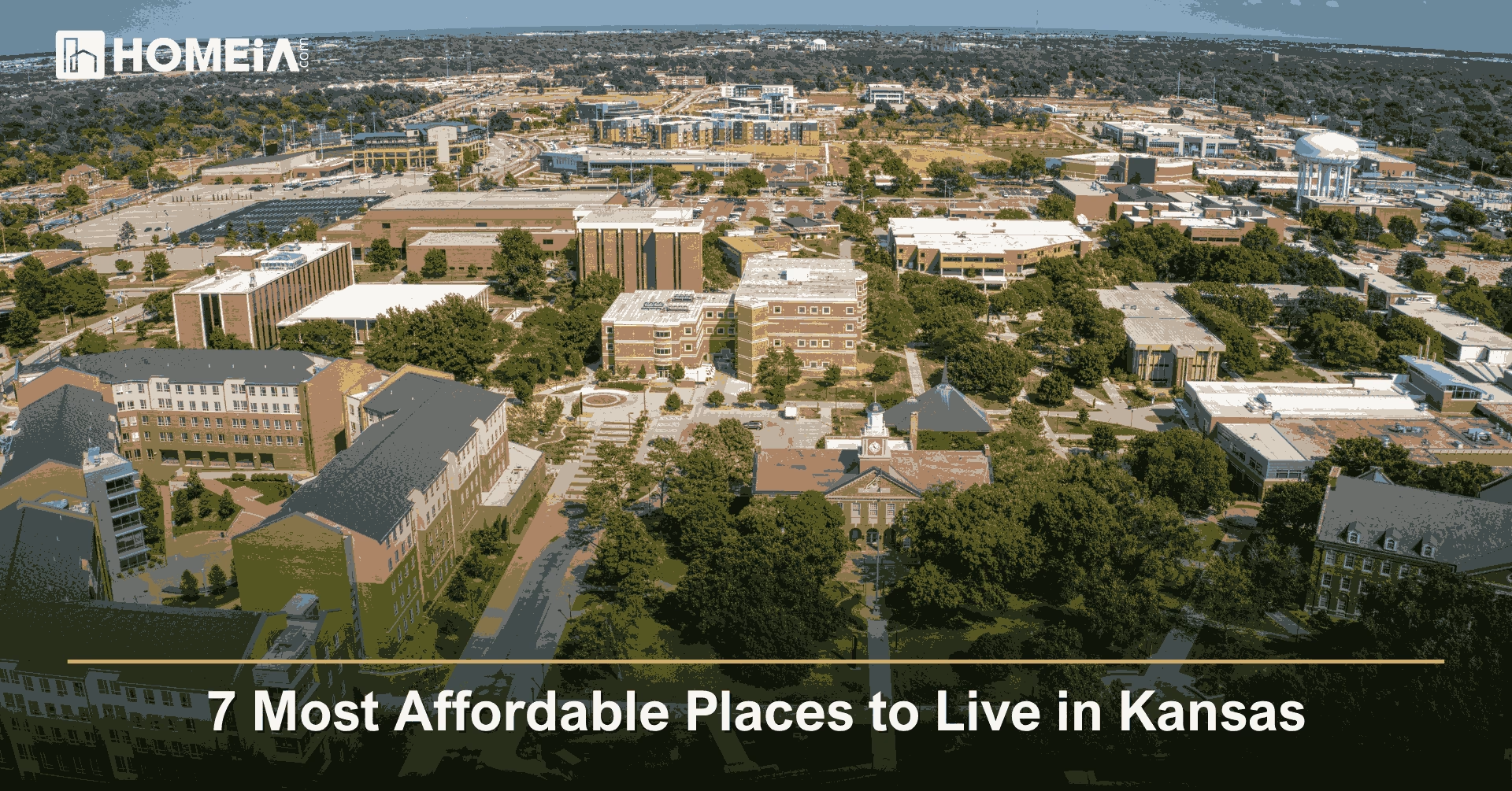
Most Affordable Places to Live in Kansas: A Data-Driven Relocation Guide for Families, First-Time Buyers, Retirees, and Remote Workers. Housing costs have climbed dramatically, and for many, the American dream of homeownership has turned into an unachievable nightmare.. The national median home price reached roughly $415,000 in 2025, and in coastal and Sun Belt metros even starter homes push past $500,000. For families stretched by rising rents and retirees on fixed incomes, the math no longer works.
Kansas plays a different tune. The Sunflower State carries a cost-of-living index of 88.4, the fifth most affordable in the nation as of 2025, according to the Missouri Economic Research and Information Center. Additionally, its average home value is roughly $246,000. But the real story isn’t at the state level. This is in the communities across the central plains of their college towns, agricultural hubs, and manufacturing cities that have quietly built stable middle-class economies.
What separates a truly affordable community from a merely cheap one is livability. Somewhere with $60,000 homes but no nearby healthcare, weak broadband, and few jobs isn’t a value, it’s an isolated hardship. The communities below were judged on housing cost alongside employment, healthcare, infrastructure, safety, and economic resilience.
Key Takeaways
- Kansas ranks among the five most affordable states in the country, with a composite cost-of-living index of 88.4 versus the national baseline of 100.
- Homeownership under $200,000 remains broadly accessible in several ranked communities, where median home values range from roughly $135,000 to $220,000.
- The strongest value communities pair low housing costs with economic anchors, universities, healthcare systems, manufacturing, or agriculture, creating stable employment.
- Healthcare access varies significantly across the state, communities with regional medical centers score considerably higher on livability.
- Remote workers and retirees will find exceptional purchasing power in central and southeast Kansas, though rural broadband remains a concern despite ongoing state investment.
I. Methodology: How We Chose the Most Affordable Places
Rankings came from a weighted model across five categories designed to locate areas where cost of living, quality of life, and economic opportunity align to deliver long-term value, not merely cheap homes.
- Housing & Affordability, 30%: Evaluated median home prices (Zillow, Redfin, Realtor.com through 2025–2026), 2-bedroom rents, price-to-income ratios, property taxes, and inventory. Communities well below the state average of $246,000 scored higher.
- Cost of Living, 25%: Evaluated composite cost-of-living indices for utilities, groceries, transportation, and healthcare relative to the national average of 100. Kansas scores favorably on housing and groceries statewide.
- Access & Infrastructure, 20%: Evaluated regional healthcare, retail, broadband, highway access, and municipal services. The state keeps expanding connectivity through its $85 million, decade-long Broadband Acceleration Grant program, which has invested more than $41.5 million to date.
- Community & Safety, 15%: Evaluated crime data, community engagement, parks and recreation, school quality, and family-friendliness. Communities with below-average crime and robust institutions scored higher.
- Economic Resilience & Opportunity, 10%: Evaluated employment diversity, anchor institutions, industry concentration risk, and growth indicators including new development and business investment.
Final HOMEiA Scores reflect the weighted sum on a 100-point scale; scores above 75 indicate strong value. Places with extreme economic fragility or very limited services were excluded.
Quick Comparison: 7 Most Affordable Places to Live in Kansas
| City | HOMEiA Score | Cost of Living vs. U.S. Avg. | Avg. Rent (2-Bed) | Home Price-to-Income Ratio | Income-to-Rent Ratio | Safety Rating |
| Garden City | 74/100 | ~13% below | ~$1,100 | ~3.5 | 4.9x | 65/100 |
| Emporia | 76/100 | ~15% below | ~$900 | ~3.2 | 5.0x | 67/100 |
| Pittsburg | 77/100 | ~18% below | ~$795 | ~2.8 | 5.1x | 69/100 |
| McPherson | 78/100 | ~10% below | ~$890 | ~2.8 | 6.4x | 76/100 |
| Newton | 79/100 | ~13% below | ~$900 | ~3.0 | 5.2x | 75/100 |
| Hutchinson | 80/100 | ~15% below | ~$1,000 | ~2.7 | 4.7x | 68/100 |
| Salina | 84/100 | ~17% below | ~$1,100 | ~3.1 | 4.3x | 72/100 |
Note: HOMEiA Scores are composite rankings based on the weighted methodology above. Income-to-Rent Ratio is median household income divided by monthly rent (higher = more favorable). Safety Rating is relative to Kansas cities.

Related article
Our Methodologies to create HOMEiA Score Ratings for Each Group of Content
HOMEiA uses a consistent, data-driven methodology to evaluate U.S. states for livability, affordability, and long-term value. Our analysis centers on key factors such as Housing and Affordability, Cost of Daily Living, Access and Infrastructure, Community Strength, Safety and Quality of Life, Economic Resilience and Job Market…
II. Detailed Community Analysis
1. Garden City: Western Kansas’ Economic Engine
HOMEiA Score: 74/100
- Cost of Living: ~13% below U.S. average
- Monthly Rent: ~$1,100
- Home price to income ratio: ~3.5
- Income to rent ratio: 4.9x
- Safety rating: 65/100
A. Cost of Living & Housing: Garden City’s picture has shifted as median sale prices now reach about $245,000–$272,000, higher than several cities here. However, western Kansas’s processing wages support that price point and overall living costs stay below national norms. Rents have surged about 42% year over year through mid-2025.
B. Economy & Job Market: Garden City’s economy is built on beef. Tyson Fresh Meats is the largest employer at about 3,600 workers, and Empirical Foods opened a 280,000-square-foot facility in December 2025, adding over 250 jobs. Cons include heavy concentration in one industry, exposing it to commodity and labor swings.
C. Access & Infrastructure: GC is the most isolated city here, about 200 miles from Wichita, with a regional airport offering connecting service via Denver. St. Catherine Hospital provides acute, emergency, and specialty care locally, which matters given the distance.
D. Quality of Life & Culture: There exists a genuinely multicultural character shaped by decades of immigration tied to processing, with festivals reflecting Latino, Southeast Asian, and Somali communities. Lee Richardson Zoo and the Arkansas River anchor recreation. The independence and severe plains climate shape daily life.
Bottom line: Garden City suits someone with secure local employment, especially in agriculture or processing. It is unfavorable for remote workers needing reliable connectivity or anyone without an established job connection.
2. Emporia: The Flint Hills Gateway
HOMEiA Score: 76/100
- Cost of Living: ~15% below U.S. average
- Monthly Rent: ~$900
- Home price to income ratio: ~3.2
- Income to rent ratio: 5.0x
- Safety rating: 67/100
A. Cost of Living & Housing: Emporia’s cost-of-living index of about 85 reflects genuinely affordable basics, with housing roughly 41% below the national average. An average home value is about $169,000, with 2-bedroom rent around $900–$1,073. Utilities run about 33% below national norms.
B. Economy & Job Market: Emporia rests on three pillars: Emporia State University, Newman Regional Health, and a manufacturing base including Michelin, Hill’s Pet Nutrition, Cargill, and Simmons Pet Food, a food-and-staples mix that is largely recession-resistant. A 2025 FORGE grant is boosting small-business growth.
C. Access & Infrastructure: It sits at the intersection of I-35 and the Kansas Turnpike, with Wichita about 100 miles southwest and Kansas City about 110 northeast. Newman Regional Health provides acute and specialty care.
D. Quality of Life & Culture: Situated at the doorstep of the Flint Hills, Tallgrass Prairie National Preserve is nearly 30 miles west. Their downtown has seen a quiet ESU-driven revival. Crime has historically warranted neighborhood-level scrutiny.
Bottom line: Emporia’s manufacturing diversity, university anchor, and interstate location make it more resilient than its home prices suggest, and the Flint Hills setting is a quality-of-life asset no cost index captures.


Related article
15 Best Places to Live in Oklahoma
Are you planning to relocate to Oklahoma? Whether you are drawn to the cosmopolitan vibes of the cities or the tranquility of rural life, we curated a list of 15 of the best communities to live in Oklahoma for those considering making the Sooner State their new home…
3. Pittsburg: Southeast Kansas’ College-Town Value
HOMEiA Score: 77/100
- Cost of Living: ~18% below U.S. average
- Monthly Rent: ~$795
- Home price to income ratio: ~2.8
- Income to rent ratio: 5.1x
- Safety rating: 69/100
A. Cost of Living & Housing: Anchored by Pittsburg State University, the section pairs some of the lowest cost metrics in Kansas with traditional college town amenities, about 18% below the national average. Average home values are roughly $134,500, with rent around $792–$821. Housing stock skews older, though new development from $210,000 is emerging.
B. Economy & Job Market: Academia drives Crawford County’s economy, and its Block22 downtown redevelopment has generated 516 jobs and $83.2 million in economic impact. Beyond the university there is manufacturing, healthcare, and retail, though job diversity is limited.
C. Access & Infrastructure: This area sits in the far southeast corner, about 120 miles south of Kansas City via four-lane U.S. 69. Via Christi Hospital provides acute care, with tertiary care in Joplin, Missouri (about 30 miles) or Wichita.
D. Quality of Life & Culture: Quintessential college town vibes ooze from the area including a walkable university district, lively downtown, and ongoing Block22 revitalization. USD 250 offers dual-enrollment through PSU.
Bottom line: Pittsburg delivers the lowest absolute housing costs of any services-complete city here. The isolation and education-centric job market are real tradeoffs, but for remote workers, retirees, or PSU-tied families, its value is exceptional.
4. McPherson: Central Kansas’ Underrated Gem
HOMEiA Score: 78/100
- Cost of Living: ~10% below U.S. average
- Monthly Rent: ~$890
- Home price to income ratio: ~2.8
- Income to rent ratio: 6.4x
- Safety rating: 76/100
A. Cost of Living & Housing: McPherson delivers one of the most favorable income-to-cost ratios in Kansas. Median income is roughly $68,000–$78,000, higher than many peers, while median home values run about $182,000–$217,000, keeping the price-to-income ratio below 3.0. Owner-occupancy is high at 75.8%.
B. Economy & Job Market: Here punches above its weight for a city of about 14,000, with an industrial base spanning Equus Computer Systems, MCII bus manufacturing, and petroleum and chemical processing. McPherson College, known nationally for automotive restoration, anchors the community.
C. Access & Infrastructure: McPherson Hospital handles community care, with specialty care via Salina Regional (about 45 miles north) or Wichita. U.S. 56 and U.S. 135 provides regional access as commutes run under 10 minutes.
D. Quality of Life & Culture: This part of the state is quiet and family-oriented, with Lawson Park and Inman Lake. Crime is among the lowest here and USD 418 is well-regarded. The nightlife and dining variety are not as plentiful.
Bottom line: Higher-than-average incomes, below-average housing costs, and an admirable safety profile give McPherson one of the best household financial positions here, an underrated community whose modest profile maintains economical prices.
Recommended for you




5. Newton: Wichita’s Quiet Northern Neighbor
HOMEiA Score: 79/100
- Cost of Living: ~13% below U.S. average
- Monthly Rent: ~$900
- Home price to income ratio: ~3.0
- Income to rent ratio: 5.2x
- Safety rating: 75/100
A. Cost of Living & Housing: Newton, the Harvey County seat, pairs affordability with a prime location 10 miles north of Wichita on I-135. The average home value is roughly $171,000–$173,500, up 3%–4% year over year, with gross rent around $897. The county’s cost-of-living index is about 87.
B. Economy & Job Market: Harvey County’s economy spans manufacturing, healthcare, construction, and education, with unemployment around 2.9%. The Kansas Logistics Park draws distribution investment, and with 20–30 minute commutes, Wichita’s economy contributes to their labor market.
C. Access & Infrastructure: Newton’s I-135 location provides connectivity without metro congestion alongside being one of the few cities in-state with Amtrak service. Newton Medical Center anchors local healthcare, with the Air Capital of the World 20 minutes south.
D. Quality of Life & Culture: Their community is rooted in its Mennonite heritage, visible in its historic downtown and the Kauffman Museum at Bethel College. USD 373 is well-regarded. For retirees, affordable housing plus proximity to Wichita’s medical resources is favorable; the main limit is a modest job market.
Bottom line: Newton may be the best-positioned city for remote workers and retirees seeking small-town living with immediate metro access, a real force multiplier without a matching jump in housing cost.
6. Hutchinson: Reno County’s Affordable Anchor
HOMEiA Score: 80/100
- Cost of Living: ~15% below U.S. average
- Monthly Rent: ~$1,000
- Home price to income ratio: ~2.7
- Income to rent ratio: 4.7x
- Safety rating: 68/100
A. Cost of Living & Housing: Hutchinson offers some of the most accessible home prices for its size, about $149,900 as of April 2026, up 6.7% year over year. With median income near $56,000, the price-to-income ratio sits well below 3.0, and 2-bedroom rentals run $800–$1,100.
B. Economy & Job Market: Reno County employs over 29,000 people, led by manufacturing. Notable employers include Superior Boiler, Hutchinson Regional Medical Center, and the Cosmosphere, which supports an estimated 2,200 jobs.
C. Access & Infrastructure: Hutchinson lies about 50 miles northwest of Wichita on U.S. 50. Hutchinson Regional Medical Center provides acute, emergency, and specialty care, with Wichita’s larger campus a 45–50 minute drive.
D. Quality of Life & Culture: Hutchinson’s signature asset is the Cosmosphere, a Smithsonian-affiliated space museum holding more than 13,000 artifacts, notably the Apollo 13 command module. Strataca, the underground salt museum, is another rare draw. The tradeoff is a crime rate, especially property crime, above the state average.
Bottom line: Hutchinson’s price-to-income ratio is among the best here and its cultural assets are exceptional. Crime is a real consideration, but for affordability and unique character, it overdelivers.

Related article
The Pros and Cons of Living in Colorado
When considering a move to the Rocky Mountain region, many people weigh the pros and cons of living in Colorado. From breathtaking natural beauty and abundant outdoor activities to a higher cost of living and unpredictable weather, the state offers a unique mix of advantages and challenges…
7. Salina: Central Kansas’ Most Complete City
HOMEiA Score: 84/100
- Cost of Living: ~17% below U.S. average
- Monthly Rent: ~$1,100
- Home price to income ratio: ~3.1
- Income to rent ratio: 4.3x
- Safety rating: 72/100
A. Cost of Living & Housing: The average home value as of April 2026 is nearly $175,900, up 4.0% year over year, with recent median sales near $195,000–$204,000. Cost of living runs roughly 17% below the national average, while 3-bedrooms stay attainable in the $160,000–$200,000 range.
B. Economy & Job Market: As the economic center of north-central Kansas, Salina draws on healthcare, manufacturing, aerospace, and distribution, with employers like Salina Regional Health Center, AdventHealth, and Great Plains Manufacturing. Employment diversity makes it recession-resistant.
C. Access & Infrastructure: Salina sits where I-70 meets I-135, with commercial flights from its airport. Salina Regional Health Center is a Level III trauma center and accredited stroke center. Broadband is reliable and retail comprehensive.
D. Quality of Life & Culture: The Smoky Hill River corridor offers trails and an annual festival. USD 305 schools are well-regarded and the full-service medical center draws retirees. The tradeoff is car-dependence with limited transit.
Bottom line: Salina earns the top spot because it delivers in every category, not merely housing: consistent job offerings, real healthcare, remarkable infrastructure, and authentic community.
III. A Relocation Checklist for Your Kansas Move
1. Budget Beyond Housing
Price or rent is only the beginning. Kansas property taxes vary by county, from below 1.0% to above 1.5%, and homeowner’s insurance runs higher than the national average due to severe-weather exposure. Summer cooling costs surprise newcomers, and a car is essentially mandatory outside a few downtowns.
2. Secure Employment Before Moving
If you aren’t remote, don’t relocate without a job offer or concrete lead. Some cities here, especially Pittsburg and Garden City, have employment markets concentrated in specific industries. Remote workers should confirm their employer supports the move while factoring in Kansas state income tax.
3. Visit During Different Seasons
Sunflower State weather is central to life here. Summers regularly top 100°, winters bring ice storms, tornadoes are a genuine spring reality, and western Kansas wind is relentless. Visit in February or March and again in July before deciding.
4. Verify Internet Availability
This cannot be overstated for remote workers. Kansas is expanding rural broadband through its $85 million Broadband Acceleration Grant program and private investment like Twin Valley’s $12.3 million in 2026 upgrades, but coverage gaps remain. Verify providers and speeds before committing.
5. Research Healthcare Access
For retirees this is the most consequential factor beyond housing. There lies tried-and-true regional centers in Salina, Wichita, and Kansas City, but rural communities can be 60–100 miles from the nearest specialist. If you have chronic conditions, confirm the right specialists practice nearby.
Conclusion: Your Affordable Kansas Future Awaits
Kansas has always been underestimated. The flyover narrative misses what residents know. Here, your dollar goes further, and the fundamentals of a stable life, homeownership, safe neighborhoods, reliable work, revered schools, are genuinely accessible to people of ordinary means.
Each community has their flaws. What matters most is fit. A remote-working couple may love Newton’s access to Wichita, a retiree couple may thrive in McPherson’s quiet, and a university-tied family might find Pittsburg or Emporia ideal. Affordability rewards relocation most when paired with purpose. Visit the places that speak to you, walk the neighborhoods, and drive your future commute.
Recommended for you




FAQs About the Most Affordable Places to Live in Kansas
1. Can you still buy a home under $200,000 in Kansas?
Yes, in several communities here. Pittsburg averages about $134,500, Hutchinson around $150,000, and Newton roughly $171,000–$173,500. Even in Salina, sub-$200,000 homes remain available with patience. A statewide average of $246,000 is well below national norms.
2. Which affordable Kansas city has the strongest job market?
Salina, with its mix of healthcare, aerospace, manufacturing, and distribution, has the most resilient base. Newton plugs into Wichita’s economy with a 20–30 minute commute, McPherson posts among the highest incomes for its size, and Garden City offers steady beef-processing work. Always verify current hiring before relocating.
3. Is western Kansas cheaper than eastern Kansas?
In raw home prices, often yes, but the picture is nuanced. Western Kansas has fewer retail options, meaning residents travel farther and pay more for goods, healthcare is costlier because specialists are distant, broadband is less reliable, and appreciation potential is lower. Eastern Kansas offers better value once access and equity are weighed.
4. Are these communities good for retirees?
Several are excellent. Newton and McPherson balance affordability, safety, and manageable healthcare access. Salina is best for retirees with significant medical needs given its Level III trauma center. Pittsburg and Emporia suit healthy, active retirees who value low costs, with distant healthcare to weigh. Garden City is generally not recommended without established local ties.
Several costs surprise newcomers. Homeowner’s insurance runs well above national averages due to severe weather. Property taxes, in higher-mill-levy counties, can add $2,000–$3,500 a year. Vehicle expenses are crucial, with two-car households the norm. Summer utility bills spike during 100-degree stretches, and the adjustment to tight-knit plains communities deserves honest self-assessment.
Share