






7 Most Affordable Places to Live in Vermont
- Local Editor:Local Editor: The HOMEiA Team


Most Affordable Places to Live in Vermont. This State has never been a cheap place to live. The statewide median sale price reached $438,400 in March 2026, up 9.1% year over year, against a structural housing shortfall of 24,000 to 36,000 units through 2029. Massachusetts carries a cost of living index of 135, with New York and Vermont behind at 127 and 114 respectively. Affordability still exists in this wooded state, but has become increasingly difficult. Deals are concentrated in central, southern, and far northern regions, where prices remain well below the Burlington-area premium. This article identifies seven of the most affordable places to live in Vermont and weighs the real tradeoffs.
Key Takeaways
- Vermont’s statewide median home price ($438,400 in early 2026) masks significant county-to-county variation with some communities offering median prices below $300,000.
- Vermont remains more affordable than Massachusetts (COL index 135) and New York (127), making it a realistic option for buyers relocating from higher-cost New England/Northeast markets.
- Heating costs, fuel oil, propane, and electric heat, are a non-negotiable part of the annual household budgLet and must be factored into any affordability analysis.
- Some of Vermont’s most affordable towns offer reliable job markets than others; housing price alone is an incomplete measure of livability.
- Local broadband availability, healthcare access, and road conditions (including Vermont’s fifth season, mud season) require specific verification before any relocation decision is final.
Related article
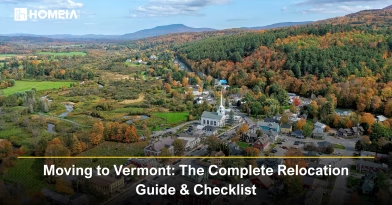
Moving to Vermont: The Complete Relocation Guide & Checklist
Vermont attracts newcomers seeking natural beauty, outdoor recreation, and a strong sense of community. From the slopes of the Green Mountains to the shores of Lake Champlain, the state offers a lifestyle centered on sustainability, local culture, and year-round adventure. With low unemployment, quality education, and close-knit towns, Vermont appeals to those prioritizing quality of life over urban pace…
I. Methodology: How We Chose the Most Affordable Places
Identifying genuinely affordable communities requires more than sorting by median home price. A town can have inexpensive housing and still impose a financial burden through high property taxes, weak employment, or utility costs that overwhelm a modest budget. The HOMEiA scoring model weights five categories to reflect the full cost-of-life picture.
- Housing & Affordability (30%): This category evaluates median home prices relative to area incomes, average 2-bedroom rental rates, and home-price-to-income ratios. Their statewide median household income was approximately $82,700 in 2024. Communities where median home prices fall at or below a 4:1 price-to-income ratio received higher scores.
- Cost of Living (25%): Cost of living indexing at 114 reflects above-average utility costs, healthcare, and services. Communities falling meaningfully below that statewide figure scored higher. Heating expenses, given their dependence on fuel oil (approximately $4.72 per gallon in early June 2026) and propane, are a key sub-variable.
- Access & Infrastructure (20%): This evaluates proximity to hospitals and emergency care, broadband availability, major shopping, and highway access. Vermont has more than 8,500 miles of dirt roads, and proximity to paved infrastructure affects both daily life and seasonal access.
- Community & Safety (15%): Here is one of the safer states in the country, with a statewide violent crime rate of 219 per 100,000, well below the national rate. Individual community crime rates, school quality, and overall community life factor into this category.
- Economic Resilience & Opportunity (10%): This evaluates the breadth and stability of local employment, major employer presence, and evidence of economic investment or decline. A community with a single dominant employer carries more risk than one with a diversified base.
Data Sources: Zillow Home Value Index (through April 2026), Redfin market data (through March 2026), Realtor.com market reports, U.S. Census Bureau American Community Survey (2024), Bureau of Labor Statistics, Vermont Department of Labor, Vermont Agency of Commerce and Community Development, Vermont Housing Finance Agency, and Vermont Public.

Related article
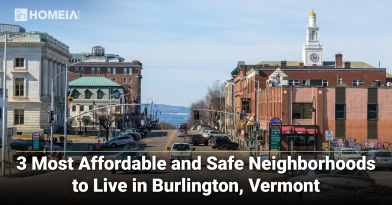
3 Most Affordable Places to Live in Burlington, Vermont
Burlington’s Old North End, South End, and Downtown offer a unique mix of culture, creativity, and affordability. From historic charm to urban convenience and housing programs, each neighborhood showcases the city’s progressive spirit, rural appeal, and commitment to accessible living—making Burlington a standout destination for those seeking vibrant community life…
II. 7 Vermont Communities: Quick Comparison Table
| City/Town | HOMEiA Score | Cost of Living vs. U.S. Avg. | Avg. Rent (2-BR) | Home Price-to-Income Ratio | Income-to-Rent Ratio | Safety Rating |
| Newport | 61/100 | ~12% below | ~$1,100 | 3.7x | 25.8 | 62/100 |
| Bennington | 65/100 | ~6% below | ~$1,250 | 3.5x | 27.9 | 64/100 |
| Springfield | 67/100 | ~8% below | ~$1,200 | 3.9x | 26.5 | 65/100 |
| Barre | 72/100 | ~4% below | ~$1,413 | 3.7x | 28.6 | 74/100 |
| St. Albans | 73/100 | ~5% below | ~$1,500 | 4.3x | 27.0 | 70/100 |
| Morrisville | 74/100 | ~5% below | ~$1,400 | 5.9x | 26.8 | 73/100 |
| Rutland | 76/100 | ~10% below | ~$1,550 | 4.1x | 25.5 | 68/100 |
HOMEiA scores are composite estimates based on available market data through early 2026. Home-price-to-income ratios use Zillow/Redfin median home values and county-level median household income from the 2024 ACS.
III. Detailed Community Analysis
1. Newport: The Northeast Kingdom’s Lake Town
HOMEiA Score: 61/100
- Cost of Living: ~12% below U.S. average
- Monthly Rent: ~$1,100
- Home price to income ratio: 3.7x
- Income to rent ratio: 25.8
- Safety rating: 62/100
A. Cost of Living & Housing: Newport sits at the northern end of Lake Memphremagog in Orleans County, one of Vermont’s least expensive housing markets. The average home value as of April 2026 was $260,690, with median sold prices around $263,000. Rental inventory is extremely limited. The price point is among its most accessible for buyers.
B. Economy & Job Market: Their job market requires honest assessment. North Country Hospital, the dominant employer, was subject to a state-commissioned review in 2025 recommending potential service restructuring, though it received a $1.1 million USDA telehealth grant. Beyond healthcare, employment centers on state services, retail, and seasonal tourism. Remote workers who bring their own income are increasingly visible in its incoming population.
C. Access & Infrastructure: This section is roughly 75 miles north of Burlington via I-91. North Country Hospital provides primary care; specialty services require travel. NEK Broadband and CVFiber offer fiber starting at $59/month. Grocery and basic retail exist locally with specialty shopping requiring visiting Burlington or a trip into Québec.
D. Quality of Life & Culture: Lake Memphremagog is Newport’s defining feature: swimming, boating, and ice fishing. Winters are hard and cold this far north. Ideally, buyers with intention about small-town life who either bring their own income or can secure one of the limited institutional positions locally thrive.
Related article
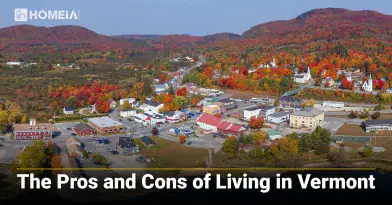
The Pros and Cons of Living in Vermont
If you’re considering relocating, this guide will help you weigh the pros and cons of living in Vermont, spotlight the best cities and towns to call home, and give you a feel for the Vermont lifestyle — from community life and cuisine to recreation and affordability…
2. Bennington: Southwest Vermont’s Urban Anchor
HOMEiA Score: 65/100
- Cost of Living: ~6% below U.S. average
- Monthly Rent: ~$1,250
- Home price to income ratio: 3.5x
- Income to rent ratio: 27.9
- Safety rating: 64/100
A. Cost of Living & Housing: Bennington is the Green Mountain State’s most affordable city by price-to-income ratio, with a median home price of approximately $252,600. Bennington County’s median household income of approximately $73,325 is below the statewide figure, but home prices remain reachable at local incomes in a way most communities no longer support.
B. Economy & Job Market: Southwestern Vermont Medical Center (SVMC), now part of Dartmouth Health, is the largest employer in southwestern VT. Bennington College offers employment and cultural diversity unusual for a town of this size. The county launched the Building Up Bennington loan program in early 2026, targeting an estimated housing gap of 1,500 units by 2030.
C. Access & Infrastructure: Albany, New York is approximately 40 miles away, opening employment options a purely Vermont-based analysis would miss. SVMC provides comprehensive healthcare locally. US Route 7 runs north-south through town while Route 9 is the east-west corridor, though the terrain is treacherous in January.
D. Quality of Life & Culture: This area has a functioning downtown with independent shops, restaurants, and the Bennington Museum. Southern Vermont’s winters are milder than the Northeast Kingdom’s. The tradeoff is geographic isolation from the state’s northern economic core.
3. Springfield: Precision Valley, Rebuilt
HOMEiA Score: 67/100
- Cost of Living: ~8% below U.S. average
- Monthly Rent: ~$1,200
- Home price to income ratio: 3.9x
- Income to rent ratio: 26.5
- Safety rating: 65/100
A. Cost of Living & Housing: Springfield sits in Windsor County along the Black River. The median listing price is approximately $285,000, with the Springfield Village neighborhood around $244,950. Listing prices rose roughly 32% year over year through early 2026. It remains accessible at a 3.9x price-to-income ratio relative to Windsor County’s median income of approximately $77,594.
B. Economy & Job Market: Once known as Precision Valley, the town employed close to 3,000 workers in machine-tool manufacturing as recently as 1980. What remains is a manufacturing base rebuilding through Precision Park, where Vermont Packinghouse and ImageTek Manufacturing received Vermont Employment Growth Incentives in 2025. Location on I-91, roughly 25 miles north of Brattleboro, expands the realistic job market considerably.
C. Access & Infrastructure: Springfield Hospital is a critical access facility subject to state-level review regarding service sustainability. I-91 access is straightforward. Rural addresses outside the village center should verify broadband service before committing.
D. Quality of Life & Culture: Springfield is a working town. The Black River Arts Center anchors a creative community and proximity to Okemo Mountain and the Connecticut River allows for breathtaking outdoor access. Having not fully recovered from the collapse of its manufacturing base, this economic shadow is visible in housing stock and commercial vacancy. For buyers who want affordable entry prices and I-91 access, here offers more than first impressions suggest.
Recommended for you




4. Barre: Vermont’s Working-Class Hub
HOMEiA Score: 72/100
- Cost of Living: ~4% below U.S. average
- Monthly Rent: ~$1,413
- Home price to income ratio: 3.7x
- Income to rent ratio: 28.6
- Safety rating: 74/100
A. Cost of Living & Housing: Barre is the most consistently cited affordable community in-state. Zillow puts the average home value at $306,660 as of April 2026, up a modest 0.7% year over year. Redfin’s median sale price for March 2026 was $270,000. Average 2-bedroom rent runs approximately $1,413/month, well below the national average.
B. Economy & Job Market: Rock of Ages and the Barre Granite Association continue to employ skilled workers in quarrying and memorial fabrication. The state government is the major economic pillar. Montpelier, four miles up the road, employs a significant share of the regional workforce. For working families, economical home prices, reasonable rents, and short commutes to state government employment make this the most straightforwardly practical choice on this list.
C. Access & Infrastructure: Situated on US Route 302 and Vermont Route 62 provides convenient access to I-89. Central Vermont Medical Center in adjacent Berlin allows for comprehensive hospital services. The Barre-Montpelier Road corridor has reliable broadband coverage.
D. Quality of Life & Culture: Residents make this an unapologetically working city. Its violent crime rate of 1.2 per 1,000 residents in 2023 is well below national norms. The Rock of Ages quarry and Vermont Granite Museum give the town a genuine cultural identity grounded in labor and craft. Anyone who values a functional, unpretentious small city at an achievable price on a realistic income will find it delivers.
5. St. Albans: Franklin County’s Growing City
HOMEiA Score: 73/100
- Cost of Living: ~5% below U.S. average
- Monthly Rent: ~$1,500
- Home price to income ratio: 4.3x
- Income to rent ratio: 27.0
- Safety rating: 70/100
A. Cost of Living & Housing: St. Albans is growing fast, with a Redfin median home sale price of $350,000 in March 2026, up 19.5% year over year. Franklin County’s median household income of approximately $81,313 is among the state’s dominant regional figures. Investments totalling $11.4 million have gone into downtown workforce housing through the former Fonda manufacturing site deal completed in 2025.
B. Economy & Job Market: Franklin County has one of the most economically diverse bases outside of Chittenden County. Northwestern Medical Center is the largest single employer, alongside Viatris, Ben & Jerry’s, Barry Callebaut, and Peerless Clothing. Agricultural industries remain economically meaningful. For working families seeking stable employment reliant tourism, Franklin County is among the stronger markets.
C. Access & Infrastructure: I-89 runs directly through St. Albans, connecting it to Burlington (30 miles south) and the Canadian border. Burlington International Airport (BTV) is under an hour away. Northwestern Medical Center provides hospital-level care locally.
D. Quality of Life & Culture: Those who call it home resonate genuine small-city energy. Taylor Park leads downtown while proximity to Lake Champlain enhances recreational value. Winters are frigid and heating costs are a real budget item. For families in the county’s industrial or healthcare sector, there exists employment stability and community infrastructure difficult to obtain in more isolated markets.

Related article
12 Best Places to Live in Vermont in 2026
We’ll take a closer look at some of the best places to reside in Vermont, considering factors such as cost of living, job opportunities and access to amenities. Whether you’re a lifelong resident of Vermont or looking for a change, keep reading to discover the best places to call home in this stunning state…
6. Morrisville: Lamoille County’s Accessible Village
HOMEiA Score: 74/100
- Cost of Living: ~5% below U.S. average
- Monthly Rent: ~$1,400
- Home price to income ratio: 5.9x
- Income to rent ratio: 26.8
- Safety rating: 73/100
A. Cost of Living & Housing: Morrisville occupies a complicated position on an affordability list. The median listing price is $459,000, the highest of any community analyzed here, though the surrounding Hyde Park area runs lower at $385,000. A 5.9x price-to-income ratio is the highest on this list. Employers have struggled to retain workers because most service-sector employees cannot afford to live where they work.
B. Economy & Job Market: Lamoille County’s economy is tourism-driven. Stowe Mountain Resort and Smugglers’ Notch Resort headline an outdoor recreation economy skewing toward seasonal and hospitality work. Manufacturing contributes meaningfully and the Lamoille Economic Development Corporation supports business development. For remote workers or buyers with established careers, their natural amenities remain attractive.
C. Access & Infrastructure: Vermont Route 100 and Route 15 connect Morrisville to Burlington (roughly 35 miles west) and to I-89. Copley Hospital provides primary and emergency care, with tertiary facilities within the hour.
D. Quality of Life & Culture: This part of the state benefits from proximity to Stowe’s outdoor recreation without its real estate prices. The Lamoille River runs through town, and hiking, cycling, and world-class downhill terrain are all within reach. The town (and ski resort) exerts a gentrifying effect on the corridor, visible in housing prices. For buyers who can support a 5.9x price-to-income ratio, this is arguably the best quality-of-life value on this list.
7. Rutland: Vermont’s Second City
HOMEiA Score: 76/100
- Cost of Living: ~10% below U.S. average
- Monthly Rent: ~$1,550
- Home price to income ratio: 4.1x
- Income to rent ratio: 25.5
- Safety rating: 68/100
A. Cost of Living & Housing: Rutland is the Brave Little State of Vermont’s second-largest city, offering genuine value within a functioning urban context. Zillow’s average home value of $279,492 as of April 2026, up 8.9% year over year, remains substantially below Vermont’s statewide median. Rutland County’s median household income of $68,616 is the lowest of any county in this analysis.
B. Economy & Job Market: Rutland Regional Medical Center, the largest community hospital here with over 1,700 employees, drives the local economy. General Electric Aerospace, Killington Resort, Green Mountain Power, Castleton University, and multiple state agencies all maintain significant presences. For job-seekers wanting options, here offers more of them than most Vermont communities its size.
C. Access & Infrastructure: At the intersection of US Routes 4 and 7 is where this sits. Rutland Regional Medical Center provides comprehensive specialty-level care. Downtown has independent businesses and the Vermont Farmers Food Center. Amtrak’s Vermonter route stops here.
D. Quality of Life & Culture
This area has been the subject of honest conversations about opioid recovery, economic stagnation, and post-industrial challenges. Those conversations are real. The city has also made measurable progress: downtown reinvestment is visible, arts programming through the Paramount Theatre is active, and outdoor recreation access tied to Killington is exceptional.

Related article
The 5 Best Places to Live in New Hampshire: A City Comparison
New Hampshire blends historic charm, modern innovation, and outdoor beauty, making it essential to choose the right community. This guide ranks the five best places to live in 2025 based on affordability, safety, opportunity, and quality of life, from vibrant Manchester to academic Hanover, with a comparison to Washington State.
IV. A Relocation Checklist for Moving to Vermont
- Budget for Winter Heating Costs: Vermont homes heat primarily with fuel oil, propane, and electric resistance heat. Fuel oil was running around $4.72 per gallon in early June 2026. A medium-sized home consumes 800 to 1,200 gallons per heating season, translating to $3,800 to $5,650 per winter for oil heat alone. Heat pump systems, subsidized through Efficiency Vermont rebates, offer annual savings of $2,200 to $2,500 versus oil.
- Secure Employment Before Moving: Regional job markets vary dramatically. Chittenden County operates in a different economic stratosphere than Orleans or Windsor Counties. Have employment confirmed before relocating. Remote work has changed this calculus, with a 40% uptick in all-remote workplaces from 2021 to 2022. For those needing local employment, the market is thin outside of healthcare, state government, and manufacturing.
- Visit During Mud Season and Winter: The Maple State drastically differs in March and April than it does in October. Mud season runs from roughly late March through Memorial Day. A combination of snowmelt and spring rain turns unpaved roads into genuine obstacles and reveals the condition of properties that snow covers in December. Visit a potential home during this period before committing.
- Confirm Internet Availability: The state has made substantial progress on rural broadband through its Communications Union District model. Rural addresses, even within the towns on this list, can still lack adequate broadband. Confirming service at the specific property address, not only in the town generally, is essential before any purchase decision.
Conclusion
Vermont’s affordability is real, but not uniform. The communities on this list, Rutland, Barre, St. Albans, Newport, Bennington, Springfield, and Morrisville, all offer median home prices below $438,400 and cost-of-living indexes below the state average. Each presents a different balance of price, employment, and access. What unites all seven is that affordability here requires a frugal mindset and realistic relationship with what the state actually is: serious winters, thin rural job markets, and an intimate community scale. These are functional, honest places representing some of the most affordable options remaining in New England.
Before any relocation decision, visit in winter and mud season, verify broadband at the specific address, and confirm employment. Ground-level research produces better outcomes than any market report.
Recommended for you




FAQs About Most Affordable Places to Live in Vermont
1. Is Vermont an affordable state to live in?
Vermont sits above the national cost-of-living average at an index of approximately 114, making it the second most expensive New England state after Massachusetts (135). Specific communities in central, southern, and far north remain accessible, especially for buyers coming from higher-cost Northeastern states.
2. What is the cheapest town to buy a house in Vermont?
Among communities with functional infrastructure and reasonable employment access, Bennington and Newport consistently offer the lowest median home prices. Redfin placed Bennington’s median around $252,600 and Zillow put Newport’s average home value at $260,690 as of early 2026. More rural towns offer lower prices still, but often with tradeoffs in employment, broadband, and healthcare proximity.
3. Are Vermont property taxes high?
Their property tax structure is complex. In fiscal year 2025, 87% of Vermont towns saw homestead education tax increases, with some rising more than 30%. The practical combined range for most towns is roughly $1.50 to $2.90 per $100 of assessed value, and about two-thirds of homesteaders receive income-based relief through the state’s circuit breaker program.
4. Is Vermont a good state for retirees?
Vermont has real appeal for retirees because of its low violent crime, state-of-the-art healthcare infrastructure, exceptional outdoor recreation, and a community culture that values local involvement. The challenges include long winters, substantial heating costs, and income tax on a portion of Social Security benefits. Communities like Bennington, Rutland, and Barre offer hospital access, manageable housing costs, and a pace of life that suits retirement.
5. Which affordable Vermont town is best for families?
Barre is the most practical choice, combining low home prices, reasonable rents, proximity to Montpelier state government employment, and Central Vermont Medical Center. St. Albans is a respectable alternative for families who need manufacturing or industrial employment. For families with remote income, Morrisville offers exceptional outdoor recreation and advanced education opportunities, though the housing cost premium requires careful planning.
Share