






Cost of Living in Florida vs South Carolina
- Local Editor:Local Editor: The HOMEiA Team


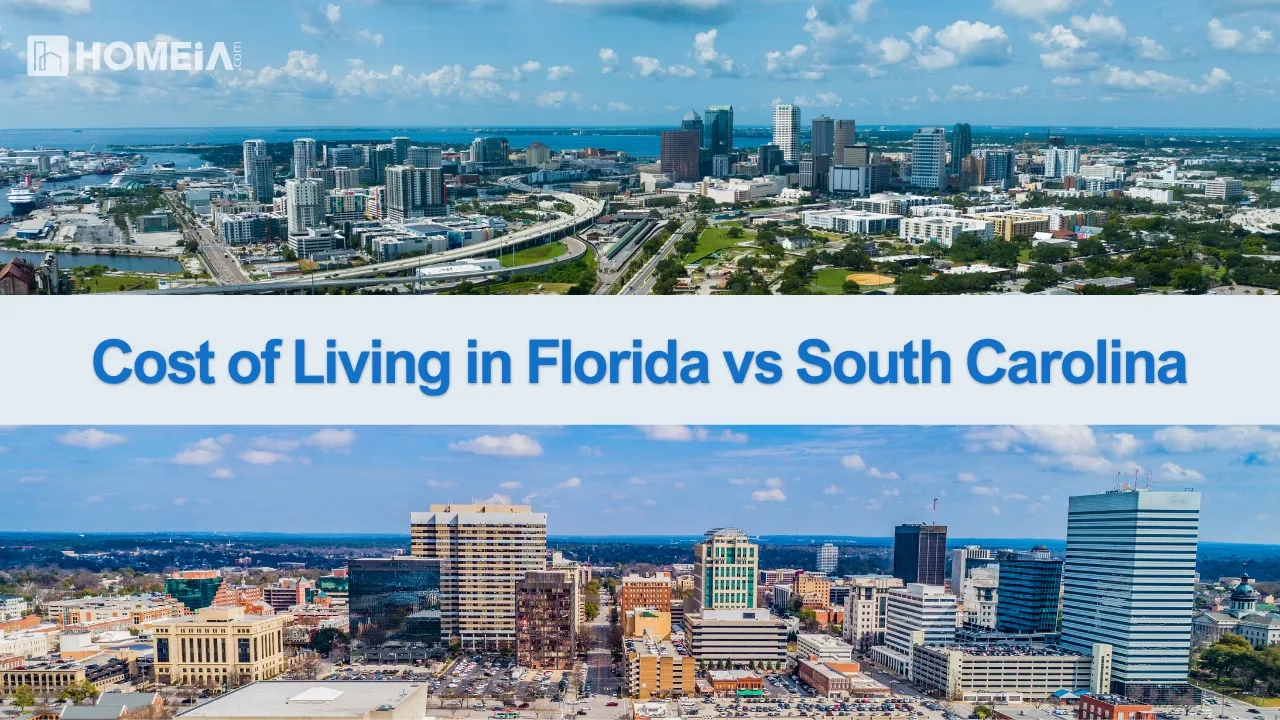
Cost of Living in Florida vs South Carolina: Florida and South Carolina have become two of the most competitive relocation destinations in the country. The former offers zero income tax and a massive economy. The latter option claimed the title of fastest-growing state in the nation, with a cost of living index of 94.7, meaningfully below Florida’s 102.2.
This 2026 update uses current data from MIT, Zillow, Redfin, the U.S. Census Bureau, the BLS, the FBI, and the EIA to give you a fact-based picture of what life actually costs in each state.
Key Takeaways
- South Carolina’s cost of living index is 94.7 versus Florida’s 102.2, making South Carolina approximately 7% to 8% less expensive overall.
- South Carolina’s median home value of $308,062 (Zillow, May 2026) is roughly 22% to 27% below Florida’s $393,701 to $425,000 median.
- Florida’s zero income tax versus South Carolina’s new 2026 two-bracket system (1.99% and 5.21%) creates a meaningful but narrowing tax gap.
- South Carolina’s average rent of $1,228 to $1,386 per month is better economically than Florida’s statewide average of $1,684 to $2,395.
- South Carolina is the fastest-growing state in the U.S. by percentage, adding 80,000 residents in 2025, driven overwhelmingly by domestic migration.
- Homeowners insurance favors South Carolina: Florida averages $5,800 to $8,292 per year versus South Carolina’s $2,009 to $3,205.
- South Carolina’s electricity rate of 16.45 cents per kWh sits close to Florida’s 14.86 cents, making utilities broadly comparable.


Related article
3 Most Affordable and Safe Neighborhoods to Live in Columbia, South Carolina
Columbia, SC offers neighborhoods like Forest Acres, Rosewood, and Shandon that combine affordability, safety, and unique character. With strong community pride, accessible urban amenities, and reasonable housing costs, these areas appeal to families, professionals, and retirees alike, making Columbia a welcoming and practical choice for residents at every stage of life…
Florida vs South Carolina at a Glance
| Category | Florida | South Carolina |
| Population (2025 Census Est.) | 23.46 million | ~5.54 million |
| Median Household Income (2024) | $75,630 | $72,400 |
| Median Home Price (2026) | $393,701-$425,000 | $308,062 (Zillow) / $324,933 (Redfin) |
| Average Rent (1-BR, statewide) | $1,684/mo | $1,228-$1,386/mo |
| Cost of Living Index | 102.2 | 94.7 |
| State Income Tax | None | 1.99% (up to $30K) / 5.21% (above $30K) |
| Effective Property Tax Rate | 0.78%-0.89% | ~0.57% |
| Avg. Homeowners Insurance | $5,800-$8,292/yr | $2,009-$3,205/yr |
| Living Wage (Single Adult) | $24.09/hr ($50,117/yr) | ~$21.60/hr ($44,930/yr) |
| State Minimum Wage | $14.00/hr | $7.25/hr (federal floor) |
1. Living Wage Comparison
The MIT Living Wage Calculator, updated February 2026, measures the hourly income a full-time worker must earn to cover basic needs without public assistance.
A single adult in Florida needs $24.09 per hour ($50,117 annually). South Carolina’s statewide living wage for someone in a similar situation runs approximately $21.60 per hour ($44,930 annually), with coastal Beaufort County requiring $26.39 per hour and inland upstate counties closer to $19 to $20 per hour. The roughly $2.50 per hour statewide gap reflects South Carolina’s lower housing, food, and transportation costs.
For families, South Carolina’s lower cost structure provides meaningful relief. Single parents with two children need approximately $49 to $52 per hour in South Carolina, slightly below their rival’s $49.88. Dual-income couples with two children each need around $26.85 per hour in Florida and $24 to $26 per hour in South Carolina, depending on location.
Florida’s minimum wage of $14.00 per hour significantly exceeds South Carolina’s $7.25 (federal floor), a gap that matters most for workers in hospitality, retail, and service industries. For professional and remote workers, this difference is less relevant than the income tax comparison.

Related article
Affordable Assisted Living Places in Florida
Join us as we tour this beautiful state’s affordable communities offering a great place to retire while receiving high-quality assisted living care. The following sections will guide you through the choices available and the key factors you must consider, helping you make an informed decision about your or your loved one’s assisted living needs…
2. Housing Costs
Housing is the largest cost difference between the two states, with South Carolina maintaining a clear affordability advantage in 2026.
A. Home Prices: Zillow’s May 2026 data shows South Carolina’s average home value at $308,062, with Redfin’s median at $324,933. Charleston’s median exceeds $500,000, making it one of the priciest markets in the Southeast. Greenville County’s median was $368,146 in May 2026. Myrtle Beach and the Grand Strand range from $290,000 to $340,000. Columbia and Spartanburg hold medians around $230,000 to $280,000.
Florida’s median single-family home was $393,701 to $425,000 in May 2026. Miami-Dade commands $455,000 or more. Orlando, Tampa, and Jacksonville range from $295,000 to $410,000. Their statewide median runs approximately 22% to 38% above South Carolina’s. A $300,000 budget buys a comfortable single-family home in Greenville or the Columbia suburbs; in Tampa or Orlando, the same budget requires significant tradeoffs in size or location.
B. Renting: South Carolina’s statewide median rent was $1,228 in January 2026, with Apartments.com placing the one-bedroom average at $1,386 as of June 2026. Charleston commands approximately $1,685 per month. Alternatively, Columbia and Greenville average $1,100 to $1,350. FL’s statewide one-bedroom average was $1,684 per month. Moving from Tampa or Orlando to Greenville or Columbia can save $300 to $600 per month, or $3,600 to $7,200 per year.
C. Homeowners Insurance: This is one of the most financially significant differences between the two states, clearly favoring South Carolina. The Sunshine State’s average of $5,800 to $8,292 per year is the highest in the nation, with South Florida coastal properties exceeding $10,000. The Palmetto State’s average runs $2,009 to $3,205 per year, reflecting genuine coastal risk along its barrier islands but far lower exposure than Florida’s peninsula geography. Even at the high end, South Carolina’s premiums run 40% to 60% below Florida’s, representing annual savings of $2,500 to $5,000 on a comparable home.
D. Property Taxes: South Carolina carries one of the lowest effective property tax rates in the nation at approximately 0.57%, well below Florida’s 0.78% to 0.89%. On a $325,000 home, South Carolina taxes average approximately $1,852 per year versus $3,120 to $3,560 on a comparable $400,000 Florida home. Annual property tax savings compound meaningfully over a 20-year ownership period.
Related article
7 Key Factors to Know About Living in Fort Myers, Florida
Whether you’re seeking the excitement of urban living or the tranquility of a suburban retreat, Fort Myers’ neighborhoods provide a spectrum of affordable living options without compromising on the joys and comforts of life…
3. Economy and Taxes
A. Growth and Employment: Florida’s GDP reached $1.85 trillion in Q3 2025, beating the national rate, with unemployment around 4.0%. Tourism generated $134.9 billion in visitor spending in 2024. South Carolina’s GDP grew 3.2% in 2025 and is projected to grow 2.5% in 2026, led by manufacturing giants BMW, Volvo, Boeing, and Michelin, paired alongside the professional services sector in Charleston, Greenville, and Columbia. South Carolina’s unemployment spiked to 4.8% in late 2025, slightly above Florida’s, with improvement projected through 2027.
B. Income and Purchasing Power: Florida’s median household income was $75,630 in 2024 while South Carolina’s was $72,400. The $3,200 gap is largely offset by South Carolina’s 7% to 8% lower cost of living. A South Carolina household at $72,400 often has purchasing power comparable to a Florida household at $75,000 to $78,000, particularly for housing and everyday expenses.
C. Tax Comparison
| Tax Category | Florida | South Carolina |
| State income tax | None | 1.99% (up to $30K) / 5.21% (above $30K) |
| Capital gains tax | None | Taxed as income (up to 5.21%) |
| Sales tax | 6% + local (avg. 7.05%) | 6% + local (avg. 7.46%) |
| Effective property tax | 0.78%-0.89% | ~0.57% |
| Standard deduction (single) | N/A | $15,000 (new SCIAD, 2026) |
Florida’s zero income tax remains its most powerful financial advantage over SC. Under the new 2026 rates signed by Governor McMaster in March 2026, a single filer earning $100,000 in South Carolina pays approximately $3,624 in state income tax. At $150,000, the liability rises to $6,249 and at $200,000, to $8,874. Here has also established a legal path toward eventual income tax elimination, narrowing this gap over time. Homeowners who save $3,000 per year on insurance and $1,500 on property taxes recover roughly $4,500 of that annual tax cost, making the net Florida tax advantage smaller than the headline rates suggest.
Recommended for you




4. Safety
South Carolina’s violent crime rate decreased 8.4% from 2023 to 2024, the fourth consecutive annual decline and the lowest rate since 1995, with murders falling 15.8%. Despite improvements, South Carolina’s violent crime rate of 437 to 493 per 100,000 remains above Florida’s 267.1 per 100,000, and property crime of 1,966 to 2,669 per 100,000 also runs higher than Florida’s 1,420. Both areas contain dramatic regional variation. South Carolina’s safest communities, including Tega Cay, Fort Mill, Mount Pleasant, and the Bluffton area, rank among the safest in the Southeast, comparable to Florida’s safest suburbs. Buyers should compare specific ZIP codes rather than statewide averages.
5. Climate and Geography
Florida and South Carolina share arid summers, mild winters, and hurricane seasons from June through November. Florida’s summers are more extreme and prolonged. South Carolina’s Upstate region near the Blue Ridge Mountains offers noticeably cooler and drier conditions than anywhere in Florida, a genuine lifestyle distinction. Residents face coastal flood and hurricane risk, though South Carolina’s inland areas face substantially less exposure than coastal Florida.
Florida’s year-round warmth, 8,000 miles of coastline, and the Everglades are unmatched outdoor assets. South Carolina adds the Blue Ridge Mountains to its Lowcountry and Grand Strand offerings, providing seasonal variety Florida cannot match.

Related article
7 Cheapest Places to Live in South Carolina
South Carolina offers an affordable lifestyle with low property taxes, living costs below the national average, and access to coastal charm and growing job markets. However, affordability varies widely across communities. This guide highlights seven budget-friendly cities and towns where residents can balance housing costs, quality of life, and long-term financial stability…
6. Education
South Carolina’s 2024-25 graduation rate reached 86.7%, a 10-year high, with the number of schools rated Good or Excellent rising from 549 to 623. However, only 75.1% of students are college or career ready. Per-pupil spending runs approximately $12,000 to $13,000, below the national average. Florida’s graduation rate of nearly 88% edges South Carolina’s, and Florida ranks first for education freedom four consecutive years due to its school choice programs.
For higher education, in-state tuition at the University of South Carolina runs approximately $13,964 per year while Clemson charges $16,002. Florida’s University of Florida charges $6,381, and FIU charges $6,168. The state’s Bright Futures Scholarship can cover 75% to 100% of tuition for qualifying graduates. Families with college-bound students will find Florida’s public university costs considerably more affordable.
7. Childcare
Unlike the large childcare gaps seen in California-Florida or New York-Florida comparisons, Florida and South Carolina are broadly similar in childcare costs.
| Care Type | Florida | South Carolina |
| Infant, center | $760-$870/mo ($9,120-$10,440/yr) | $850-$873/mo ($10,200-$10,474/yr) |
| Toddler, center | $683-$790/mo ($8,200-$9,480/yr) | $750-$792/mo ($9,000-$9,504/yr) |
| Preschool, center | $625-$750/mo ($7,500-$9,000/yr) | $640-$750/mo ($7,680-$9,000/yr) |
DaycareCalc’s 2026 data shows Florida infant center care at $760 per month and South Carolina at $850, with the states trading places by age group across sources. The difference is insignificant. South Carolina’s childcare subsidy program covers families earning up to $7,263 per month, with maximum infant subsidies of $620 per month.

Related article
5 Best Places to Live in Fort Lauderdale, Florida
This lovely region on Florida’s southeastern coast is gaining acclaim as a premier destination for families looking to plant roots in a locale that promises a high quality of life, economic prosperity, and a warm, inclusive community…
8. Healthcare
Neither state has adopted Medicaid expansion. Florida’s adult uninsured rate is approximately 10.2% compared to South Carolina’s at approximately 13.2%, one of the higher rates in the nation, leaving roughly 350,000 South Carolinians in a coverage gap. For employer-insured workers and Medicare retirees, healthcare access and costs are broadly comparable. Florida’s larger healthcare infrastructure, particularly its concentration of geriatric specialists and elder-care facilities, is a genuine advantage for retirees with complex medical needs.
9. Additional Cost Considerations
- Utilities: South Carolina’s residential electricity averaged 16.45 cents per kWh versus Florida’s 14.86 cents, a modest gap of approximately $190 to $240 per year for a typical household. Unlike comparisons with California or New York, utilities are not a decisive differentiator here.
- Gas Prices: South Carolina consistently ranks among the cheapest states for gas, averaging $2.85 to $3.05 per gallon in mid-2026 versus Florida’s $3.46 to $3.65. At 15,000 miles of annual driving, the savings reach $500 to $700 per year per vehicle.
- Groceries: South Carolina’s grocery index of approximately 97.0 runs slightly below Florida’s 99.0 to 102.0, a difference of roughly 3% to 5%, an additional $300 to $500 per year for an average family of four.
- Transportation: Both states are car-dependent outside a few urban cores. Florida’s major metros offer limited but functional public transit in Miami, Orlando, and Tampa. South Carolina has minimal public transit statewide, making vehicle ownership essentially mandatory for most residents.
Conclusion
South Carolina offers a lower total cost of ownership for most homebuyers, driven by lower home prices, dramatically lower homeowners insurance, and lower property taxes. Homeowners saving $3,000 on insurance and $1,500 on property taxes recovers much of what Florida’s zero income tax advantage provides. Florida’s case is optimal for higher earners, larger job markets, and retirees who prioritize healthcare infrastructure. South Carolina’s rapid growth and ongoing tax reform signal a state narrowing the gap quickly. Buyers who move now capture the current pricing advantage before that normalization accelerates.
Recommended for you




FAQs About the Cost of Living in Florida vs South Carolina
1. How much cheaper is South Carolina than Florida overall?
South Carolina’s cost of living index of 94.7 versus Florida’s 102.2 represents roughly a 7% to 8% gap. The biggest differences are in homeowners insurance (40% to 60% lower), property taxes (0.57% versus 0.78% to 0.89%), and home prices (22% to 27% lower statewide). Rent runs 15% to 25% lower, with gas prices consistently $0.40 to $0.60 per gallon cheaper. Florida holds the income tax advantage and a marginal edge on groceries. For a household spending $60,000 per year in FL, moving to comparable SC markets can reduce annual expenses by $4,000 to $6,000 before accounting for income taxes.
2. Does South Carolina’s income tax erase its affordability advantage?
For higher earners, partially. A filer earning $150,000 in South Carolina pays approximately $6,249 in state income tax under 2026 rates. However, savings of $3,000 on insurance and $1,500 on property taxes recover nearly $4,500 of that gap. At incomes below $100,000, combined housing, insurance, and property tax savings often exceed the income tax cost. South Carolina has also established a legal path toward income tax elimination, reducing this disadvantage gradually.
3. Which state is better for retirees?
Florida’s zero income tax saves a retiree drawing $80,000 per year approximately $2,600 to $3,500 annually. However, South Carolina exempts Social Security entirely and provides retirement income deductions for residents 65 and older, narrowing the gap. South Carolina’s lower home prices and dramatically lower homeowners insurance often offset the remaining tax difference for homeowners drawing modest retirement income. Retirees needing Florida’s healthcare depth and elder-care infrastructure, or who prefer year-round warmth, will favor Florida. Those drawn to South Carolina’s Lowcountry, mountain access, and lower total cost of ownership often find the financial math works in their favor.
4. Why is South Carolina the fastest-growing state in 2026?
South Carolina added 66,622 domestic migrants between July 2024 and July 2025, the highest percentage gain in the nation, with the total population growing 1.5% to reach roughly 5.54 million. Growth is concentrated in Greenville, Charleston, Horry (Myrtle Beach), Berkeley, and York counties. Key drivers include lower housing costs relative to Northeast states, manufacturing economy anchored by BMW, Boeing, and Volvo, warm climate, and a cost of living 7% to 8% below Florida’s. Most arrivals come from New York, New Jersey, Ohio, and Virginia.
5. Which state is better for remote workers?
Florida saves a remote worker earning $100,000 approximately $3,600 per year in income taxes and offers larger metro environments with established remote-work communities in Miami, Tampa, and Orlando. South Carolina appeals to remote workers seeking lower housing costs, quieter pace, and proximity to mountains and coast. Greenville consistently ranks among the top mid-size cities nationally for quality of life, affordability, and outdoor access. For pure financial optimization, Florida’s tax advantage is real. For a balance of affordability, lifestyle, and community, South Carolina’s Greenville and Charleston corridors are compelling alternatives.
Share