





Hawaiʻi is known for its beauty and high costs, yet pockets of affordability still exist. While home prices exceed national averages, careful planning can make island living attainable. This guide analyzes housing, utilities, and transportation to identify seven of the most affordable Hawaiʻi communities…
Retirement Cost of Living in Hawaii vs. Florida
- Local Editor:Local Editor: The HOMEiA Team
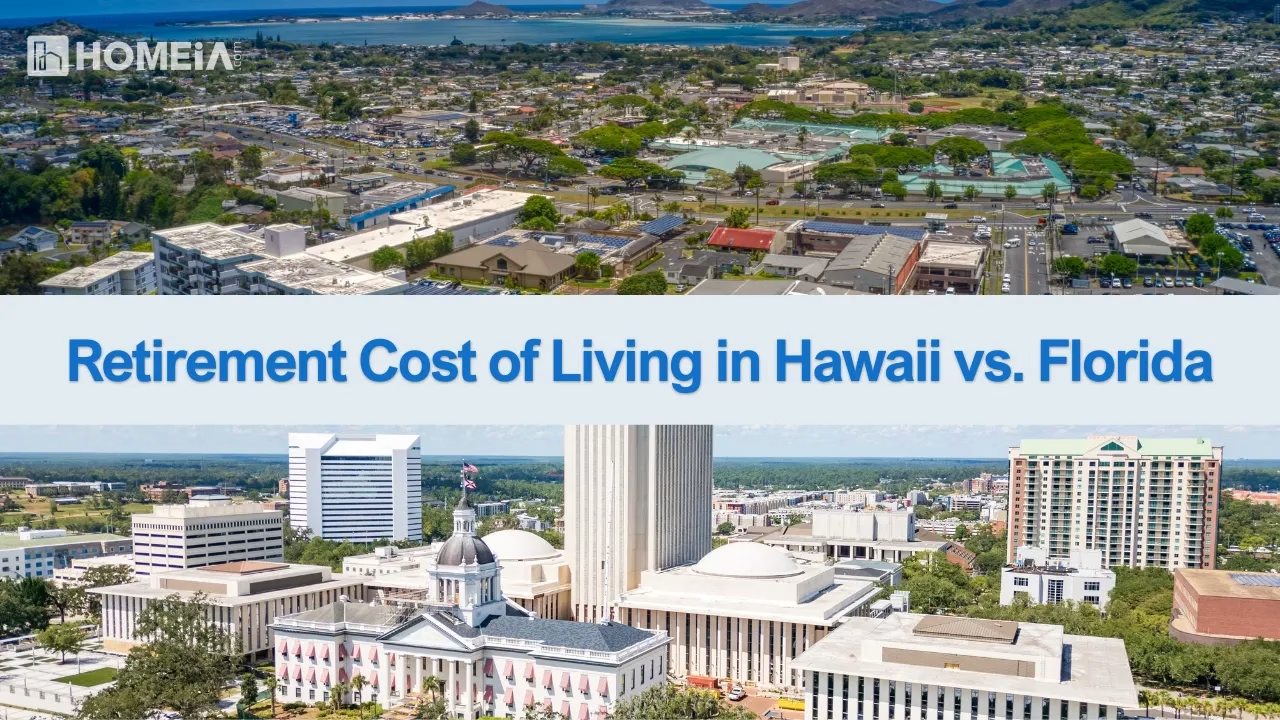
Retirement Cost of Living in Hawaii vs. Florida: Hawaii and Florida share sun, sand, and a reputation as retirement destinations, but their cost structures play in different waters. The Aloha State consistently ranks as the most expensive state in the nation, with a cost of living index roughly 80 to 90 points above the national average. The Sunshine State, by contrast, hovers near or slightly above the baseline. Yet the story does not end there. Florida’s sky-high homeowners insurance and rising property taxes erode much of its apparent affordability, while Hawaii’s more affordable rates offer financial relief to retired homeowners.
This 2026 update draws on MIT Living Wage, Tax Foundation, Zillow, Census, and insurance industry data to help determine which tropical state fits a given budget.
Key Takeaways
- Hawaii’s cost of living index (~183–193) runs roughly double the national average, while Florida’s index (100–103) sits near the baseline.
- Hawaii homeowners pay some of the nation’s lowest insurance premiums (400 to 900 dollars per year), while Florida homeowners face among the highest (roughly 3,800 to 8,500 dollars, with several 2026 sources reporting statewide averages nearer 7,000 to 8,500 dollars). This gap can exceed 6,000 to 7,500 dollars annually.
- Hawaii’s median home price (900,000 to 1,200,000 dollars) is more than double Florida’s median (roughly 420,000 to 432,000 dollars).
- The MIT Living Wage for a single adult in Hawaii runs roughly 64,500 to 73,500 dollars versus roughly 45,000 to 50,000 dollars in Florida, a gap near 20,000 dollars.
- Florida has no state income tax; Hawaii has a progressive income tax with 12 brackets reaching an 11 percent top rate above 200,000 dollars for single filers.
- Hawaii’s property tax rate (~0.29%) ranks among the nation’s lowest, while Florida’s (~0.78%) is more than double that rate.
- Hawaii’s childcare costs are the highest in the nation, with infant care averaging 20,000 to 24,000-plus dollars annually, versus roughly 14,000 to 15,000 dollars in Florida.


Related article
The 5 Best Places to Live in Hawai’i: A City Comparison
Hawaiʻi blends ancient culture, modern innovation, and tropical landscapes, making community choice essential. This guide ranks the state’s 5 best places to live using data on jobs, affordability, safety, amenities, and quality of life. From Honolulu’s urban energy to Hilo’s laid-back charm, we highlight where you can build a fulfilling future in the Pacific…
At a Glance Comparison
| Category | Hawaii | Florida |
|---|---|---|
| Population (2025 Est.) | ~1.43 million (declining) | ~23.7 million (growing) |
| Median Household Income | ~$92,000–$102,000 | ~$67,000–$75,000 |
| Median Home Price | ~$900,000–$1,200,000 | ~$420,000–$432,000 |
| Average Rent (1-BR statewide) | ~$2,200–$3,000/mo | ~$1,500–$1,900/mo |
| Cost of Living Index | ~183–193 | ~100–103 |
| State Income Tax | 1.4%–11% (12 brackets) | None |
| Effective Property Tax Rate | ~0.29% | ~0.78% |
| Average Homeowners Insurance | ~$400–$900/yr | ~$3,800–$8,500/yr |
| Living Wage (Single Adult, annual) | ~$64,500–$73,500 | ~$45,000–$50,000 |
| State Minimum Wage | $16/hr (Jan 2026) | $14/hr (rising to $15, Sept 2026) |
1. Living Wage Comparison
The MIT Living Wage Calculator highlights a stark gap between the two states. A single adult in Hawaii needs roughly 31 dollars per hour to cover basic needs, amounting to approximately 64,500 to 73,500 dollars annually. This may be difficult for retirees, especially on a fixed income. In Florida, the same single adult requires closer to 21 to 24 dollars per hour, or 45,000 to 50,000 dollars per year, much more manageable for those who have finished working. Hawaii’s living wage is among the highest in the nation.
The gap widens significantly for families. A two working parent household with two children in Hawaii needs 115,800 dollars per year to cover basic expenses including childcare, whereas a single income family of three requires at least 102,800 dollars. Florida’s thresholds, while still substantial, fall well below these figures.
If planning on continuing to be employed in some capacity, keep in mind that Hawaii’s minimum wage reached 16 dollars per hour in January 2026, on a path toward 18 dollars by 2028. Florida’s minimum wage stands at 14 dollars per hour through September 2026, then rises to 15 dollars. In neither does the minimum wage cover a single adult’s basic costs without supplemental income or benefits.

Related article
Moving to Florida: THE Complete Relocation Guide and Checklist
Moving to Florida? This all-in-one guide covers everything you need — cost of living, job market, best places to live, and settling-in tips. Whether you’re eyeing Miami, Orlando, St. Augustine, or anywhere between 30A and A1A, we’ll help you make a smart, informed move to the Sunshine State with confidence…
2. Housing Costs
A. Home Prices
Hawaii’s housing market is in a category of its own, especially for those wanting to spend their golden years in paradise. The statewide median single family home price hovers around 950,000 to 1,000,000 dollars, with Oahu medians reaching roughly 1,200,000 dollars. Condos on Oahu average close to 510,000 dollars, and even on the more affordable Big Island, median prices sit near 595,000 dollars.
Florida’s statewide median single family home price runs approximately 420,000 to 432,000 dollars. Metro medians fluctuate. Naples leads at approximately 850,000 dollars, while more affordable markets like Jacksonville and Tampa sit well below their average. Hawaii’s median remains more than double Florida’s for interested residents that are retired.
B. Renting
Rental markets reflect the same gulf, but may serve as a more affordable option for those not working. Honolulu two bedroom rents average 2,500 to 3,800 dollars per month, and one bedroom units across Hawaii typically run 2,200 to 3,000 dollars monthly. Florida’s one bedroom rents average closer to 1,500 to 1,900 dollars, with two bedroom units around 1,800 to 2,500 dollars depending on the metro.
C. Homeowners Insurance
This is where Hawaii’s affordability advantage shines brightest. Hawaii homeowners pay some of the lowest insurance premiums in the nation, averaging anywhere from 400 to 900 dollars per year for standard dwelling coverage. Some analyses even place the statewide average lower, near 376 to 382 dollars. Florida, by contrast, bears the nation’s highest homeowners insurance costs. Several 2026 industry reports pinpoint the average between 3,800 and 8,500 dollars, with a growing number of sources citing figures closer to 7,000 to 8,500 dollars as rates have only partially stabilized. Coastal premiums in Miami-Dade and Monroe County frequently exceed 10,000 to 15,000 dollars.
The resulting gap, often 4,000 to 7,500 dollars annually and wider still on the coast, means Florida’s true housing cost runs far above list prices alone. Hurricane, flood, and litigation exposure drive Florida’s rates, while Hawaii’s stable climate and strict building codes keep claims low.
D. Property Taxes
Hawaii’s effective property tax rate averages roughly 0.29 percent of assessed value, among the lowest in the country, though this varies by county from about 0.22 percent in Maui to 0.35 percent in Hawaii County. On a 1,000,000 dollar home, annual taxes run nearly 2,900 dollars, though homeowner exemptions in counties like Honolulu can push the effective rate even lower for owner occupants. Their rival’s effective rate averages about 0.78 percent; on a 425,000 dollar Florida home, roughly the state median, annual taxes run approximately 3,300 dollars.
The twist is Florida’s lower home prices mean that even with a higher rate, the absolute tax bill on a median priced home remains relatively close to Hawaii’s. For those buying above median homes in either state, the dollar-denominated property tax bill can become substantial regardless of the nominal rate.

Related article
The Pros and Cons of Living in Hawai’i (updated)
Hawai‘i offers breathtaking scenery, rich culture, and unique island living, but high costs, isolation, and limited jobs present challenges. Explore its advantages, drawbacks, and best islands…
3. Economy and Taxes
A. Economic Landscape
Florida’s economy is a powerhouse. Its nominal GDP of roughly 1.85 trillion dollars ranks among the largest state economies in the country, though its inflation adjusted real GDP is closer to 1.39 trillion dollars. Growth remains consistent, driven by tourism, aerospace, finance, and population gains, with unemployment holding low across most sectors.
Hawaii’s economy is petite, remaining tourism-dependent. Real GDP reached approximately 91 to 94 billion dollars in 2025, growing about 2.5 percent, with growth projected to moderate to roughly 1.4 to 1.6 percent in 2026 amid tariff related headwinds and softening tourism. Their economy is less than one-tenth the size of Florida’s on a real GDP basis. This means weaker job competition but fewer opportunities outside tourism, hospitality, construction, and government. This may not be relevant to all retirees, but it is good to keep in mind if you’re interested in returning to work in some capacity.
B. Tax Comparison
| Tax Category | Hawaii | Florida |
|---|---|---|
| State Income Tax | 1.4%–11% (12 brackets) | None |
| Sales/Excise Tax | ~4.5% combined avg (GET) | 6.0% state + local (avg ~7.02%) |
| Effective Property Tax Rate | ~0.29% | ~0.78% |
| Capital Gains Treatment | Long-term: 7.25% flat; short-term: ordinary income | Taxed as ordinary income (no state tax) |
| Estate/Inheritance Tax | Estate tax above $5.49M exemption | None |
The tax story is one of give and take. Florida’s lack of income tax is a major draw as a household earning 100,000 dollars pays nothing in state income tax, while the same household in Hawaii owes roughly 6,000 to 8,000 dollars depending on deductions and filing status. At 150,000 dollars, Hawaii’s bill climbs toward 12,000 to 15,000 dollars; at 200,000 dollars, it approaches 18,000 to 22,000 dollars.
However, FL’s higher property taxes and insurance costs claw back much of that advantage for homeowners. A Florida homeowner with a 425,000 dollar home pays roughly 3,300 dollars in property taxes plus 3,800 to 8,500 dollars in insurance, for 7,100 to 11,800 dollars annually before mortgage costs. A HI homeowner with a 1,000,000 dollar home pays roughly 2,900 dollars in property taxes and 400 to 900 dollars in insurance, for roughly 3,300 to 3,800 dollars total. Renters, who avoid both property taxes and insurance, generally remain in better positions financially in Florida.
Recommended for you
4. Safety
Crime data tells a mixed story. Hawaii’s violent crime rate remains below the national average, and the state’s uninsured driver rate is among the lowest in the country at roughly 6 to 9 percent. Florida’s crime picture is more complex, with some metros exceeding the national violent crime average while suburban and retirement communities rank among the nation’s safest; Florida’s uninsured driver rate runs notably higher, roughly 18 to 20 percent, which pushes up auto insurance costs broadly. These areas contain some of the nation’s safest suburbs alongside higher crime urban cores, so prospective movers should research specific cities and ZIP codes.
5. Climate and Geography
Hawaii offers one of the most stable climates on earth, with year round temperatures between 75 and 88 degrees Fahrenheit and two mild seasons defined by trade winds. There is no snow, freezing, or extreme heat. For an older crowd, this is ideal for one’s joints. Hurricane risk exists but is materially lower than Florida’s, and the islands’ building codes reflect that reality.
Florida’s climate is far more volatile, facing coastal hurricanes, interior tornadoes, severe thunderstorms, and occasional winter events. For cost purposes, climate matters most through insurance. Their hurricane and storm exposure drives materially higher premiums, while Hawaii’s stable climate produces far fewer weather claims, the core reason for its much lower homeowners insurance costs.

Related article
The 8 Best Places Near the Beach for Retirees in Florida
While some of these communities are affordable, others are more luxurious. We have presented options that will fit different budgets and needs, so there should be a choice for everyone…
6. Education
Hawaii’s K-12 system ranks near the middle of the pack nationally, with recent assessments placing the state in the mid-20s overall. Educational outcomes still lag in the bottom third of states on proficiency measures. Florida’s K-12 system ranks more favorably, placing among the top 15 nationally in a recent WalletHub study, earning marks for digital learning and low dropout rates.
Higher education tells a different story. The University of Hawaii system offers in-state tuition meaningfully below Florida’s public universities, while the University of Florida ranks among the nation’s top public universities but comes with higher tuition. For retirees with little ones in K-12, Florida holds an edge. If the emphasis is on affordable in-state tuition, Hawaii offers better value.
7. Childcare
Childcare is one of the largest and most underappreciated cost gaps between these states.
| Age Group | Hawaii Average | Florida Average |
|---|---|---|
| Infant (center) | ~$20,000–$24,000+/yr | ~$14,000–$15,000/yr |
| Toddler (center) | ~$18,000–$22,000/yr | ~$12,000–$13,000/yr |
| Preschool (center) | ~$14,000–$18,000/yr | ~$10,000–$12,000/yr |
Hawaii’s childcare costs are the highest in the nation, consuming roughly 18 percent of median income for married couples with children. For one infant in full time center care, Florida families save roughly 5,000 to 10,000 dollars per year compared to Hawaii. With two young children, savings can reach 10,000 to 20,000 dollars annually. Although not as relevant, it is worth noting if family members plan to visit for an extended period and need someone to look after their children. Both offer subsidized childcare for income eligible families, though waitlists are common and Hawaii faces particularly acute childcare shortages in many counties.

Related article
8. Healthcare
Hawaii has one of the lowest uninsured rates in the country, hovering near 4 percent, having embraced ACA Medicaid expansion to cover a broad share of residents, including retirees. Access to care is straightforward in urban Honolulu, though rural and neighbor island areas face provider shortages.
Florida has one of the highest uninsured rates in the nation, with estimates around 17 to 20 percent, reflecting its decision not to adopt Medicaid expansion, which leaves a coverage gap for low income adults. For Medicare covered retirees, both regions provide reasonable access to care in urban and suburban areas, though Hawaii’s infrastructure concentrates in Honolulu while Florida’s is more geographically distributed.
9. Additional Cost Considerations
A. Utilities: Hawaii has the highest electricity rates in the nation, averaging roughly 40 to 47 cents per kilowatt-hour, with monthly bills running 200 to 350 dollars. Florida’s rates average around 14 to 16 cents per kilowatt-hour, with monthly bills of 130 to 170 dollars.
B. Gas Prices: Hawaii gas prices are the highest in the nation, averaging roughly 5.40 to 5.70 dollars per gallon, versus roughly 3.80 to 4.00 dollars in Florida. Over 15,000 annual miles, that gap adds roughly 800 to 1,200 dollars per year.
C. Groceries: Hawaii’s grocery costs are the nation’s highest, with food-at-home prices running roughly 50 percent above the national average. Florida’s grocery costs sit closer to the national average, a gap that adds roughly 3,000 to 6,000 dollars annually for a typical family.
D. Transportation: Hawaii’s car dependency and high gas prices make driving expensive, and vehicle registration generally exceeds Florida’s fees. The Sunshine State’s extensive toll system adds commuting costs in Miami, Orlando, and Tampa, but lower gas prices partially offset those expenses.

Related article
The 8 Best Places to Live in Florida For Retirees
We have presented options that will fit different budgets and needs – there should be a choice for everyone. We have listed the most affordable cities first, though the ranks and index scores are assigned based on a larger set of characteristics that we have reviewed…
Conclusion
Neither state is a clear universal winner for retirees. Hawaii offers unmatched natural beauty, exceptionally low property taxes, and the nation’s cheapest homeowners insurance, but those advantages come with home prices more than double Florida’s, the highest grocery and utility costs nationally, and a progressive income tax reaching 11 percent. Florida offers no income tax, lower home prices, and a far larger economy, but faces the nation’s highest insurance costs, elevated property taxes, and real hurricane risk.
Although you will get a golden tan no matter where you choose, those in their golden years often live better in Hawaii thanks to low carrying costs on paid off homes, provided they can afford the entry price. However, those not ready to stop building wealth or carrying a mortgage may find Florida’s lower purchase price and tax free income more practical. Renters and remote workers generally see the clearest financial advantage in Florida.
Recommended for you




FAQs About the Retirement Cost of Living in Hawaii vs. Florida
1. Is Florida really that much cheaper than Hawaii in 2026?
Yes. Hawaii’s cost of living index of roughly 183 to 193 runs nearly double Florida’s 100 to 103. Housing is the primary driver, with Hawaii’s median home price more than double Florida’s, and groceries, utilities, and gas all cost significantly higher in Hawaii. The one major reversal is homeowners insurance, where Hawaii averages 400 to 900 dollars annually while Florida runs 3,800 to 8,500 dollars or more.
2. How much salary do you need in Florida to match a Hawaii lifestyle?
A household earning 100,000 dollars in Hawaii would need roughly 55,000 to 65,000 dollars in Florida to maintain a similar standard of living. The precise figure varies by housing choices, since Florida’s lower home prices and rents provide the largest savings while property taxes and insurance partially offset those gains for owners.
3. Which state is better for retirees in 2026?
Hawaii offers a well-rounded financial case for many retirees who own their homes outright, given its low property taxes and cheap insurance, and neither state taxes Social Security income. Florida wins for retirees prioritizing lower everyday costs, no income tax, and easier mainland access. The entry price matters most: those who can afford Hawaii’s high home prices often find lower recurring costs once settled.
4. Are people still moving from Hawaii to Florida in 2026?
Yes. Hawaii has recorded population decline in five of the past six years, driven by domestic out-migration that outpaces natural growth and international arrivals. Florida continues to attract domestic migrants, including former Hawaii residents, drawn by lower housing costs and no income tax, though the flow is not entirely one-way.
5. Which state is better for remote workers in 2026?
Florida offers the more proven financial case for most remote workers, given lower housing costs, no income tax, and cheaper everyday expenses. Hawaii competes for remote workers prioritizing lifestyle and outdoor recreation, but its higher home prices, groceries, and utilities offset those benefits for all but the highest earners.
Share