







Alabama blends Southern charm, rich history, and diverse landscapes, making community choice essential. This guide ranks the state’s five best places to live using data on jobs, affordability, safety, amenities, and quality of life. From Huntsville’s innovation hub to Mobile’s historic coastal appeal, we highlight where you can build…
Cost of Living in Florida vs. Alabama
- Local Editor:Local Editor: The HOMEiA Team
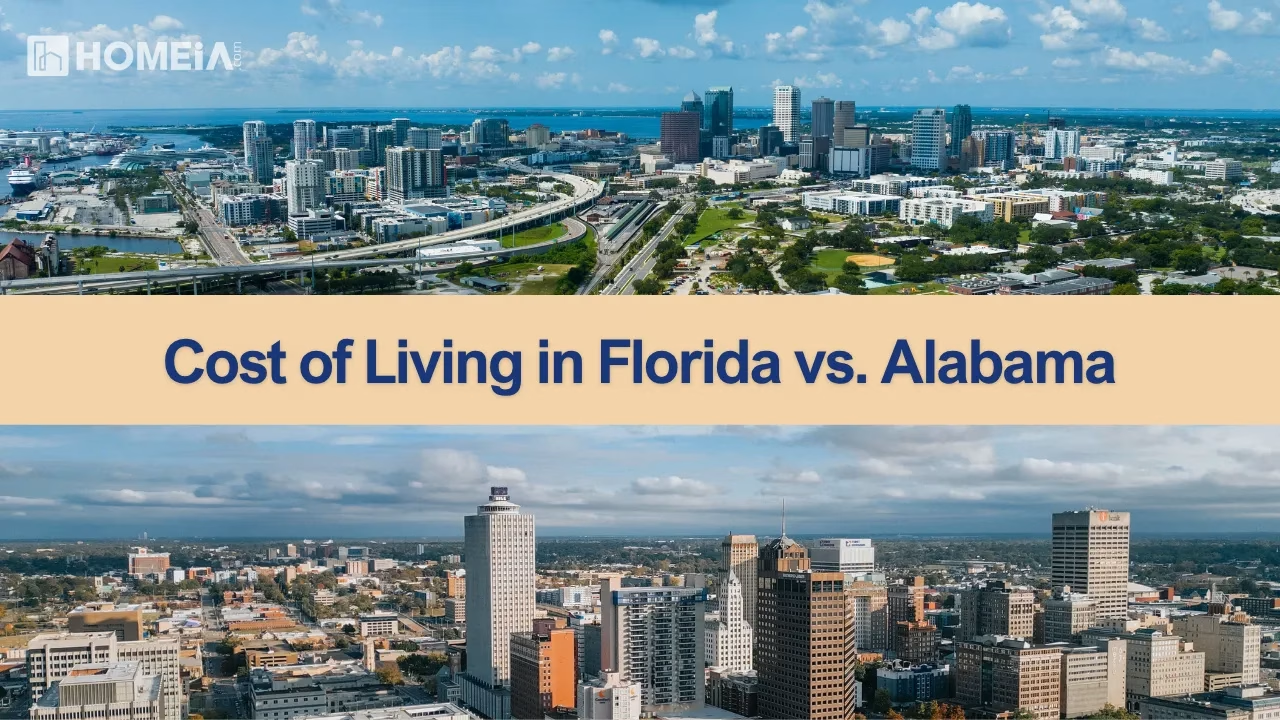
Cost of Living in Florida vs. Alabama: These two States sit side by side in the Southeast, but their cost structures are what separates them. Florida draws residents with no income tax, warm winters, and a substantial job market, yet carries steep insurance premiums and higher housing costs in many coastal metros. Alabama offers some of the lowest home prices and property taxes in the country, along with a cost of living well below the national average, but its income tax and generally lower wages cut into take‑home pay. Relocation decisions between these states come down to tradeoffs across housing, taxes, insurance, wages, and everyday expenses.
This 2026 Cost of Living in Florida vs. Alabama update draws on MIT Living Wage estimates, cost‑of‑living indices, Zillow and Realtor housing data, Census and BLS statistics, and health coverage metrics to help sort through the numbers.
Key Takeaways
- Florida’s overall cost of living index sits right above the national average, in the low‑100s, while Alabama’s index is in the high‑80s, among the more affordable states.
- Florida homeowners face some of the nation’s highest insurance premiums, often ranging from about 3,800 to more than 8,000 dollars per year, versus Alabama’s roughly 1,900 to 3,400 dollars, a gap of around 2,000 to 5,000 dollars annually.
- Alabama home prices are substantially lower statewide, with median around 240,000 to 280,000 dollars, while Florida’s typical home values and median listing prices generally cluster in the upper‑300,000 to low‑400,000‑dollar range.
- The MIT Living Wage (February 2026) estimates the income needed for a single adult at roughly 50,100 dollars per year in Florida versus about 43,800 dollars in Alabama, a gap of a little over 6,000 dollars annually.
- Florida collects no state income tax on wages, while Alabama taxes wage income on a graduated scale around 2% to 5%. A 100,000‑dollar earner in Alabama can expect several thousand dollars in state income tax each year.
- Florida’s childcare costs rank high nationally, with infant center care often above 14,000 dollars per year, compared with roughly 8,600 dollars per year in Alabama.
- Both continue attracting new residents, with Florida drawing people from across the United States and abroad, and Alabama attracting primarily regional migrants, although migration flows have moderated from pandemic peaks.
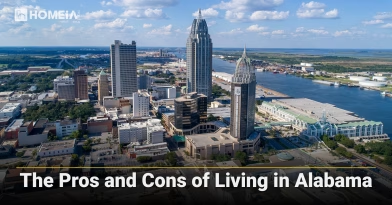
Related article
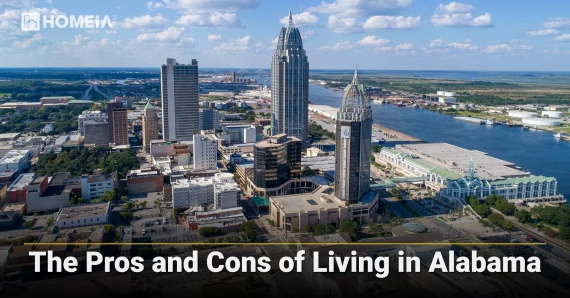
The Pros and Cons of Living in Alabama
Alabama offers more than Southern stereotypes, combining affordable living, natural beauty, and a relaxed lifestyle. But challenges include hot summers, limited public transportation, and uneven education outcomes. This guide delivers a balanced look at the pros and cons of life in the Yellowhammer State and highlights the best cities for young professionals, families, and retirees.
At‑a‑Glance Comparison
| Category | Florida | Alabama |
| Population (2025 est.) | ~23.0 million | ~5.2 million |
| Median household income | ~74,500–77,700 dollars | ~66,600–66,700 dollars |
| Median / typical home price | ~390,000–425,000 dollars | ~240,000–280,000 dollars |
| Average rent (1‑BR, statewide) | ~1,500–2,500 dollars/month | ~1,100–1,300 dollars/month |
| Cost‑of‑living index (overall) | ~100–103 | ~87–89 |
| State income tax on wages | None | 2%–5% (graduated) |
| Effective property tax rate | ~0.74%–0.82% of value | ~0.37%–0.38% of value |
| Average homeowners insurance | ~3,800–8,300 dollars/year | ~1,900–3,400 dollars/year |
| Living wage (single adult, annual) | ~50,100 dollars | ~43,800 dollars |
| State minimum wage (2026) | 14.00 dollars/hour, rising to 15.00 | 7.25 dollars/hour (federal floor) |
1. Living Wage Comparison
The MIT Living Wage Calculator’s February 2026 update concluded that a single adult in Florida needs about 24.09 dollars per hour, roughly 50,107 dollars annually, to cover basic needs on a self‑sufficient budget. In Alabama, the comparable statewide figure is nearly 21.06 dollars per hour, or approximately 43,805 dollars per year. Housing is the primary driver of Florida’s higher threshold, with childcare and healthcare costs also running above Alabama levels.
The gap widens for families when local data is examined. In the Miami–Fort Lauderdale metro, a single parent with one child needs close to 42.73 dollars per hour, and two‑adult households with two children require both adults to earn around 28.51 dollars per hour. Compared to Coffee County, Alabama, single parents with one child need 33.26 dollars per hour, and a two‑adult household with two children needs about 23.14 dollars per hour from each adult. That difference translates to thousands of dollars in annual household budget impacts.
Florida’s minimum wage is 14 dollars per hour in 2026, scheduled to reach 15 dollars on September 30, 2026. Alabama has no separate state minimum, and the federal minimum of 7.25 dollars per hour applies. In neither state does the minimum wage alone cover a single adult’s basic costs without supplemental income or benefits. Additionally, the gap between minimum wage and living wage is pronounced in Florida’s higher‑cost metros.


Related article
Best Places to Live in Tallahassee, Florida
Tallahassee has something to offer everyone, whether you’re drawn by its educational opportunities, governmental significance, or the sheer beauty of its natural settings. Let’s uncover the charm of living in Tallahassee and what makes it a standout city in Florida…
2. Housing Costs
Housing is the central driver of the cost‑of‑living difference between Florida and Alabama.
A. Home Prices
Florida’s statewide median home value is nearly 390,000 to 425,000 dollars as of mid‑2026, depending on the specific source and whether listing or sale prices are used. Data from listing platforms found median listing prices near the low‑400,000‑dollar range, while Zillow’s typical home value metric places statewide values somewhat below that but still above national averages. Major metros command substantial premiums. Miami’s median is around 625,000 dollars, Naples often exceeds 699,000 dollars, and Orlando typically ranges from 350,000 to 400,000 dollars. Jacksonville is more economical, with medians closer to 290,000 dollars.
Alabama’s statewide median home values land between about 240,000 and 280,000 dollars, with Zillow’s typical statewide value in the mid‑200,000‑dollar range. Huntsville has seen significant growth driven by defense and aerospace, with prices trending above the state median, while Birmingham, Montgomery, and Mobile remain below the Alabama statewide median. Entering 2026, Alabama’s housing affordability is relatively favorable, with median‑income households able to qualify comfortably for most homes.
A simplified metro‑level snapshot illustrates the gap:
| Market | Median price (approx.) |
| Miami, FL | ~625,000 dollars |
| Naples, FL | ~699,000 dollars |
| Orlando, FL | ~350,000–400,000 dollars |
| Jacksonville, FL | ~290,000 dollars |
| Huntsville, AL | ~300,000–350,000 dollars |
| Birmingham, AL | ~240,000–280,000 dollars |
| Montgomery, AL | ~220,000–250,000 dollars |
| Mobile, AL | ~210,000–240,000 dollars |
Overall, Florida’s statewide home prices are roughly one‑and‑a‑half to nearly twice Alabama’s, depending on the metro.

Related article
Rents in these regions have stabilized as new supply enters the market. In Florida, one‑bedroom units average about 1,500 to 2,500 dollars per month statewide, with Miami near 2,900 dollars for a one‑bedroom and Jacksonville closer to 1,675 dollars. Alabama one‑bedroom rents tend to run closer to 1,100 to 1,300 dollars per month.
The gap is substantial. Florida renters often pay 400 to 1,200 dollars more per month than Alabama renters for comparable units. Over a year, that translates into 4,800 to over 14,000 dollars in additional rent, making Alabama significantly more appealing for cost‑conscious renters.
C. Homeowners Insurance
Insurance is where Florida’s affordability challenge is most acute. Average Florida homeowners insurance premiums are currently estimated around 3,800 dollars per year statewide, but rates vary widely by county and proximity to the coast. In lower‑risk areas like Sumter County, premiums can be nearly 1,600 dollars annually, while properties in the Florida Keys may see premiums that exceed 14,000 dollars per year. Some statewide estimates that capture more coastal exposure place the average closer to 6,000 to 8,300 dollars.
Alabama homeowners insurance averages roughly 1,900 to 3,400 dollars per year, with Gulf Coast counties facing expensive premiums due to hurricane risk and tornado‑prone regions in northern and central Alabama seeing elevated rates. The result is often a 2,000 to 5,000‑dollar annual premium gap between typical Florida and Alabama homes, which materially increases Florida’s true housing cost beyond what sale prices alone suggest.
The Sunshine State’s effective property tax rate generally averages about 0.74% to 0.82% of assessed value. On a 400,000‑dollar Florida home, that translates to around 3,000 dollars per year before homestead exemptions. Florida’s Save Our Homes amendment caps annual assessment increases at 3% for homesteaded properties, giving long‑term owners some protection against large tax spikes.
The Cotton State’s effective property tax rate averages about 0.37% to 0.38%, among the lowest in the country. On a 260,000‑dollar Alabama home, annual property taxes are near 960 dollars. That is roughly one‑third of the tax burden on a comparably valued Florida home, and over a decade the difference in property taxes alone can add 15,000 to 25,000 dollars in additional carrying costs for Florida owners.

Related article
Moving to Florida: THE Complete Relocation Guide and Checklist
Moving to Florida? This all-in-one guide covers everything you need — cost of living, job market, best places to live, and settling-in tips. Whether you’re eyeing Miami, Orlando, St. Augustine, or anywhere between 30A and A1A, we’ll help you make a smart, informed move to the Sunshine State with confidence…
3. Economy and Taxes
A. Economic Landscape
FL’s economy is one of the largest among U.S. states, with a gross state product estimated around 1.8 trillion dollars in 2026, placing it in the range of a major national economy. Forecasts for 2026 place growth near 2.5% to 2.7%, driven by sectors including tourism, financial services, healthcare, logistics, and technology. Unemployment in mid‑2026 sits around 4.5% to 4.8%, near or slightly above national averages.
Bama’s GDP is smaller, near the low‑hundreds of billions of dollars, with growth projections around 1.5% to 2.4%. Its economy spans manufacturing, including automotive and aerospace, defense installations, agriculture, and healthcare. Unemployment is tight, estimated around 2.7% to 3.0%, among the lower rates nationally and indicative of a relatively strong labor market.
The former’s more diversified economy provides broader job options across more sectors. Alabama’s tighter unemployment reflects a balance of fewer workers and steady demand, but with generally lower wage levels than in Florida’s major metros.
B. Tax Comparison
| Tax Category | Florida | Alabama |
| State income tax on wages | None | 2%–5% (graduated) |
| Sales tax (state + typical local) | 6% state; average combined ~7.0% | 4% state; average combined ~9.5% |
| Effective property tax rate | ~0.74%–0.82% of value | ~0.37%–0.38% of value |
| Capital gains treatment | Taxed as income for federal only | Taxed as income at federal and state |
| Estate/inheritance tax | None at state level | None at state level |
FL’s lack of state income tax on wages provides a clear advantage for earners. On a 100,000‑dollar salary, a Florida resident pays zero state income tax, while an Alabama resident pays roughly 3,500 to 4,500 dollars. At 150,000 dollars of income, Alabama’s tax bill rises toward 6,000 to 7,500 dollars, and at 200,000 dollars toward 8,500 to 10,000 dollars.
However, AL’s much lower property taxes and insurance costs offset some of this gap for homeowners. For renters, the income tax difference is more straightforward, since they do not benefit from Alabama’s property tax advantage. Their sales tax structure is more complex as the state rate is 4%, but local add‑ons can push combined rates into the double digits, with a typical average around 9.5%. Florida’s state rate is 6%, and common local surtaxes bring combined averages near 7%. They exempt groceries from sales tax in most cases, while Alabama generally taxes food, although temporary state‑level reductions and suspensions have recently applied.
Recommended for you




4. Safety
Recent crime data through 2024 positions Florida near the middle of national rankings for violent crime, with property crime rates not far from national averages. Alabama’s violent and property crime rates tend to run somewhat above national averages, but statewide data mask large local differences.
Each includes some of the nation’s safest suburbs. In Florida, communities such as Naples, Sarasota, and parts of St Johns County, along with many master‑planned suburbs, report low crime rates. In Alabama, suburbs such as Vestavia Hills, Hoover, and Madison have similarly commendable safety records, even as nearby urban cores experience higher crime. Prospective movers should focus on city‑ and neighborhood‑level crime statistics instead of relying solely on state averages.
5. Climate and Geography
Florida spans subtropical and tropical climates, with arid summers and generally mild winters. The entire coastline faces hurricane risk on the Gulf Coast and the Atlantic seaboard, along with flood risk, occasional tornadoes, and extreme heat. Florida’s climate directly shapes insurance and infrastructure costs, as hurricane and flood exposure drives high premiums and ongoing resilience investments.
Alabama stretches from Gulf Coast beaches through rolling hills into Appalachian foothills in the north. Residents face hurricane risk along the coast, significant tornado activity in the region known as Dixie Alley, severe thunderstorms, and intense summer heat. Winter weather events occasionally affect northern Alabama, but prolonged freezes are less common than farther north.
From a cost perspective, climate matters most through insurance, maintenance, and energy use. Florida’s hurricane and flood risk drives materially higher homeowners insurance, while Alabama’s tornado and severe storm risks lead to meaningful but lower premiums. Energy costs for cooling are substantial in both states, but actual bills depend on local rates and home efficiency.

Related article
The 30 Best Things to Do in Montgomery, Alabama
Montgomery is Alabama’s state capital and the seat of Montgomery County. It’s a lively city with over 200,000 people. With a diverse selection of culture, history, and activities, there’s plenty for people to enjoy…
6. Education
Florida’s K‑12 system typically ranks in the upper‑middle tier nationally, with many reports placing it roughly between the low‑teens and low‑twenties among states. Government has invested heavily in school choice, digital learning, and accountability systems. Florida’s public universities are highly regarded. The University of Florida, for example, is often ranked among the top national universities and top public schools, with strong traditional and online programs.
Alabama’s K‑12 system tends to rank in the lower half among states, often near the forties, and faces persistent challenges in educational attainment and funding. Higher education is stronger than K‑12 rankings might suggest. Institutions such as the University of Alabama and the University of Alabama at Birmingham have reputable programs, with UAB recognized in global university rankings.
In‑state tuition at Florida’s public universities varies by campus, with the University of Florida near 6,400 dollars annually and other public universities ranging from about 4,000 to 7,000 dollars. Alabama public universities often charge in‑state students around 8,000 to 11,000 dollars per year. As a result, Florida’s four‑year public degrees can be more affordable on an annual tuition basis, despite the state’s higher cost of living in other categories.
7. Childcare
Childcare is a significant but often underappreciated cost gap between Florida and Alabama.
| Age Group | Florida Average | Alabama Average |
| Infant (center) | ~14,200 dollars/year | ~8,600 dollars/year |
| Toddler (center) | ~12,300 dollars/year | ~8,200 dollars/year |
| Preschool (center) | ~10,800 dollars/year | ~6,500 dollars/year |
Florida’s infant care costs rank among the nation’s highest, while Alabama’s are near the lower end of the national spectrum. For one infant in full‑time center care, an Alabama family can save around 5,600 dollars per year compared with a Florida family. With two young children in care, savings can reach 10,000 to 12,000 dollars annually, or 40,000 to 60,000 dollars over four to five years of early childhood care.
Both sections offer subsidized childcare for income‑eligible families, but waitlists are common in major metros. For middle‑income households without large subsidies, the childcare differential can be a decisive factor in the overall affordability of each state.

Related article
The 3 Most Affordable and Safest Neighborhoods to Call Home in Miami, Florida
Miami’s neighborhoods of Kendall, Westchester, and The Hammocks are among the cheapest places to live in the city. Each offers safe, affordable living with its own charm, Kendall’s rising home values, Westchester’s cultural richness, and The Hammocks’ natural appeal, making them ideal for budget-conscious residents seeking quality and security…
8. Healthcare
Florida’s uninsured rate sits around the low double digits, above the national average. The state has not adopted a full Medicaid expansion under the Affordable Care Act, leaving a coverage gap for some low‑income adults. For ACA marketplace shoppers, premiums often reflect their higher underlying healthcare cost structure, especially in regions with significant demand and limited competition among plans.
Alabama’s uninsured rate is higher still, often estimated in the mid‑teens as a percentage of residents. They have also not implemented broad Medicaid expansion, contributing to ongoing coverage gaps. As federal ACA subsidy structures evolve, analysts expect Alabama’s uninsured rate to remain elevated.
For Medicare‑covered retirees, each provides reasonable access to care in urban and suburban areas. Florida’s healthcare infrastructure is more widely distributed across its larger population, with many providers clustered in retirement‑heavy regions. Alabama’s provider network is more concentrated in Birmingham, Huntsville, Mobile, and a few additional hubs, which can mean longer travel for specialized care from smaller towns.
9. Additional Cost Considerations
- Utilities. Florida electricity rates average around 15 to 16 cents per kilowatt‑hour, with heavy summer cooling loads pushing bills higher. Standard monthly electric bills often run in the 150 to 160‑dollar range for moderate‑sized homes, with substantial seasonal variation. Alabama’s average electric rates are similar or slightly higher per kilowatt‑hour, around 15 to 17 cents, and typical monthly bills can be near 186 dollars due to usage patterns and climate, especially in homes with older equipment.
- Gas prices. Florida gasoline prices are notably higher than Alabama’s, generally around 3.85 to 4.35 dollars per gallon in mid‑2026. Alabama’s gas prices are closer to roughly 3.50 to 3.90 dollars per gallon. For drivers traveling 15,000 miles per year, that gap can add about 200 to 400 dollars annually in fuel costs for Florida residents.
- Groceries. Florida grocery costs rank above the national average. A family of four may spend anywhere from 900 to 1,200 dollars monthly on food. Alabama’s grocery costs are among the nation’s lower averages, with a similar family spending around 700 to 900 dollars monthly, creating an annual gap of about 1,500 to 3,000 dollars. Florida generally exempts unprepared groceries from state sales tax, while Alabama taxes food, although the state has implemented temporary reductions on food tax rates.
- Transportation. Florida vehicle registration fees vary by vehicle value and county and typically exceed Alabama’s flat fee near 65 dollars per year. Florida’s extensive toll road network adds commuting costs in regions including Miami, Orlando, and Tampa. Alabama’s toll network is limited, keeping direct roadway charges low, although fuel and parking costs in busy areas still matter. Auto insurance rates are higher in Florida, influenced by hurricane risk, higher claim rates, and a significant share of uninsured drivers, while Alabama’s auto insurance premiums generally align more closely with national averages.

Related article
Conclusion
Neither Florida nor Alabama is a universal winner. The better fit depends on household priorities, income, and lifestyle. Alabama holds a substantial cost of living edge, with far lower home prices, property taxes, and homeowners insurance, as well as lower grocery and childcare costs. Florida offers no state income tax, warmer winters and coastal access, and a bolstered labor market, but its housing, insurance, and early childhood expenses are materially higher.
Homeowners focused on recurring housing costs often find Alabama more sustainable, while renters also benefit from Alabama’s lower rent levels. Retirees see a mixed picture: Alabama offers lower day‑to‑day costs but taxes many forms of retirement income, whereas Florida exempts such income from state tax but can erode purchasing power through higher insurance and property expenses. For remote workers and mobile professionals, the choice hinges on how much value they place on Florida’s climate and amenities versus Alabama’s lower cost of living.
Recommended for you




FAQs About the Cost of Living in Florida vs. Alabama
1. Is Alabama really that much cheaper than Florida in 2026?
Yes, Alabama maintains a clear affordability advantage in most major expense categories. Cost of living indices typically place Alabama in the high‑80s relative to a national baseline of 100, while Florida sits slightly above 100. Alabama undercuts Florida in home prices, rent, groceries, and childcare. One major reversal is insurance; Florida’s homeowners premiums average around 3,800 to 8,300 dollars annually, compared with Alabama’s roughly 1,900 to 3,400 dollars. When total housing costs are compared, the gap narrows slightly but Alabama remains more affordable overall.
2. How much salary do you need in Alabama to match a Florida lifestyle?
A household earning about 90,000 dollars in Florida would often need roughly 74,000 to 78,000 dollars in Alabama to maintain a similar standard of living, given the typical 12% to 17% difference in overall costs. The precise figure varies by housing choices, since Alabama’s lower home prices and rents provide the largest savings, while Florida’s lack of income tax partially offsets the cost gap for higher‑earning wage earners.
3. Which state is better for retirees in 2026?
Alabama generally offers a consistent financial case for retirees focusing on day‑to‑day budget stability. Low property taxes around 0.37% to 0.38%, cheaper homeowners insurance in the 1,900 to 3,400‑dollar range, and lower grocery costs help preserve fixed incomes. Florida’s higher property tax rates, around 0.74% to 0.82%, and insurance premiums in the 3,800 to 8,300‑dollar range can erode purchasing power. However, Florida has no income tax and does not tax Social Security or most retirement distributions, while Alabama taxes retirement income even though Social Security is exempt. Florida is often favored by retirees prioritizing no income tax and coastal amenities.
4. Are people still moving to Florida in 2026?
Yes. Florida continues to attract several hundred thousand net new residents each year, though volumes have eased from pandemic peaks. Drivers include the absence of state income tax, warm weather, and a large and diverse job market. Alabama also attracts new residents, primarily from neighboring Southern states, drawn by lower housing costs, tight labor market, and comparatively low everyday expenses.
5. Which state is better for remote workers in 2026?
Alabama offers a straightforward financial case for most remote workers. Lower housing costs, affordable rent, and significantly lower insurance costs allow workers to convert more income into savings or discretionary spending. Florida appeals to remote workers who place a premium on beaches, coastal lifestyle, and access to larger urban amenities, and who benefit from the lack of income tax. For many households, the savings in Alabama outweigh Florida’s tax advantage, but for high earners who value climate and lifestyle, the income‑tax benefit can tilt the calculation toward Florida.
Share