






Cost of Living in Idaho vs. Texas
- Local Editor:Local Editor: The HOMEiA Team


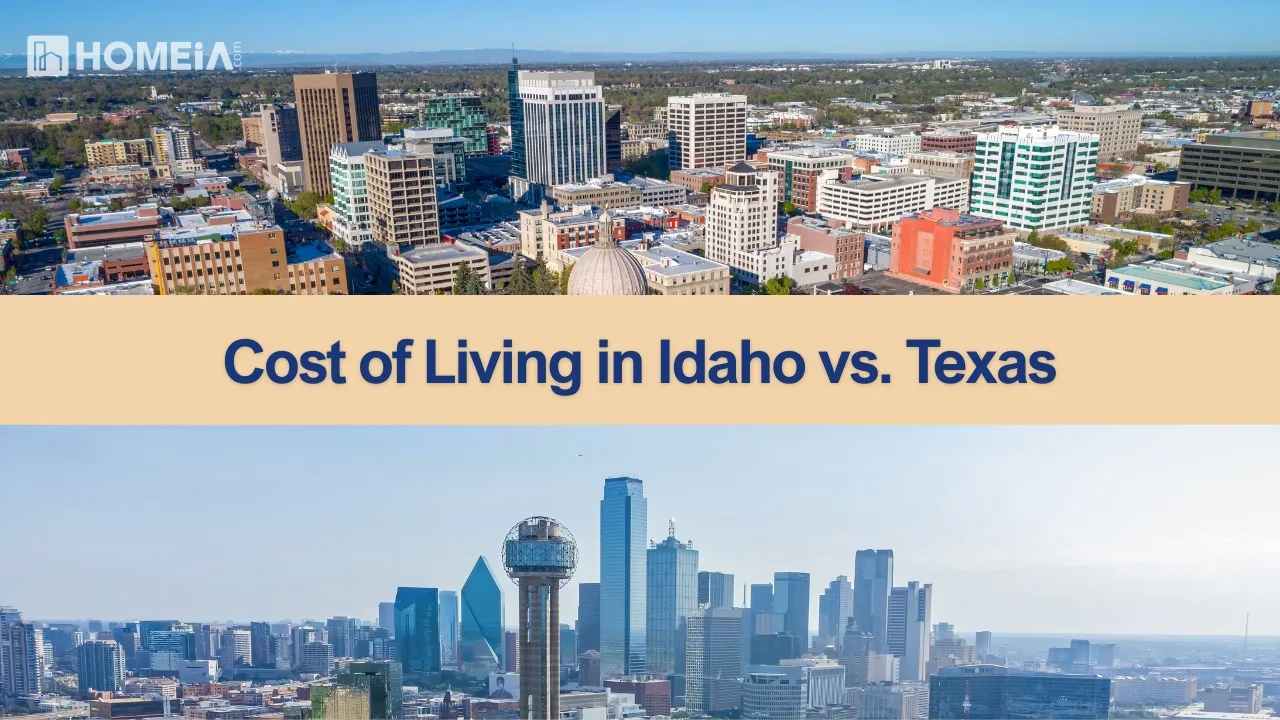
Cost of Living in Idaho vs. Texas: Idaho and Texas essentially trade places on taxes as one collects income tax but keeps property bills and insurance premiums low, while the other skips income tax entirely and makes up the difference through some of the nation’s steepest property taxes. Factor in mountain scenery and a slower pace on Idaho’s side against sprawling metros and Gulf Coast access on Texas’s, and you get two states with genuinely different appeals. Both have drawn heavy domestic migration over the past decade, though growth is now outpacing home construction in Idaho more than in Texas.
This comparison draws on 2025–2026 data from MIT Living Wage, Census Bureau, Zillow, and the Tax Foundation.
Key Takeaways
- Texas holds a modest cost-of-living edge (index ~91–92) versus Idaho’s ~96–99, generally 2%–8% more affordable statewide.
- Idaho homeowners pay markedly less for insurance (~$1,975–$2,195/year) versus Texas’s $3,400–$4,500, a gap that can exceed $1,500–$2,500 annually.
- Texas home prices (~$335,000–$344,000 statewide) remain lower than Idaho’s (~$467,000–$482,000), though both markets have moderated from pandemic peaks.
- Median household income is broadly comparable: ~$81,650 in Idaho versus $81,490 in Texas (2024 figures).
- Idaho levies a 5.3% flat income tax while Texas collects none, but Texas’s property tax rate (~1.4%–1.74%) runs two to three times Idaho’s (~0.50%–0.63%).
- Both maintain the federal minimum wage of $7.25/hr, well below the living wage for a single adult in either.
- Texas adds more residents in absolute terms (~391,000 in the year ending July 2025), but its growth rate (~1.2%) now trails Idaho’s ~1.4%, second nationally in 2025.


Related article
The 10 Best Places to Live in Idaho
With its safe reputation and friendly residents, Idaho is definitely a state worth considering when finding a new location to settle down on your own or with a family…
At-a-Glance Comparison
| Category | Idaho | Texas |
| Population (2025 Est.) | ~2.03 million | ~31.7 million |
| Median Household Income | ~$77,800–$81,650 | ~$78,500–$81,490 |
| Median Home Price | ~$467,000–$482,000 | ~$335,000–$344,000 |
| Average Rent (2-BR) | ~$1,450/mo | ~$1,320–$1,550/mo |
| Cost of Living Index | ~96–99 (varies by source) | ~91–93 (varies by source) |
| State Income Tax | 5.3% flat | None |
| Effective Property Tax Rate | ~0.50%–0.63% | ~1.4%–1.74% |
| Average Homeowners Insurance | ~$1,975–$2,195/yr | ~$3,400–$4,500/yr |
| Living Wage (Single Adult) | ~$46,000–$49,000/yr | ~$45,000–$45,900/yr |
| State Minimum Wage | $7.25/hr | $7.25/hr |
1. Living Wage Comparison
The MIT Living Wage Calculator, updated February 2026, estimates what it costs to meet basic needs in each state. A single adult in Idaho needs roughly $22 to $24 per hour (about $46,000 to $49,000 annually) to cover basic expenses. However, the same adult in Texas needs slightly less, near $21.80 per hour (about $45,300 to $45,900 annually). Housing is the main driver of Idaho’s higher requirement, given the state’s elevated home values relative to Texas’s broader inventory.
The gap increases modestly for families. A single parent with two children needs $44 to $45 per hour in both states to meet basic needs, figures that run close to $92,000 to $94,000 annually, with Texas’s family living wage running slightly above Idaho’s once childcare and housing in specific metros are factored in. For a dual-income couple with two children, each adult must earn in the mid-$20s per hour in either state.
Each maintains the federal minimum wage of $7.25 per hour as of 2026. Idaho’s minimum wage has not changed since 2009, and Texas prohibits cities and counties from setting higher local rates. For minimum wage workers, the shortfall between earnings and the living wage is substantial in both states, though lower-cost housing in smaller Idaho cities and outer Texas metros can partially offset it.
Related article
15 Best Cities for Families in Texas
There are many employment opportunities throughout the state and many enjoyable communities to call home. We’ve compiled a list of 15 cities that rank high in education, affordability, and safety; areas of interest for many potential homeowners…
2. Housing Costs
Housing is the predominant household budget line item, and the price gap is the most consequential affordability difference between the two states.
A. Home Prices
Idaho’s average home value stood at approximately $482,000 as of mid-2026 per Zillow’s Home Value Index, with median sale price closer to $467,000. Prices have risen sharply from pre-pandemic levels, though the market has cooled since 2023.
Texas’s statewide median home price ran around $335,000 to $344,000 in 2026, according to Redfin and Texas Realtors data. The market entered 2026 with elevated inventory in many metros, favoring buyers. Major metro medians illustrate the range:
| Market | Median Price |
| Boise, ID | ~$510,000–$550,000 |
| Coeur d’Alene, ID | ~$480,000–$520,000 |
| Idaho Falls, ID | ~$370,000–$410,000 |
| Pocatello, ID | ~$330,000–$360,000 |
| Austin, TX | ~$415,000–$430,000 |
| Dallas-Fort Worth, TX | ~$350,000–$395,000 |
| Houston, TX | ~$280,000–$295,000 |
| San Antonio, TX | ~$265,000–$285,000 |
B. Rental Market
Idaho’s average rent for a two-bedroom unit runs nearly $1,450 per month statewide. Texas rents vary by metro, with statewide averages reported between roughly $1,320 and $1,550 per month depending on the source and unit size. Both markets experienced softening as new apartment supply absorbs demand, though Idaho’s rental market remains comparatively tight due to limited inventory.
C. Homeowners Insurance
Insurance is where Idaho’s affordability advantage is clearest. Idaho homeowners pay around $1,975 to $2,195 per year on average, below the national average of $2,490 to $2,543.
Texas homeowners insurance averages $3,400 to $4,500 per year depending on carrier and region, driven by hail, hurricane, tornado, and flood exposure. Texas ranks among the more expensive states for home insurance, though not uniformly the top five as sometimes claimed. Rates are impacted by coastal proximity. The gap between the two states commonly runs $1,500 to $2,500 per year for comparable coverage, increasing the total cost of Texas homeownership beyond list price alone.
D. Property Taxes
Idaho’s property tax structure is advantageous over Texas. Idaho’s effective rate runs roughly 0.50% to 0.63% of assessed value depending on the source, among the lower rates nationally, aided by a homestead exemption that reduces taxable value by 50% up to $125,000. On a $470,000 Idaho home, annual property taxes run approximately $2,350 to $3,000.
Texas property taxes average an effective rate of approximately 1.4% to 1.74%, among the higher rates nationally, though below the top states like New Jersey and Illinois. On a $340,000 Texas home, annual taxes run roughly $4,760 to $5,900. Rates in some North Texas counties exceed 2.0% before homestead exemptions. Over a 10-year period, the property tax gap between median-priced homes in each state can compound to $20,000 to $30,000 in additional Texas costs, though this is offset for buyers by Texas’s substantially lower purchase price.

Related article
7 Most Affordable Places to Live in Idaho
Idaho continues to offer pockets of affordability despite rising housing costs nationwide. While prices in and around Boise have increased significantly, many smaller cities and towns still provide attainable housing, lower living expenses, and strong community appeal. This guide highlights seven Idaho communities where affordability, quality of life, and long-term financial stability remain within reach…
3. Economy and Taxes
A. Economic Landscape
Texas possesses one of the largest and most diversified economies in the country, spanning energy, tech, manufacturing, financial services, healthcare, and aerospace. The Dallas Federal Reserve’s 2026 outlook anticipates continued but slower job growth, consistent with the broader national migration slowdown reported by the Census Bureau.
Idaho’s economy is smaller but expanding, led by healthcare, technology manufacturing, retail, and federal research facilities. It ranked second nationally in population growth rate in 2025, behind South Carolina, driven heavily by the Boise metro area.
B. Income and Purchasing Power
Median household income is close, roughly $81,650 in Idaho and $81,490 in Texas per single-year 2024 Census figures, though five-year ACS averages (which smooth annual volatility) put both closer to the high $70,000s. Because Idaho’s cost of living index is generally slightly higher than Texas’s, real purchasing power tilts modestly toward Texas for renters, though the property tax and insurance premium narrows this for homeowners.
In practice, an Idaho household earning at or near the state median often ends with comparable or slightly less disposable income than a Texas counterpart, once housing and insurance costs are factored in.
C. Tax Comparison
| Tax Category | Idaho | Texas |
| State Income Tax | 5.3% flat | None |
| Sales Tax (state + avg. local) | 6.0% + minimal local (~6.02% avg) | 6.25% + local (up to 8.25%) |
| Effective Property Tax Rate | ~0.50%–0.63% | ~1.4%–1.74% |
| Capital Gains Treatment | Taxed as ordinary income at 5.3% | No state tax on capital gains |
| Estate/Inheritance Tax | None | None |
For a homeowner comparing a $400,000 home in each state, the property tax difference runs $3,500 to $4,800 more per year in Texas, which partially offsets Texas’s lack of income tax. At a taxable income of $100,000, Idahoans owed approximately $4,450 to $5,300 in state income tax, while Texans owed none. The net advantage shifts meaningfully with income level and home value: high earners with modest homes benefit more in Texas, while owners of lavish properties see the tax premium eat further into this tax-free advantage. Renters in Texas capture more of the state’s tax advantage directly, since they do not bear property tax, though landlords typically pass through a portion of it in rent.
Recommended for you




4. Safety
Using 2024 FBI data, Idaho recorded a violent crime rate of nearly 245 per 100,000 residents, notably below Texas’s rate of roughly 389 per 100,000. Property crime followed a similar pattern, with Idaho at around 1,400 per 100,000 versus Texas at near 2,040. Idaho’s overall crime profile ranks among the lowest in the western United States.
Statewide averages mask considerable local variation. Both contain communities ranking among the safest in the nation alongside higher-crime urban cores. The Boise metro consistently ranks among the safest mid-sized cities nationally, while Texas suburbs including Frisco, The Woodlands, and Sugar Land also rank highly for safety even as some urban cores post higher crime rates. Prospective movers should research specific cities and ZIP codes rather than relying on statewide figures alone.
5. Climate and Geography
Idaho offers four distinct seasons with cold, snowy winters and mild to warm summers. Mountains, forests, and high desert dominate the landscape, with a majority of land under federal administration, supporting extensive outdoor recreation. Wildfire risk has increased in recent years and affects insurance underwriting in some areas, but Idaho faces no hurricane, tornado, or coastal flood exposure, which helps keep its insurance premiums low.
Texas spans Gulf Coast beaches, Hill Country, Panhandle plains, and western desert, with climate risk distributed unevenly: hurricane exposure along the coast, flash flooding, tornadoes in North Texas and the Panhandle, extreme summer heat statewide, and occasional winter storms. The 2021 grid failure remains a reminder of vulnerability, though the ERCOT grid operator has invested in weatherization since then.
For cost purposes, climate matters most through insurance. Texas’s broader severe weather exposure drives premiums meaningfully higher than Idaho’s, even though Idaho’s wildfire risk can raise rates in specific mountain and forested communities.

Related article
3 Most Affordable & Safe Neighborhoods to Live in San Antonio, Texas
With an advantageous tax structure, a low cost of living, and a warm, diversified climate, San Antonio blends financial attractiveness and cultural life, making it a dynamic and cheap Texas destination…
6. Education
Idaho’s K-12 system ranks in the mid to lower third nationally by most composite assessments, with a high school graduation rate of roughly 80% to 82%. The state has expanded school choice and education savings options in recent years, continuing to face funding pressure tied to rapid population growth.
Texas’s K-12 system is larger and more variable by district, with a graduation rate of approximately84%. Texas has enacted universal education savings account programs that expand school choice options statewide.
Higher education favors Idaho on sticker price. The University of Idaho, Boise State, and Idaho State charge roughly $8,500 to $9,500 per year in in-state tuition and fees, supplemented by the Idaho Opportunity Scholarship and other aid. Texas public university in-state tuition ranges from $9,860 to $16,500 depending on campus, with UT Austin and Texas A&M near $11,000 to $12,000. The Lone Star State froze in-state tuition for 2025-26 and 2026-27, offering some relief. For families projecting four-year costs, Idaho’s lower baseline tuition is a meaningful advantage, while Texas’s larger system offers broader program depth and national name recognition.
7. Childcare
Childcare costs are meaningfully lower in Idaho, representing one of the more significant recurring cost differences between the two states.
| Age Group | Idaho Average | Texas Average |
| Infant (center) | ~$8,600–$9,600/yr | ~$11,000–$11,350/yr |
| Toddler (center) | ~$9,000–$11,400/yr | ~$10,500–$11,500/yr |
| Preschool (center) | ~$7,000–$7,500/yr | ~$9,000–$10,000/yr |
For a family with one infant in full-time center care, Idaho saves roughly $2,000 to $2,800 per year versus Texas; with two young children, annual savings can reach $4,000 to $6,000. Over four to five years of center-based care, that can total $15,000 to $25,000 in savings. Both states offer subsidized childcare for income, though waiting lists are common in major metros in both states, and middle-income families generally pay full market rates.

Related article
Moving to Idaho: The Complete Relocation Guide & Checklist
Idaho attracts newcomers with its blend of affordability, outdoor recreation, and strong sense of community. From rugged mountains and scenic rivers to growing job opportunities in technology, agriculture, and manufacturing, the Gem State offers a lifestyle centered on both opportunity and adventure. While housing costs vary by region, many areas outside of Boise remain relatively affordable. This guide covers housing…
8. Healthcare
Texas has one of the highest uninsured rates of any state, estimated at 16.6% to 17.3% of residents depending on the survey year, compared to Idaho’s roughly 10.8%. Both exceed the national average of about 8%. Idaho expanded Medicaid, while Texas has not, leaving a coverage gap for many low-income adults in Texas.
For individuals purchasing ACA marketplace plans, monthly premiums in Texas are higher than in its competitor, reflecting a less competitive insurance market and cost-shifting associated with a higher uninsured population. Family plan premiums follow a similar pattern. For Medicare-covered retirees, both states offer reasonable access to care in urban and suburban areas. Idaho’s healthcare infrastructure concentrates around Boise and a handful of mid-sized cities, while Texas offers a broader network of major medical centers, including the Texas Medical Center in Houston, one of the largest medical complexes in the world.
9. Additional Cost Considerations
- Utilities: Electricity rates favor Idaho, benefiting from hydropower and averages 10.5 to 11.5 cents per kilowatt-hour, among the lowest in the nation. Texas remains closer to 13.5 to 15.4 cents. Monthly bills run somewhat lower in Idaho, though both states face significant summer cooling demand.
- Gas Prices: Texas consistently offers lower gas prices, generally running $0.30 to $0.50 per gallon below Idaho. Over 15,000 miles of annual driving at 25 mpg, that difference amounts to roughly $180 to $300 per year in Texas’s favor.
- Groceries: Both states run modestly below the national grocery average, with Texas typically cheaper due to its grocery sales tax exemption and broader food supply logistics, while Idaho fully taxes groceries at 6% (offset partially by a per-person grocery tax credit). For a family of four spending $800 per month on food, the practical difference is roughly $20 to $50 per month.
- Transportation: Idaho’s average commute (about 21.6 minutes) tends to be shorter than in major Texas metros. Vehicle registration costs are broadly comparable between the two states. Idaho has fewer toll roads than Texas, which can reduce commuting costs for residents outside major metro areas.
Related article
12 Key Factors to Know When Living in Dallas, Texas
The city is the 9th largest in the United States. Dallas Texas is a little bit country, a little bit rock ’n’ roll, and a whole lot of history, arts, culture and business in the center of the fourth-largest metropolitan statistical area in the United…
Conclusion
Neither state is a clear winner. Texas offers lower home prices, no state income tax, and generally lower everyday costs for renters and mobile households, but that advantage is meaningfully offset by higher property taxes, higher homeowners insurance, and a higher uninsured rate. Idaho offers dramatically lower insurance and property tax burdens, lower childcare costs, and lower crime, but carries a state income tax and higher home prices that weigh most heavily on new buyers.
Families prioritizing childcare and property tax savings may find Idaho more favorable; renters, remote workers without major property holdings, and those most sensitive to state income tax may find Texas’s math more compelling. Retirees and dual-income professional households should model both states’ total housing cost, mortgage, insurance, and property tax combined rather than relying on cost of living indices alone.
Recommended for you




FAQs About the Cost of Living in Idaho vs. Texas
1. Is Texas really cheaper than Idaho in 2026?
Texas holds a modest overall cost of living edge, with most indices placing it a few points below Idaho on a 100-point national scale. Texas undercuts Idaho on home prices and gas, but Idaho’s dramatically lower homeowners insurance and property taxes narrow the gap substantially for homeowners.
2. How much salary do you need in Texas to match an Idaho lifestyle?
Given a cost of living gap of roughly 2% to 8% depending on the index used, a household earning $90,000 in Idaho would generally need something in the $83,000 to $88,000 range in Texas to maintain similar purchasing power, with renters benefiting more than homeowners exposed to Texas’s property tax.
3. Which state is better for retirees?
It depends on income structure and lifestyle. Idaho’s lower property taxes and insurance help fixed-income retirees, while Texas’s lack of income tax preserves retirement account withdrawals. Idaho suits retirees valuing outdoor recreation and a four-season climate; Texas suits those who want a larger healthcare network and milder winters. Neither state taxes Social Security benefits.
4. Are people still moving from Idaho to Texas in 2026?
Migration patterns are shifting. Texas still added the most residents of any state in absolute terms in 2025 (about 391,000), but its growth rate has slowed to 1.2%, while Idaho’s growth rate of about 1.4% ranked second nationally. Domestic migration into Texas has slowed considerably from its pandemic-era peak.
5. Which state is better for remote workers?
Texas offers a more straightforward financial case for renters and those without significant home equity, given lower housing costs and no income tax. Idaho competes for remote workers who prioritize outdoor lifestyle, lower property taxes, and lower insurance costs, with Boise’s growing tech scene offering a mix of career opportunity and quality of life.
Share