






Cost of Living in Utah vs. Idaho
- Local Editor:Local Editor: The HOMEiA Team


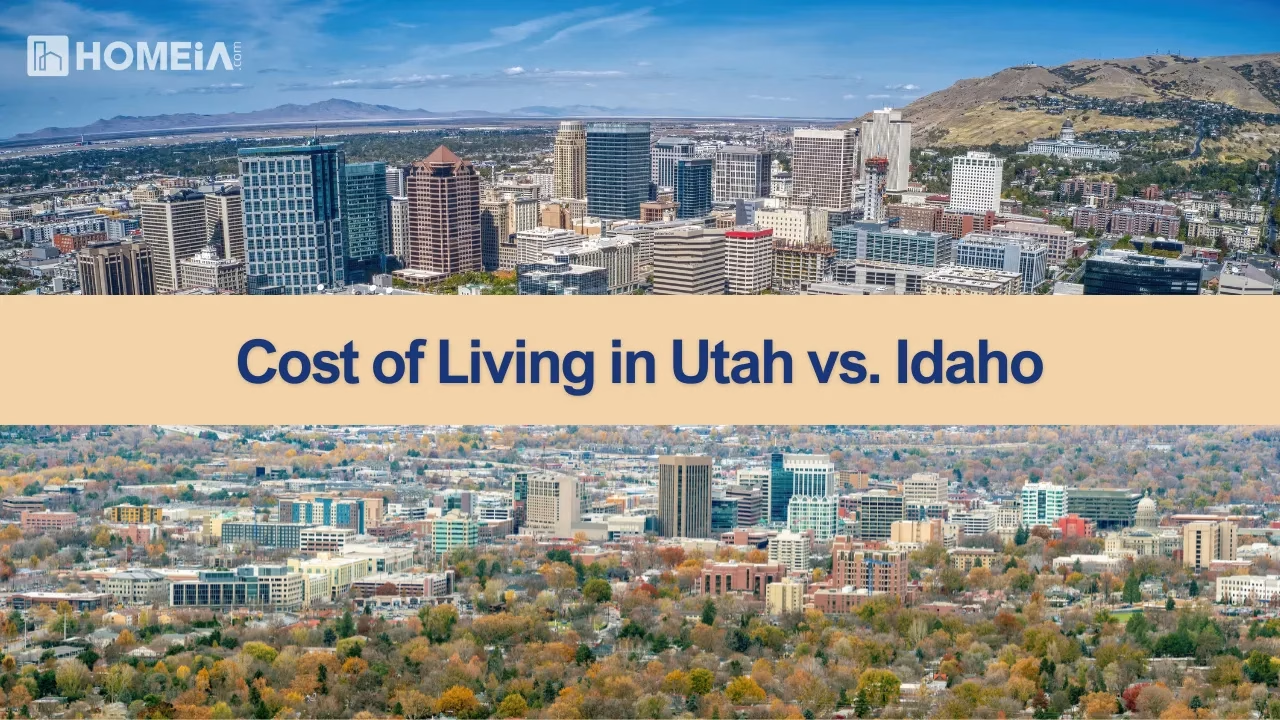
Cost of Living in Utah vs. Idaho: Utah and Idaho share a border, mountain-west geography, and years of consistent population growth keeping both states on movers’ shortlists. Utah’s biggest attraction is their significantly successful and diversified economy paired with higher incomes across the board. Idaho counters quietly, holding a broad affordability edge appearing in housing and childcare alike. That tradeoff plays out differently depending on the household, since income level, family size, and career field all pull in different directions. Housing ends up being the major factor separating the two.
This comparison draws on the MIT Living Wage Calculator, Census Bureau, Zillow, Redfin, and Tax Foundation data.
Key Takeaways
Idaho holds a modest cost of living edge, with an index near 98–99 versus Utah’s ~106–110, making Utah about 7–10% more expensive overall.
- Housing is the largest differentiator: Utah’s median home price (~$518,000–$575,000) runs well above Idaho’s (~$468,000–$473,000).
- Property taxes are nearly identical: Utah ~0.48% versus Idaho ~0.50%.
- Income taxes favor Utah: a 4.5% flat rate versus Idaho’s 5.3%, costing a $100,000 household ~$800 more per year in Idaho.
- MIT’s living wage for a single adult is ~$51,400 in Utah versus ~$46,300 in Idaho.
- Both states rely on the $7.25 federal minimum wage, well below either state’s living wage threshold.
- Idaho’s population growth ranked among the nation’s highest in 2025, driven by migration, while Utah’s growth has moderated toward natural increase.


Related article
Cost-Conscious Living in Utah: A Guide to the State’s Cheapest Cities
Each city holds unique surprises and perks for residents looking to make a savvy, budget-conscious move. So, let’s dive into these budget-friendly gems and see why they’re considered the best-kept secrets of Utah!…
Utah vs. Idaho at a Glance
| Category | Utah | Idaho |
| Population (2025 est.) | 3.54 million | 2.03 million |
| Median Household Income (2024) | ~$96,000–$97,000 | ~$77,800 |
| Median Home Price (2026) | ~$518,000–$575,000 | ~$468,000–$473,000 |
| Average Rent (1-BR) | ~$1,370–$1,470/mo | ~$1,400–$1,460/mo |
| Cost of Living Index | ~106–110 | ~98–99 |
| State Income Tax | 4.5% flat | 5.3% flat |
| Effective Property Tax Rate | ~0.48% | ~0.50% |
| Average Homeowners Insurance | ~$1,283/yr | ~$1,409/yr |
| Living Wage (Single Adult, annual) | ~$51,400 | ~$46,300 |
| State Minimum Wage | $7.25/hr (federal) | $7.25/hr (federal) |
1. Living Wage Comparison
The MIT Living Wage Calculator, updated February 2026, measures what it costs to meet basic needs. A single adult in Utah must earn approximately $24.71/hour (roughly $51,400 annually), while the same adult in Idaho needs about $23.60/hour (approximately $46,300). Housing, significantly more expensive across the Wasatch Front than in most Idaho communities, drives a majority of the gap.
The difference expands for families: a single parent with two children needs approximately $51.06/hour in Utah versus roughly $44.55/hour in Idaho. Both areas rely on the federal minimum wage of $7.25/hour, far below the living wage threshold for any household type, meaning low-income and service-sector workers in either face significant challenges without additional income sources.

Related article
The 10 Best Places to Live in Idaho
With its safe reputation and friendly residents, Idaho is definitely a state worth considering when finding a new location to settle down on your own or with a family…
2. Housing Costs
A. Home Prices
Utah’s housing market remains among the most expensive in the Mountain West, with a median home value of approximately $518,583 as of late 2025 and listing prices reaching $575,000 in early 2026. Salt Lake County’s median hit $645,000 in the second quarter of 2026. Listing prices have softened modestly, down about 2.2% year over year. However, affordability remains a challenge for first-time buyers. Idaho’s market, while also elevated compared to pre-pandemic levels, remains more accessible, with the statewide Zillow Home Value Index at approximately $473,335 as of March 2026 and median sale prices ranging from $440,000–$478,000 depending on the source.
| Market | Median Price Range |
| Salt Lake City, UT | ~$575,000–$645,000 |
| Provo-Orem, UT | ~$500,000–$550,000 |
| Ogden, UT | ~$450,000–$500,000 |
| Boise, ID | ~$500,000–$550,000 |
| Idaho Falls, ID | ~$380,000–$420,000 |
| Pocatello, ID | ~$350,000–$390,000 |
| Coeur d’Alene, ID | ~$500,000–$600,000 |
B. Renting
Utah’s average rent runs approximately $1,361/month across all unit types, with one-bedroom apartments averaging $1,370–$1,470. Idaho’s average rent is nearly $1,377/month, with one-bedroom units averaging $1,400–$1,460. The rental cost difference between the states is minimal, though their booming metros, particularly Salt Lake City, command higher rents than most Idaho cities outside Boise.
C. Homeowners Insurance
Utah holds a modest insurance advantage, with homeowners paying an average of approximately $1,283 annually, though premiums have climbed roughly 59% since 2021 according to the Utah Office of the Legislative Fiscal Analyst, driven largely by wildfire risk along the Wasatch Front. Idaho homeowners pay slightly more, averaging around $1,409/year, reflecting wildfire exposure in forested areas and severe winter storm risk. The annual offsetting $125 is modest compared to the housing cost differential.
D. Property Taxes
Property taxes are nearly identical between the states. Utah’s effective rate averages 0.48% of assessed value, while Idaho’s averages 0.50%. Applied to a $500,000 home, annual taxes would run approximately $2,400 in Utah and $2,500 in Idaho, a minimal difference of about $100. Both regions rank among the lowest in the nation for property taxes, and neither imposes an estate or inheritance tax, making them attractive for retirees and high-net-worth households.

Related article
Moving to Utah: The Complete Relocation Guide and Checklist
Moving to Utah? This complete guide and relocation checklist covers cost of living, job market trends, moving timelines, and the best places to live. Whether you’re drawn to Silicon Slopes, outdoor adventures, or family-friendly communities, we’ll help you make an informed, confident move to one of America’s fastest-growing states…
3. Economy and Taxes
A. Economic Landscape
UT’s economy is substantially larger and more diversified, with GDP reaching approximately $1.85 trillion in 2025 and growth projected near 2.6% for early 2026. Major drivers include tech (Silicon Slopes), financial services, manufacturing, and tourism, with unemployment near 3.7%. ID’s smaller economy has gradually grown in early 2026, with unemployment also near 3.7%. Key industries include healthcare, technology manufacturing, retail, and federal research. Utah’s median household income of approximately $96,000–$97,000 outpaces their rival’s roughly $77,800 by about $18,000–$19,000, though this is partially offset by Utah’s higher cost of living.
B. Tax Comparison
| Tax Category | Utah | Idaho |
| State Income Tax | 4.5% flat | 5.3% flat |
| Sales Tax (state + avg. local) | ~7.42% | 6% state, limited local |
| Effective Property Tax Rate | ~0.48% | ~0.50% |
| Estate/Inheritance Tax | None | None |
| Gas Tax | 38.55 cents/gal | 33 cents/gal |
Income tax is the most consequential tax gap. For a household earning $100,000, Utah’s rate results in $4,500 in state income tax versus Idaho’s $5,300, a difference of $800. At $150,000 the gap balloons to $1,200, and at $200,000 it reaches $1,600. Sales taxes partially offset this in Idaho’s favor. Utah’s combined rate of approximately 7.42% versus Idaho’s 6% state rate saves a family spending $60,000 annually on taxable goods roughly $850 per year.
Recommended for you




4. Safety
Using 2024 FBI data, Utah recorded a violent crime rate of approximately 267 per 100,000 residents, while Idaho’s rate was lower at roughly 240 per 100,000. Property crime also favored Idaho, at around 1,200 per 100,000 versus Utah’s 1,420. These states reported homicide rates below the national average. Statewide figures mask local variation, and suburbs like Sandy, Draper, and Lehi in Utah and Meridian, Eagle, and Idaho Falls in Idaho consistently rank among the safest in their respective states.
5. Climate and Geography
Utah’s high desert landscape features the Wasatch Range running through its most populated corridor, with arid summers, heavy mountain snowfall supporting a renowned ski industry, and wildfire risk along the foothills that has driven recent insurance increases. Idaho provides greater geographic diversity, from the Rocky Mountains to the Columbia Plateau, with four distinct seasons, milder conditions in the Boise Valley, and wildfire and winter storm risk concentrated in northern and central areas. For cost purposes, Utah’s wildfire exposure has contributed to its steep 59% insurance premium increase since 2021, while Idaho’s comparable risk has not driven similar increases in most areas.
Related article
The Pros and Cons of Living in Idaho
This guide details both the pros and cons of living in Idaho and highlights the best Idaho cities for young professionals, families, and retirees so you can decide whether the Gem State fits your lifestyle and budget…
6. Education
Utah’s K-12 system ranks among the most significant nationally, placing 11th overall in a 2025 WalletHub study with exceptional math scores, and per-pupil spending of approximately $9,977, below the national average but consistent with the state’s younger population and larger class sizes. Idaho’s K-12 system faces greater challenges, ranking near the bottom nationally in per-pupil spending at approximately $13,020 statewide in 2025, though this figure and rank combination should be read cautiously given inconsistent reporting methods. It has expanded school choice options in recent years. Higher education costs are comparable as the University of Utah charges roughly $9,000–$10,000 in-state, similar to Idaho’s public universities at $8,000–$10,000. Both participate in the Western Undergraduate Exchange for reduced tuition.
7. Childcare
Childcare represents a substantial expense in both states, with Utah running notably higher across most age groups.
| Age Group | Utah Average | Idaho Average |
| Infant (center) | ~$14,500/yr | ~$8,500–$11,400/yr |
| Toddler (center) | ~$11,000–$14,000/yr | ~$9,000–$11,400/yr |
| Preschool (center) | ~$9,000–$10,000/yr | ~$7,000–$9,000/yr |
For a family with one infant in full-time center care, Idaho saves approximately $3,000–$6,000 annually; with two young children, savings can reach $6,000–$12,000 per year. In this portion of the country, subsidized childcare is offered for income-eligible families, while Utah expanded its Child Care Business Tax Credit in 2026 to improve affordability for working families.

Related article
6 Best Affordable Places to Live in Utah
The state is well-known for its outdoor recreation. From hiking in the red rocks of Southern Utah and snow skiing in Park City to ice fishing at one of the numerous lakes, it’s no surprise that Utah comes in as one of the best states for outdoor activities…
8. Healthcare
Neither Utah nor Idaho has adopted Medicaid expansion, limiting coverage for low-income residents. Utah’s uninsured rate was approximately 8.3% in 2024, ranking around 33rd nationally, while Idaho’s rate was slightly higher at approximately 9.2%. Idaho has faced particular challenges with child uninsurance, among the higher rates in the nation. Here, ACA marketplace premiums are roughly comparable to national averages. Utah’s more concentrated medical infrastructure, anchored by Intermountain Healthcare and University of Utah Health in Salt Lake City, may possess advantages for retirees and those with chronic conditions, while Idaho’s more decentralized system relies heavily on Boise’s St. Luke’s Health System as a regional referral center.
9. Additional Cost Considerations
- Utilities: Electricity rates run lower in Utah, averaging approximately 13–14 cents/kWh, well below the national average, while Idaho averages approximately 12 cents. Monthly bills run $130–$150 in either state, with seasonal variation driven by summer cooling in Utah and winter heating in Idaho.
- Gas Prices: Gas prices are comparable, with Utah averaging approximately $3.87–$4.09/gallon in mid-2026 versus Idaho’s $4.02–$4.15. Over 15,000 annual miles, the difference amounts to roughly $100–$200 per year in Utah’s favor.
- Groceries: Grocery costs run slightly higher in Utah, with a grocery index near 95.7 compared to Idaho’s 98.9 relative to the national baseline. For a family spending $1,000 monthly on food, the difference amounts to roughly $400 per year.
- Transportation: Locals are car-dependent due to limited public transit outside major cities. Idaho’s gas tax of 33 cents/gallon is slightly lower than Utah’s 38.55 cents, while auto insurance rates run comparably, with Utah’s denser Wasatch Front areas seeing marginally higher urban premiums.
Conclusion
On pure affordability, Idaho holds a modest edge, with lower housing and childcare costs granting many households greater disposable income. The roughly 7–10 point cost-of-living gap adds up to real annual savings. Utah counters with higher median incomes, a developed economy, lower income tax rate, and commendable K-12 system, benefiting higher-earning professionals. Families with young children will likely find Idaho’s childcare savings decisive, while higher-income households and those valuing Utah’s job market may prefer the Beehive State despite steeper housing costs.
Recommended for you




FAQs About the Cost of Living in Utah vs. Idaho
1. Is Idaho really that much cheaper than Utah in 2026?
Yes, modestly. Idaho’s cost of living index runs near 98–99 versus Utah’s 106–110, roughly a 7–10% gap. Idaho undercuts Utah substantially in housing and childcare, though the latter’s lower flat income tax (4.5% versus 5.3%) offsets some of that advantage for higher earners.
2. How much salary do you need in Idaho to match a Utah lifestyle?
A household earning $100,000 in Utah would need approximately $90,000–$93,000 in Idaho for comparable purchasing power, based on the cost of living gap. Families with little ones may need less, given Idaho’s substantial childcare savings.
3. Which state is better for retirees in 2026?
Both offer favorable tax treatment, with neither taxing Social Security or imposing estate taxes. Utah’s lower income tax benefits retirees with significant taxable retirement income and offers more developed healthcare infrastructure. To counter, Idaho’s lower housing costs benefit retirees on fixed incomes.
4. Are people still moving to Utah and Idaho in 2026?
Yes, though migration has moderated in both states. Idaho ranked among the fastest-growing states in 2025, with net migration driving most of that growth, while Utah’s growth has slowed as natural increase now plays a larger role than migration.
5. Which state is better for remote workers in 2026?
Idaho offers a reliable financial case for most remote workers, given lower housing and childcare costs that let workers retain more income as savings. Utah’s lower income tax rate benefits higher-earning remote workers, though this advantage is often outweighed by Idaho’s overall affordability edge.
Share