






Stuck With a Rent You Cannot Afford: Five Moves That Help
- Local Editor:Local Editor: The HOMEiA Team
- Category: USA , Cost of Living



Stuck With a Rent You Cannot Afford: 5 Moves That Help. Traditional belief says housing should not exceed 30 percent of your income, but that guideline pertains to a different era. Today, national data shows that roughly 22 to 23 million renter households, close to half of all renters, spend more than 30 percent of their income on housing.
After federal and state taxes, payroll deductions, and healthcare premiums, a 30 percent gross rent payment can easily consume 40 to 50 percent or more of net disposable income.
If you are staring at a rent you cannot to afford, you are not alone. A lease is a legal contract, but tenant protections and mitigation rules provide real exit routes. This article walks through five strategic moves that can help.
Key Takeaways
- A lease is a contract, not an inescapable trap. In many cases, landlords prefer a negotiated exit over a costly eviction.
- In most states, landlords have a duty to mitigate damages and must make reasonable efforts to re-rent your unit.
- Early termination clauses often cost the equivalent of one to two months of rent and can release you from the remaining term.
- Subletting shifts day to day payment to another occupant while you remain secondarily liable. Lease assignment, where allowed, can release you from future obligations.
- Statutory exit rights exist in many jurisdictions for active duty military, domestic violence survivors, and serious habitability violations.
- Domestic or interstate moves to lower cost markets can structurally reduce rent, but require careful planning and realistic expectations.

Related article
Property Taxes by State: The Hidden Cost of Living Increase
Property taxes are one of the most overlooked costs of homeownership, yet they can have a significant impact on your long-term housing budget. While buyers often focus on home prices and mortgage rates, annual property tax bills can add thousands of dollars to the true cost of owning a home.
1. Negotiate a Mutual Lease Cancellation or Buyout Clause

Many standard leases include an early termination or liquidated damages clause allowing tenants to exit before the end of the term in exchange for notice and a defined payment. Paying a fixed, predictable amount can be less costly and less stressful than continuing to struggle with an unaffordable rent for several more months.
A. Check for Liquidated Damages Clauses
Your lease may already spell out how to break it. Common early termination clauses require:
- Written notice, often 30 to 60 days in advance.
- A fixed buyout fee equal to a set number of months of rent, often one or two.
- Return of the unit in clean and reasonably good condition.
On a 2,000 dollar per month lease, a two month buyout represents 4,000 dollars. That is substantial, but significantly less than paying 12,000 dollars to cover six remaining months at full rent. For households already falling behind, a defined and finite obligation can be more manageable than a long string of late payments.
B. Negotiate a Mutual Cancellation
If your lease does not include a clear early termination clause, negotiation is the next step.
Practical steps include:
- Contact your landlord before missing payments. Proactive communication is typically viewed more favorably than silence.
- Explain the hardship with documentation, preferably recent pay stubs, bank statements, or a layoff notice.
- Emphasize the landlord’s opportunity to re-lease the unit at a market rate rather than frame the discussion only around your challenges.
- Propose a specific exit date and a concrete arrangement, like paying one additional month of rent or surrendering the deposit in exchange for a full release.
Evictions are costly for landlords. Filing fees, attorney costs, court appearances, and lost rent can easily add up to several thousand dollars. When given a choice between a cooperative exit with a predictable timeline and an extended non-payment situation that may end in eviction, many landlords choose the cooperative path.
Action step: Always formalize any agreement with a signed mutual lease termination document that:
- Clearly releases you from future rent obligations starting on a specific date.
- Specifies what will happen with your security deposit.
- States any agreed charges or credits for cleaning, repairs, or unpaid utilities.
- Confirms that both parties are voluntarily ending the lease.

Related article
Is It Cheaper to Rent or Buy Right Now?
The decision to rent or buy a home is no longer as straightforward as it once was. Rising home prices, higher mortgage rates, and changing market conditions mean the better financial choice depends on factors such as location, expected length of stay, and personal finances…
2. Enforce the Landlord’s Duty to Mitigate Damages
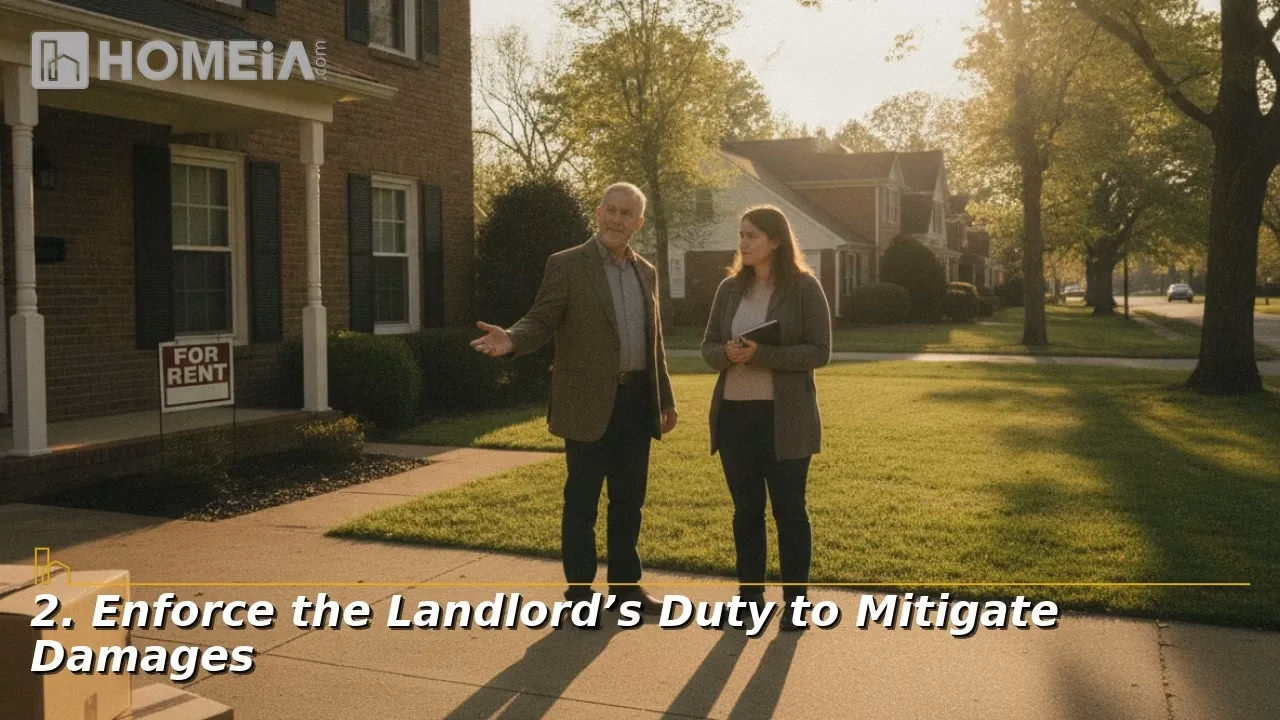
In most states, landlords have a legal obligation to mitigate damages when a tenant leaves early. They must make reasonable efforts to re-rent the unit and cannot leave it vacant and bill the existing tenant for the entire remaining term.
Many tenants assume that if they move out early, they are automatically responsible for every remaining month of rent until the lease end date. In practice, most areas have adopted some version of a duty to mitigate. By doing so, landlords must act in good faith to reduce their losses, often by promptly listing the unit and accepting a reasonable replacement tenant.
A. How Mitigation Works in Practice
Although specific rules vary by state, the duty to mitigate usually means that a landlord must:
- Advertise the unit in a reasonable time frame after vacancy.
- Offer the property at a realistic market rent rather than an artificially high figure that discourages applicants.
- Show the unit to prospective tenants and process applications.
- Not unreasonably reject qualified applicants.
Your financial liability is typically limited to:
- Rent for the period the unit sits vacant before a new tenant moves in.
- Reasonable costs to re-rent the unit, with advertising or screening fees.
- Any documented damage beyond normal wear and tear.
In tight rental markets, vacancy periods for reasonably priced units can be relatively short, sometimes measured in weeks rather than months. The shorter the vacancy, the smaller your ultimate liability.
B. Tracking Landlord Efforts
To protect yourself, keep careful records. Practical steps include:
- Monitoring online listings for your building and similar units in the area and capturing screenshots of dates and asking rents.
- Checking when a specific unit appears in listings after you move out.
- Comparing the asking rent for your former unit with comparable units in the same area to see whether it is priced reasonably.
- Requesting written confirmation from the landlord or property manager describing their efforts to re-rent.
If a landlord waits an extended period to list the unit, prices it substantially above comparable units, or declines qualified replacement tenants without reasonable cause, a court may reduce or eliminate the amount owed.
Recommended for you




3. Execute a Sublet or Full Lease Assignment

Subletting and lease assignment are two ways to shift payment obligations for your unit to a new occupant. Subletting places the new occupant under you, while remaining responsible to the landlord. Assignment transfers your lease obligations directly to the new tenant and can, when approved, release you from future liability.
A. Subletting vs Lease Assignment
| Option | What Happens | Your Liability | Landlord Approval |
| Subletting | A subtenant moves in and pays rent to you or directly to the landlord under your lease | You remain secondarily liable if the subtenant fails to pay | Usually required and often granted with conditions |
| Lease Assignment | A new tenant assumes the lease and becomes directly responsible to the landlord | You may be released from future liability if the landlord agrees in writing | Typically required, with screening similar to a new tenant |
Subletting can make sense if you plan to return to the unit later and want to maintain your lease position. Assignment is generally preferable if you intend to leave permanently and want to avoid future obligations.
B. Navigating Landlord Consent and Screening
Many leases require landlord approval for subletting and assignment. While landlords have an interest in screening tenants, they generally cannot unreasonably withhold consent in jurisdictions that limit such behavior. In practice, most will approve a well qualified replacement rather than risk a prolonged vacancy.
To improve your chances:
- Advertise your unit or room using realistic rent aligned with current market levels.
- Pre-screen potential subtenants or assignees for income, employment, and credit, focusing on basic criteria such as income at or above three times the rent.
- Provide the landlord with complete applications and supporting documentation.
- Ask for written confirmation of approval and, for assignments, a signed release that clearly ends your obligations as of a specific date.
Red flags include landlords delaying responses for weeks, repeatedly rejecting objectively qualified applicants without clear reasons, or insisting on new terms differing substantially from your existing lease. In those cases, documenting communication and seeking legal advice can be helpful.

Related article
Should You Move for Lower Housing Costs or Stay for Higher Income?
A higher salary does not always translate into greater financial security. While major metropolitan areas often offer larger paychecks, higher housing costs and everyday expenses can significantly reduce purchasing power…
4. Invoke Statutory Exit Rights or Habitability Rules

Direct Answer: In all states, landlords must provide habitable housing meeting basic health and safety standards. Serious failures can justify moving out without penalty under the doctrine of constructive eviction. In addition, many jurisdictions provide specific statutory exit rights for active duty military personnel and survivors of domestic violence.
A. Implied Warranty of Habitability and Constructive Eviction
Residential leases carry an implied warranty of habitability. This means landlords are responsible for maintaining core building systems and ensuring the unit is fit for basic residential use. While details vary, common habitability violations include:
- No heat during cold weather within required temperature ranges.
- Lack of hot or running water.
- Structural defects that create safety hazards, such as collapsing ceilings or unsafe stairways.
- Severe mold or persistent moisture problems that affect health.
- Major pest infestations such as bedbugs or rodents.
- Non-functioning plumbing that leads to sewage backups.
Constructive eviction occurs when a landlord’s failure to address severe problems effectively forces a tenant to leave. To pursue this option successfully, tenants generally need to:
- Document conditions with dated photos and videos.
- Provide written notice describing the problem and requesting repairs within a reasonable time.
- Follow up if repairs are not occurring, and clearly communicate an intention to move out if issues remain unresolved.
- Move out within a reasonable period after giving notice, then retain documentation for any legal or deposit disputes.
Because constructive eviction claims depend on facts and state law, tenants considering this path should consult local legal resources or tenant advocates for guidance.
B. Special Statutory Exemptions
Many jurisdictions offer specific protections for:
- Active duty military personnel covered by federal law, who may terminate a lease when receiving qualifying orders for deployment or permanent change of station.
- Survivors of domestic violence, sexual assault, or stalking, who may be able to terminate a lease with documented proof such as a police report, court order, or certified statement from a qualified professional.
These statutes typically require written notice and supporting documentation, and they may set specific timelines for lease termination. When properly invoked, they allow tenants to exit without traditional penalties.
In all cases, maintaining a thorough paper trail of notices, responses, inspection reports, and related documentation is critical. Courts often place significant weight on written evidence.

Related article
Auto Insurance Cost Guide by State in 2026 (the first 12 States)
Auto insurance costs vary widely across the United States, making your state of residence one of the biggest factors affecting what you pay. Differences in accident rates, weather risks, repair costs, insurance regulations, and litigation trends create substantial variations in premiums from one state to another. This guide compares average auto insurance costs across the country…
5. Capitalize on Geographic Arbitrage

Moving within your metro area, to a different region, or another state can structurally lower your rent and overall housing costs. However, these moves involve their own friction costs and should be evaluated with realistic numbers.
A. Domestic Geographic Relocation
Regional price parity data shows that housing costs shift across states than prices for most goods and services. High cost jurisdictions like Washington, D.C. and California have housing rent price levels far above the national average, while states such as West Virginia, Mississippi, Arkansas, and Iowa sit well below.
Illustrative rent index differences:
| State / Jurisdiction | Aggregate Price Index | Housing Rent Index | Approximate Rent Difference vs National Average |
| District of Columbia | Above national average | substantially above national average | significantly higher |
| California | Above national average | substantially above national average | significantly higher |
| New Jersey | Above national average | well above national average | higher |
| Iowa | Below national average | well below national average | lower |
| Oklahoma | Below national average | well below national average | lower |
| Mississippi | Below national average | well below national average | lower |
| Arkansas | Below national average | well below national average | lower |
| West Virginia | Below national average | among the lowest | significantly lower |
In practical terms, a household paying 2,500 dollars per month for a modest apartment in a high rent state may be able to find a broadly comparable unit in a lower rent state for nearly half to two thirds of that figure, depending on metro, neighborhood, and quality level. Even smaller moves, like relocating an hour away from a central business district into a more affordable suburb or regional center, can reduce rent by 20 to 30 percent. Renters considering a move to escape high housing costs can see how widespread the problem is in this report on rent burden across American renter households, which found nearly half are cost burdened.
B. International Relocation for Remote Workers
Some remote workers consider international moves to countries where local housing and service costs are nicer on the wallet than in U.S. cities. When combined with U.S. expat tax provisions such as the Foreign Earned Income Exclusion, this strategy can substantially reduce both housing costs and federal income tax on qualifying earned income.
For 2026, the Foreign Earned Income Exclusion allows eligible taxpayers to exclude up to 132,900 dollars of foreign earned income from U.S. federal income tax. For 2025, the maximum exclusion is 130,000 dollars. To qualify, workers must meet specific residency or physical presence tests and file the appropriate forms.
Example scenarios often cited involve remote workers earning six figure incomes relocating to cities with significantly lower rents, potentially cutting housing costs by 50 percent and reducing federal income tax on wages that fall within the exclusion limit. However, this approach carries legal, tax, and practical complexities and is best evaluated with professional guidance.
Conclusion and Actionable Next Steps
If you are stuck with a rent unable to afford, you have more options than waiting for them to improve. A combination of early termination clauses, negotiated exits, mitigation requirements, subletting or assignment, habitability protections, and geographic arbitrage creates a toolbox of strategies. The key is to act before missed payments escalate into larger problems.
Ready to find an affordable housing market that fits your budget? Explore lower-cost rental hubs and connect with trusted local housing experts on HOMEiA. Download the HOMEiA Tenant Relief Calculator to model your lease exit costs vs. relocation savings
Recommended for you




FAQs About 5 Moves That Help With a Rent You Cannot Afford
1. Can a landlord make you pay for the entire lease if you move out early?
In many states, landlords cannot leave a unit vacant and charge you for every remaining month of the lease after you leave. They must make reasonable efforts to re-rent the unit and can typically recover only the rent lost during the actual vacancy period plus reasonable re-leasing costs. However, you can still be responsible for rent while the unit is empty and for documented damage beyond normal wear and tear.
2. How much does a typical early lease termination buyout cost?
Many early termination clauses require 30 to 60 days of written notice plus a buyout fee equal to one to two months of rent. On a 2,000 dollar per month lease, that means paying between 2,000 and 4,000 dollars to exit early. While significant, it can still be less than the total rent due over several remaining months. Always ensure the terms are documented in writing and signed by both you and the landlord.
3. What are my rights if I am in the military and need to break my lease?
Federal law provides protections for active duty service members who receive qualifying orders for deployment or a permanent change of station. With proper written notice and documentation, these tenants can usually terminate leases without standard penalties. It generally takes effect a set period after the next rent due date. Specific details depend on the statute and the timing of orders, so servicemembers should review current guidance or consult their legal assistance office.
4. Can I break my lease if I am a victim of domestic violence?
Many states allow tenants who are survivors of domestic violence, sexual assault, or stalking to terminate a lease early under specific conditions. Typically, the tenant must provide written notice and documentation such as a police report, court order, or a statement from a qualified professional. Some laws also address lock changes and other safety measures. Because requirements vary, it is important to consult your state’s statutes or a local legal resource.
5. What happens if my landlord refuses to re-rent the unit after I leave?
If a landlord does not make reasonable efforts to re-rent a unit after you vacate, or if they list it at an unrealistically high rent, courts in many jurisdictions may find that they failed to mitigate damages. In such cases, the amount of rent collected from you may be reduced or limited to the period during which they acted reasonably. Documenting their actions or inaction with dates, screenshots, and correspondence will strengthen your position if a dispute arises.
Share