











Remote work has made skilled professionals valuable recruits, prompting cities to offer relocation incentives up to $25,000. This guide analyzes the top 12 programs, evaluating not just payouts but long-term livability using the HOMEiA Score. The best opportunities combine strong incentives with high overall value and long-term stability.
Top 12 U.S. Cities Offering Cash Incentives for Remote Workers
- Local Editor:Local Editor: The HOMEiA Team
- Category: USA
The remote work revolution has suddenly altered the economic landscape, turning fully employed professionals into highly sought-after imports for communities across the 50 states. Cities and towns are competing fiercely for mobile transplants, offering creative incentive packages (up to $25,000) to attract and retain talent.
This guide provides a strategic analysis of the top 12 relocation programs available in 2025. Rather than focusing solely on the cash prize, we use the proprietary HOMEiA Score to evaluate each location’s long-term value, livability, and affordability. Perfect execution pairs a generous incentive with a high HOMEiA Score, ensuring long-term financial stability and quality of life.
Key Takeaways
- Strategic Relocation: Don’t chase the money. True value lies in combining the incentive with a high HOMEiA Score, measuring long-term affordability and quality of life.
- Top Performers: Tulsa, OK (92.8/100) leads the list, thanks to its exceptional internet and robust coworking community, resulting in a 95% retention rate.
- Infrastructure is Key: Connectivity is critical. Tulsa and Newton, IA (87.1/100) offer world-class fiber internet, scoring highest in infrastructure metrics.
- Economic Impact: These programs are highly effective, generating over $4 in local economic benefit for every $1 invested by recruiting high-income earners.
I. Our Methodology: The HOMEiA Score for Remote Work
Each HOMEiA Score is a weighted metric (out of 100) designed to measure a city’s overall appeal for remote professionals. It emphasizes the non-negotiable foundations of remote work and long-term financial health:
- Housing & Affordability (25%): Median home prices, rental fees, and price-to-income ratios.
- Internet Speed, Access & Infrastructure (25%): Average download/upload speeds, fiber availability, and broadband reliability.
- Cost of Living (COL) (20%): Day-to-day expenses (groceries, utilities, transportation, healthcare).
- Coworking, Community & Safety (20%): Strength of the remote ecosystem, dedicated coworking spaces, community engagement, and crime rates.
- Economic Resilience & Opportunity (10%): Economic diversity and employment trends for long-term stability.

Related article
Our Methodologies to create HOMEiA Score Ratings for Each Group of Content
HOMEiA uses a consistent, data-driven methodology to evaluate U.S. states for livability, affordability, and long-term value. Our analysis centers on key factors such as Housing and Affordability, Cost of Daily Living, Access and Infrastructure, Community Strength, Safety and Quality of Life, Economic Resilience and Job Market…
II. Why Cities Pay You to Move
Municipalities invest in these programs because the economic returns significantly outweigh costs. Research shows that every $1 invested in attracting a remote worker can generate over $4 in local economic benefits. Participants typically have incomes double the median community income, providing an immediate boost to local tax bases and consumer spending. Successful programs focus on community integration through perks like coworking memberships and local event tickets, leading to retention rates as high as 95%.
1. The Top 12 Cities: Ranked Lowest to Highest HOMEiA Score
This comparison table details the 12 most compelling relocation programs, reorganized based on their HOMEiA Score.
| Rank | City/State | HOMEiA Score | Incentive Amount | Program Name | Key Requirements |
| 12 | Jackson, MI | 80.8/100 | $25,000 Down Payment Asst. | 100 Homes Program | Home purchase on vacant lot; home cap $178k. |
| 11 | Eastern KY | 80.8/100 | $5,000 + $2,500 Partner Bonus | Eastern Kentucky | Remote work outside the region; includes a welcome package. |
| 10 | Paducah, KY | 82.0/100 | Up to $2,500 + 12 Months Internet | Paducah Relocation | Remote work requirements; reimbursement-based. |
| 9 | Texarkana, TX | 84.2/100 | $5,000 + Perks ($17,000+ total) | REDI Set Move | $60k+ income; remote work outside the region. |
| 8 | Baltimore, MD | 84.6/100 | $2,000-$5,000 | Live Near Your Work | Employer-matched program; first-time buyers. |
| 7 | Mattoon, IL | 84.7/100 | $5,000 Cash + Perks ($11,703 total) | Move To Mattoon | $45k+ income; 2-year residency commitment. |
| 6 | West Virginia | 85.8/100 | $12,000 | Ascend WV | 2-year residency; remote work outside WV. |
| 5 | Newton, IA | 87.1/100 | $10,000 | Newton Housing Initiative | Purchase new home $240k+; primary residence. |
| 4 | The Shoals, AL | 87.3/100 | $10,000 | Remote Shoals | $52k+ income; 1-year residency. |
| 3 | Noblesville, IN | 88.1/100 | $5,000 Cash + Perks | MakeMyMove | Remote work outside the region; coworking included. |
| 2 | Topeka, KS | 90.3/100 | Up to $15,000 | Choose Topeka | 1-year residency; employer participation (remote eligible). |
| 1 | Tulsa, OK | 92.8/100 | $10,000 | Tulsa Remote | 1-year residency; remote work outside OK. |
Last Updated: November 2025. And here are affordable places to live in America.
Note: Program details, incentive amounts, and availability are subject to change. Always verify current program status and requirements directly with program administrators before making relocation decisions.
Related article
Best U.S. Cities for Remote Workers: A Strategic Guide to WiFi, Coworking & Affordability
Remote work now frees professionals to live where quality of life and affordability align. Ideal cities offer strong infrastructure, reasonable costs, and supportive communities. Using the proprietary HOMEiA Score, this guide ranks top U.S. locations for remote workers, helping individuals choose places that provide long-term value and a thriving lifestyle.
2. Program Highlights by Score
Tier 1: Optimal Value & Infrastructure (88.1 – 92.8)
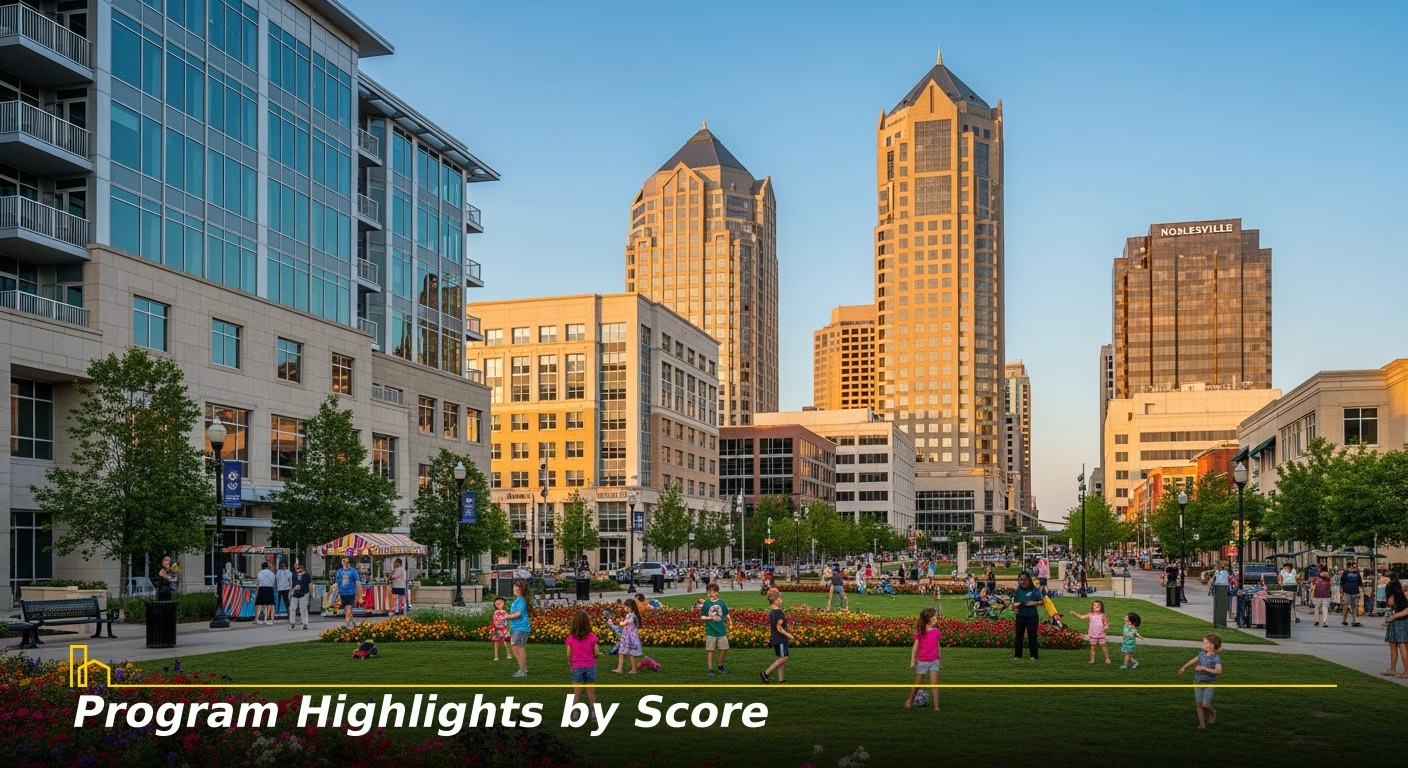
A. Noblesville, Indiana (HOMEiA Score: 88.1/100)
- Incentive: $5,000 cash plus extensive perks (coworking, health stipends, local gift cards).
- Pros: Advantageous proximity to the Indianapolis metro tech hub while retaining small-town charm. Excellent Coworking, Community & Safety (90/100), with professional spaces like COhatch.
- Payment: $2,500 upfront, $2,500 after one year.
B. Topeka, Kansas (HOMEiA Score: 90.3/100)
- Incentive: Up to $15,000 for homebuyers or up to $10,000 for renters.
- Pros: High marks for Internet Infrastructure (92/100), with AT&T Fiber providing up to 5 Gbps to 79% of the city. A substantial average participant salary ($80,000) goes significantly further here due to the low cost of living.
- Status: Has received over 4,000 applications.
C. Tulsa, Oklahoma (HOMEiA Score: 92.8/100)
- Incentive: $10,000 cash grant.
- Retention Rate: 95% overall since 2019, proving its long-term viability.
Pros: Leads the analysis with elite scores in Internet Infrastructure (95/100) and Coworking, Community & Safety (98/100). Tulsa boasts a median fixed broadband speed of 291 Mbps and a dense, high-quality coworking network (including a free three-year membership to 36 Degrees North for participants). Every $1 invested yields more than $4 in local economic benefits.
Recommended for you
Tier 2: Balanced Mid-Markets (84.2 – 87.3)
A. Texarkana, USA (HOMEiA Score: 84.2/100)
- Incentive: Comprehensive package valued over $17,000, including $5,000 cash and substantial perks (tuition discount, membership to creator space).
- Focus: Attracting workers to the unique dual-state metro area (Texas/Arkansas).
- Pros: Solidly balanced scores across all metrics.
- Requirements: $60,000+ minimum annual income.
B. Baltimore, Maryland (HOMEiA Score: 84.6/100)
- Incentive: $2,000 to $5,000 via the Live Near Your Work program.
- Focus: This is an employer-matched program, making it less of a pure remote worker cash incentive.
- Pros: As a major metro, it excels in Internet Infrastructure (90/100) and Coworking/Community (95/100).
- Cons: Impactful cost of living (78/100) and housing (75/100) typical of the East Coast. Best for those prioritizing urban life.
C. Mattoon, Illinois (HOMEiA Score: 84.7/100)
- Incentive: $5,000 cash plus $2,555 in local gift cards and perks, totaling approximately $11,703 in value.
- Pros: Manageable cost of living (6% below national average) and reliable fiber internet access (Fidium Fiber offers 2 Gbps to 73% of homes).
- Requirements: Must earn at least $45,000 annually and commit to two years of residency.
D. West Virginia (HOMEiA Score: 85.8/100)
- Incentive: $12,000 cash and extensive outdoor recreation perks (Ascend WV program).
- Focus: Leveraging the state’s natural beauty and multiple participating communities (e.g., Morgantown, Charleston).
- Pros: Exceptional affordability and intentional community-building focus (97% retention rate).
- Note: Internet speed varies significantly by location; research the specific town before moving.
E. Newton, Iowa (HOMEiA Score: 87.1/100)
- Incentive: $10,000 cash for new homebuyers.
- Pros: Exceptional Internet Speed & Infrastructure (93/100). Newton boasts world-class rural internet with symmetrical 2 Gbps fiber to 100% of the city via MCG and Windstream.
- Focus: Expanding quality housing inventory. Requires purchasing a new home valued at $240,000 or more.
F. The Shoals, Alabama (HOMEiA Score: 87.3/100)
- Incentive: $10,000 cash stipend.
- Focus: Attracting remote workers to the four-city region (Florence, Muscle Shoals, Sheffield, Tuscumbia).
- Pros: Top scores in Housing & Affordability (95/100) and Cost of Living (96/100).
- Requirements: $52,000+ income; distributed in three installments over one year.
Related article
Remote Work Relocation Tax Guide: Moving to Tax-Free States
Remote work has freed professionals to choose where to live, making tax strategy a major factor. States with no personal income tax offer high earners significant financial advantages, but decisions must consider more than taxes. This guide evaluates all nine no-tax states using the HOMEiA Score to balance savings with overall livability.
Tier 3: Affordability & Homeownership Focus (80.8 – 82.0)
A. Jackson, Michigan (HOMEiA Score: 80.8/100)
- Incentive: $25,000 in down payment assistance (with potential for additional state funds).
- Focus: Revitalization through new construction. It’s exclusively for homebuyers, assisting with the purchase of new homes capped at $178,000 on vacant city lots.
- Pros: Exceptional financial aid for homeownership.
- Cons: Lower scores in Internet Infrastructure (82/100) and Coworking (70/100).
B. Eastern Kentucky (HOMEiA Score: 80.8/100)
- Incentive: $5,000 cash, plus a $2,500 bonus per partner securing a local job.
- Pros: Outstanding affordability in Housing (93/100) and Cost of Living (95/100).
- Cons: Infrastructure is limited, scoring low in Internet (70/100) and Coworking (70/100). Best for people prioritizing budget over connectivity.
C. Paducah, Kentucky (HOMEiA Score: 82.0/100)
- Incentive: Up to $2,500 for relocation, plus 12 months of free internet service.
- Pros: Desirable affordability (90/100 Housing, 92/100 COL) and known for a supportive arts community.
- Cons: Smaller regional city with limitations typical of smaller markets.
3. Maximizing Your Relocation Bonus

Simply taking the deal is the first step; the true advantage comes from combining the incentive with a high HOMEiA Score location.
- Prioritize HOMEiA Score over Cash: A city with a slightly lower incentive but higher HOMEiA Score (like Tulsa or Topeka) offers superior long-term value due to lower living expenses and superior remote work infrastructure.
- Leverage Connectivity: Since Internet Infrastructure accounts for 25% of the score, focus on leaders including Tulsa or Newton, IA, to eliminate work interruptions.
- Combine Incentives: In cities such as Eastern Kentucky, look for dual incentives allowing multiple household members to apply or receive partner bonuses.
- Tax Consideration: Remember, relocation incentives are generally considered taxable income by the IRS and must be reported on yearly federal tax returns.
Conclusion: Remote work has become a trend extending beyond higher salaries; it’s about optimizing your life. Success stories involve selecting a city where your relocation bonus amplifies long-term value, rather than providing a short-term gain. Use the HOMEiA Score for remote work to strategically pair financial incentives with lasting affordability, connectivity, and opportunity.
Recommended for you




FAQs About Top 12 U.S. Cities Offering Cash Incentives for Remote Workers
I. Application and Eligibility
1. Can non-U.S. citizens or green card holders apply for these programs?
Generally, applicants must be authorized to work in the United States. This includes U.S. citizens, permanent residents (green card holders), and those with existing long-term employment visas (like H-1B), provided their employer approves them working remotely from the new location. The programs typically do not offer visa sponsorship.
2. What is the typical application and approval timeline?
Timelines vary, but for programs like Tulsa Remote, the process takes approximately 6 to 9 weeks from initial application review (4 weeks) through the virtual interview (2 weeks) and final background/income verification (up to 3 weeks). Once approved, most programs provide 6 to 12 months to physically move.
3. I have a remote job but want to relocate with my spouse/partner who needs local employment. Do these programs help?
Many successful programs recognize the need for dual-career support. While the programs don’t guarantee job placement, they often offer spousal support services, including:
- Networking opportunities with local employers and business leaders.
- Connections to workforce development agencies.
- In some cases (like Eastern Kentucky), a specific financial bonus for the partner securing a local job in an in-demand field (e.g., healthcare or education).
4. What happens if I accept the grant but my remote job ends after I move?
Program contracts typically require the person to maintain qualifying remote employment for the duration of the residency commitment (usually 12 to 24 months). If your job ends, you are usually given a grace period (e.g., 60-90 days) to find new qualifying employment to remain in the program and avoid repayment.
II. Financial and Long-Term Impact
5. How do these programs affect the local housing market and property taxes?
Attracting high-earning remote workers increases overall housing demand, often leading to rising residential property values and rents in the target communities. This is a primary goal (boosting the tax base), but new residents should anticipate potential property tax increases over time as commercial property values (which may decrease due to reduced office demand) are offset by rising residential values.
6. Besides federal income tax, are there state or local tax implications on the grant money?
Yes. While the grant is federally taxable as ordinary income, state tax treatment can vary. Some states are considering or have implemented state income tax subtractions or exclusions for certain workforce development grants to prevent them from negatively impacting a recipient’s eligibility for other state-level assistance (like property tax refunds or education credits). Consult a tax advisor for the specific state you are considering.
7. Does the incentive money have to be spent on moving expenses?
No, most incentives (like the $10,000 cash grants from Tulsa or The Shoals) are unrestricted cash payments intended to help you settle, not only cover literal moving costs. You can use the funds for anything, including rent deposits, home renovations, furniture, or simply bolstering savings. Exceptions are programs focused solely on homeownership, like Jackson, MI, where funds are restricted to down payment assistance.
III. Community and Lifestyle
8. Do program participants get involved in the local community?
A key measure of success for these programs is deep integration. Programs with consistent retention rates (Tulsa, Ascend WV) achieve this by hosting a continuous calendar of exclusive community-building events. Volunteer days, private networking mixers, outdoor adventure excursions, and introductions to local non-profit and civic leaders are some of the many examples.
9. What if I want to explore multiple participating communities in a region, like West Virginia or Eastern Kentucky?
For region-based programs (like Ascend WV), you typically apply to the central program, but must commit to living in one of the approved regional communities. The program office can often arrange a pre-move “hosted visit” to allow people to experience and select your preferred town before finalizing your decision.
10. Do these programs offer support beyond the one- or two-year commitment?
Yes. While the financial incentive and mandatory benefits (ex. free coworking) often expire after the commitment period, participants usually become lifelong alumni of the program network. This allows continued access for the community’s exclusive social groups (e.g., Slack/Discord channels) and professional networking events, ensuring lasting social capital.
Share