





5 Best Places to Live in Minnesota
- Local Editor:Local Editor: Phong Nguyen
Share


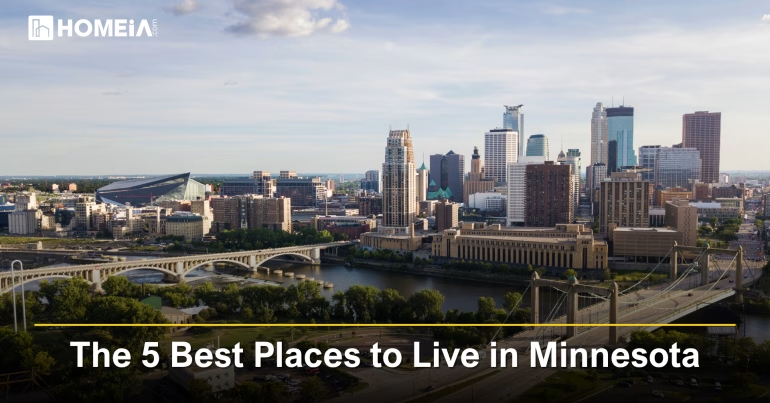
Minnesota is one of the most economically resilient states in the nation. Home to 19 Fortune 500 companies, the North Star State sustains a job market defined by high wages and low unemployment across healthcare, retail, technology, and manufacturing, all from the backdrop of the shores surrounding Lake Superior to the fertile plains of the south.
This guide delivers a rigorous, data-driven evaluation of the five best places to live in Minnesota, drawing on current labor market data, housing metrics, and quality-of-life indicators.

Related article
Our Methodologies to create HOMEiA Score Ratings for Each Group of Content
HOMEiA uses a consistent, data-driven methodology to evaluate U.S. states for livability, affordability, and long-term value. Our analysis centers on key factors such as Housing and Affordability, Cost of Daily Living, Access and Infrastructure, Community Strength, Safety and Quality of Life, Economic Resilience and Job Market…
Table of Contents:
I. Methodology: How We Built Our Rankings
Each city was evaluated across five weighted criteria using 2025–2026 data from the U.S. Census Bureau, the Bureau of Labor Statistics, the FBI UCR database, the Minnesota Association of Realtors, Zillow, and Redfin.
A. Employment and Economy (30%): Assesses industrial base diversity, the presence of anchor employers, current unemployment rates, and projected job growth through 2026.
B. Housing and Affordability (25%): Evaluates median home values, rental trends, days-on-market inventory levels, and home-price-to-income ratios to determine financial accessibility.
C. Quality of Life and Culture (20%): Considers access to Minnesota’s natural assets, presence of culinary and arts scenes, walkability, and year-round recreational opportunities.
D. Education (15%): Reviews public school district performance based on state proficiency scores and national ratings, alongside proximity to higher education institutions.
E. Safety and Community (10%): Analyzes multi-year violent and property crime trends, neighborhood stability, and the strength of civic engagement.


Related article
The Pros and Cons of Living in Minnesota
Pros and Cons of Living in Minnesota include more than cold winters and hockey. Enjoy scenic lakes, great schools, a strong economy, and rich cultural life. Whether you’re drawn by the outdoors or career opportunities, Minnesota offers a high quality of life with both urban excitement and small-town charm.
II. The 5 Best Cities in Minnesota
Ranked by composite score from lowest to highest
① St. Paul: The Capital City with Historic Roots
HOMEiA Score: 86/100
- Monthly Rent: $1,481
- Home price to income ratio: 3.86:1
- Population: 305,634
- Median Home Value: $283,444
- Median Household Income: $73,394
A. Employment and Economy: St. Paul’s economy rests on state government, higher education, and healthcare, a combination insulating the capital from cyclical downturns. Major employers including the State of Minnesota, Regions Hospital, and the University of St. Thomas collectively sustains a workforce of thousands.
- The city’s Downtown Vitality Fund is actively incentivizing ground-floor commercial activation and new residential development, driving measurable street-level economic growth heading into 2026.
- The Snelling-Midway United Village redevelopment is transforming a major urban corridor into a mixed-use district, creating new jobs in retail and hospitality while adding density to one of the city’s highest-traffic corridors.
B. Housing and Affordability: Their housing market stands out for its historic character and genuine affordability relative to Minneapolis and the western suburbs. The median home value of $283,444 represents one of the most accessible entry points among major cities, with values appreciating a stable 0.6% year-over-year. A home-price-to-income ratio of 3.86:1 secures the market firmly within reach for middle-income households, and typical homes move to pending status in 37 days, signaling a balanced rather than overheated market.
- A new 1-6 Unit Housing Development zoning framework is expanding residential density through townhomes and duplexes, with meaningful new supply expected by late 2026.
C. Quality of Life and Culture: Identity is shaped by Summit Avenue’s historic mansions and the Mississippi River. The Ordway Center, Science Museum of Minnesota, and Grand Casino Arena anchor a robust cultural calendar, while Grand Avenue and Cathedral Hill have become respectable culinary destinations. The annual Winter Carnival captures the city’s proud embrace of its climate.
D. Education: The St. Paul Public School District contains standout specialized institutions, including Jie Ming Mandarin Immersion Academy and Highland Park Senior High, recognized for rigorous academics and noted proficiency outcomes. Macalester College, Hamline University, and St. Catherine University forms a concentrated higher education cluster elevating the city’s educational profile.
E. Safety and Community: STP recorded a significant decrease in motor vehicle thefts in 2025, and ongoing investment through the Neighborhood STAR program funds community-led beautification efforts across the city’s distinctive villages. Neighborhoods like Macalester-Groveland and St. Anthony Park is consistently rated among the most livable in the Twin Cities, attributed to high social trust, active block clubs, and an identity built around tight-knit community engagement.
Recommended for you




② Rochester: The Healthcare Capital of the World
HOMEiA Score: 88/100
- Monthly Rent: $1,947
- Home price to income ratio: 3.47:1
- Population: 122,330
- Median Home Value: $310,500
- Median Household Income: $89,389
A. Employment and Economy: Rochester’s economy is one of the most purposefully engineered in the country. The Destination Medical Center (DMC) initiative, a 20-year, $5.6 billion public-private partnership, is systematically transforming the city into a global biotech and health innovation hub. At its center is the Mayo Clinic, a dominant employer and one of the most recognized medical institutions globally, employing over 51,000 people and drawing more than 2 million patient visitors annually.
- The city recorded more than $348 million in new private DMC-district investment in 2025, the majority from Mayo’s Bold Forward Unbound expansion program. This has significantly reshaped the physical and economic landscape of downtown Rochester.
- With an unemployment rate of only 2%, Rochester operates at effective full employment, and nonfarm payrolls are projected to grow 1% annually through 2026, driven entirely by healthcare and research sector expansion.
B. Housing and Affordability: Plentiful in this housing market are options reflecting the purchasing power of its professional workforce. The median home value of $310,500, supported by an average household income of $89,389, produces the lowest price-to-income ratio on this list at 3.47:1. This means the standard household carries a lighter financial burden relative to homeownership than in any other city profiled here. The city is actively addressing a projected need of 14,000 new housing units by 2030, with projects including the Loom Apartments and West Transit Village already in development.
- Rental costs have risen sharply to a median of $1,947, reflecting tight supply near the medical campus; buyers who can commit to ownership are rewarded with significantly better affordability dynamics.
C. Quality of Life and Culture: Med City is reinventing itself as a health-centric city with the America’s City for Health strategy. The Discovery Walk pedestrian corridor connects clinical campuses to downtown, Soldiers Memorial Field has a new aquatic center, and the Link Bus Rapid Transit system is slated to finish by the end of the year.
D. Education: Rochester’s public school district earns an overall B+ grade, with top-performing Mayo Senior High (A) and Century Senior High (A-) recognized for STEM programs and college preparation outcomes that consistently exceed state averages. The University of Minnesota Rochester, currently expanding its campus to accommodate growing health sciences enrollment, ensures academia is deepening alongside the city’s workforce demands.
E. Safety and Community: Here ranks 33rd nationally as a city to raise a family. Crime rates are low, the community culture is defined by professionalism and hospitality, and the Downtown Next Door initiative is fostering a homegrown entrepreneurial ecosystem.
Related article
Moving to Minnesota: THE Complete Relocation Guide and Checklist
Moving to Minnesota? This complete guide has everything you need — cost of living, job market insights, top places to live, and settling-in tips. Whether you’re drawn to the Twin Cities, St. Cloud, Rochester, a charming small town, or the scenic North Shore, we’ll help you make a confident, informed move…
③ Minneapolis: The Economic Engine of the Upper Midwest
HOMEiA Score: 89/100
- Monthly Rent: $1,651
- Home price to income ratio: 4.14:1
- Population: 425,115
- Median Home Value: $316,172
- Median Household Income: $76,332
A. Employment and Economy: Minneapolis is the primary economic engine of the Upper Midwest, ranking 23rd nationally for employment strength in 2026. Fortune 500 leaders including Target and Ameriprise Financial anchor the corporate base, while the tech sector is expanding rapidly. NetSPI recently established its headquarters locally alongside maintaining a high ratio of job openings per applicant in healthcare, professional services, and renewable energy.
B. Housing and Affordability: The City of Lakes offers a dynamic real estate market that balances urban sophistication with surprising affordability relative to other major U.S. metros. The average home value of $316,172 reflects modest 1.2% appreciation as of early 2026. Median rent of $1,651 runs nearly 13% below the national average, making the city highly competitive for renters. Buyers in 2026 are closely watching the Green Line Light Rail extension, with property values near future stations already beginning to appreciate ahead of the 2027 completion.
C. Quality of Life and Culture: Mini Apple is defined by its Chain of Lakes and a love for outdoor living across all four seasons. The Guthrie Theater, Walker Art Center, and legendary First Avenue promote a cultural scene that punches well above the city’s population weight, and the culinary landscape spans award-winning North Loop restaurants to the multicultural Eat Street corridor. With 180 parks covering over 6,000 acres, outdoor recreation is woven into daily life year-round.
D. Education: The Minneapolis Public School District serves over 29,000 students across 80 schools, with standout charter and magnet schools among the best in the state. The University of Minnesota Twin Cities anchors a highly educated population; over 40% of adults hold a bachelor’s degree.
E. Safety and Community: This area has made significant, measurable safety progress: violent crime downtown dropped 14% and robberies fell by roughly one-third between 2022 and 2025. Auto theft decreased 24% in early 2025. Neighborhoods like Linden Hills and Southwest Minneapolis are consistently cited as the safest and most family-friendly in the city. The Office of Violence Prevention deploys community-based conflict mediators rather than traditional policing, leading to sustained crime reduction across historically challenged corridors.

Related article
Cheapest Places to Live in Minnesota (2026)
Many residents love Minnesota for its natural beauty, vibrant communities, and a strong sense of Midwestern hospitality. And while some may think that living in such a place means paying a high cost, calling the Land of 10,000 Lakes home doesn’t have to come with a hefty price tag…
④ Delano: The Exurban Gold Standard
HOMEiA Score: 90/100
- Monthly Rent: $1,278
- Home price to income ratio: 3.41:1
- Population: 6,942
- Median Home Value: $375,200
- Median Household Income: $109,946
A. Employment and Economy: Delano is a high-performing Wright County suburb combining a small-town atmosphere with one of the lowest unemployment rates in MNat 1.1%. Proximity to the western Twin Cities metro gives residents access to major corporate employers, and a new $3.3 million industrial park off Highway 12 is projected to create up to 300 local jobs.
B. Housing and Affordability: This housing market reflects the purchasing power of a high-income, high-ownership community as 77% of residents own their homes. The median home value of $375,200, set against a median household income of $109,946, produces a price-to-income ratio of 3.41:1, the most favorable on this list. Rents average $1,278 per month, approximately 21% below the national average, and new residential projects including Prairie Ridge and River Waters are expanding inventory for the 2026 market.
C. Quality of Life and Culture: Quality of life centers on a historic downtown, scenic Crow River frontage, and tight community culture. The city hosts Minnesota’s largest 4th of July parade and a beloved Old Fashioned Christmas celebration. Kayaking, fishing, and trail access are minutes from most neighborhoods.
D. Education: The Delano Public School District is the premier driver of the city’s real estate demand, and its performance justifies that status. The district holds an overall “A” grade and ranks 21st out of 362 districts statewide. Proficiency rates are 73% in math and 74% in reading, well above state averages. Delano Senior High School maintains a 95% graduation rate with a teacher-to-student ratio of 19:1, and a recently completed $142,000 square foot high school addition ensures state-of-the-art facilities are in place for the current academic year.
E. Safety and Community: Here records a crime-per-capita rate of less than 1%, making it one of the safest communities in the state. Violent crime is virtually nonexistent, and residents describe a culture where children move freely and civic participation is consistently high.

Related article
The 15 Budget Friendly Towns in Minnesota for Retirees
The cost of living in Minnesota varies by location and is highest in its large metro areas, but on the whole, it compares well to the coasts and to big cities. Each community in Minnesota has its own personality, and here we will introduce you to 15 of the best options for retiring in the North Star State…
⑤ Edina: The Premier Destination for Suburban Excellence
HOMEiA Score: 92/100
- Monthly Rent: $1,844
- Home price to income ratio: 5.02:1
- Population: 53,262
- Median Home Value: $646,300
- Median Household Income: $128,767
A. Employment and Economy: Edina is the gold standard of suburbia, led by Southdale Center and the upscale 50th & France district. The $162.5 million TIF redevelopment at 72nd & France is adding luxury hotels and Class A office space to an already premium location, and over 70% of working residents hold a bachelor’s degree or higher.
B. Housing and Affordability: This section leads the Twin Cities in property values, with a median home value of $646,300 driven by a tear-down dynamic where older homes are replaced with custom estates. The 5.02:1 price-to-income ratio is the highest on this list but supported by a median income exceeding $128,000; homes go pending in only 26 days versus a regional average of 44.
C. Quality of Life and Culture: Residential quality of life is defined by impeccably maintained public spaces and a sophisticated urban sensibility within a suburban footprint. 40 parks span over 1,550 acres, headlined by Centennial Lakes Park, a 24-acre urban oasis with walking paths and seasonal programming. The 50th & France district serves as a walkable cultural epicenter, with boutique retail, high-end dining, and community events that draw visitors from across the metro. 2026 legislation prioritizes sustainable mobility, including bike lane expansion on Wooddale Avenue.
D. Education: The Edina Public School District is the most prestigious in the state, consistently ranking in the top few percent nationally. Edina Senior High holds an A+ grade, the district is completing a 142,000 sq ft high school expansion for 2026, and 42% of adult residents hold a master’s or professional degree, the highest on this list.
E. Safety and Community: Here exist exceptionally low violent crime rates and a pervasive culture of civic engagement and community pride. The Edina Citizen Connect platform allows residents to monitor police activity in real time, and the annual Night to Unite event builds direct relationships between neighbors and first responders. The city’s First Responders Fund reflects a community actively invested in its own public safety infrastructure.
Related article
8 Best Cities for Buying a House and Raising a Family in Minnesota
While everyone in Minnesota shares accesses to the great outdoors, four distinctly enjoyable seasons, and a friendly Midwestern vibe, each community has its own personality. Here are our views of the Top 8 Cities for family life in Minnesota. With a variety of personalities and attractions…
III. Comparative Market Overview
A side-by-side summary of key data points for all five cities.
| City | Score | Population | Median Home Value | Median Rent | Median Income | Price-to-Income |
|---|---|---|---|---|---|---|
| St. Paul | 86 | 305,634 | $283,444 | $1,481 | $73,394 | 3.86:1 |
| Rochester | 88 | 122,330 | $310,500 | $1,947 | $89,389 | 3.47:1 |
| Minneapolis | 89 | 425,115 | $316,172 | $1,651 | $76,332 | 4.14:1 |
| Delano | 90 | 6,942 | $375,200 | $1,278 | $109,946 | 3.41:1 |
| Edina | 92 | 53,262 | $646,300 | $1,844 | $128,767 | 5.02:1 |
Delano and Rochester carry the most favorable price-to-income ratios; Edina commands the highest lifestyle premium; Minneapolis and St. Paul offers the best urban value propositions for knowledge-economy professionals.
Conclusion: Matching Your Priorities to the Right City
Minnesota’s residential landscape is a portfolio; the right city depends on your priorities.
- St. Paul for historic urban character at an accessible price.
- Rochester for medical professionals and those seeking a city purpose-built for innovation.
- Minneapolis for high-energy urban living and the deepest labor market in the Upper Midwest.
- Delano for elite schools, exceptional safety, and strong purchasing power in a tight-knit exurb.
- Edina for the highest-ranked schools and the most prestigious real estate in the state.
The common thread is resilience; Minnesota’s diversified economy and sustained public investment make it one of the most stable long-term residential environments in the country.
Recommended for you




FAQs About Living in Minnesota
1. How does the Minnesota tax system impact new homeowners?
Minnesota’s top income tax rate is 9.85%, offset by the Homestead Market Value Exclusion for primary residents and a Circuit Breaker refund for households with exuberant property tax burdens (income limit: $142,490 for 2026). Clothing and shoes are exempt from sales tax.
2. What is the transit outlook for the metro area?
Rochester’s Link BRT completes by late 2026. The Twin Cities Green Line extension reaches downtown Minneapolis by 2027, already driving appreciation near future stations. Cars remain necessary for most suburban residents, particularly in winter.
3. How is Minnesota managing climate risks?
The 2026 Climate Action Framework prioritizes climate-smart infrastructure to address warming winters, intensifying precipitation, and more frequent rain-on-snow cycles.
4. Is 2025–2026 a buyer’s or seller’s market?
This part of the Midwest largely favors sellers; inventory remains below 2019 levels despite a 4.6% rise in new listings in early 2025. Entry-level homes under $300,000 face the most competition, while the luxury segment above $1 million has tripled in activity since 2020.
5. What are the fastest-growing job sectors for relocating professionals?
Healthcare leads growth, with nurse practitioner roles up over 10% through 2026. Tech demand is surging for data scientists and IT security professionals. Clean energy roles are expanding as it advances toward 100% carbon-free electricity by 2040.

Related Content